
⇩ Download Catalogue 42 (165MB)
Free to download. All swords in this catalogue are sold.
Index of Swords
Opening Remarks
Hi everyone, all good? It’s a cool yet sunny and crisp morning here in Southend-on-Sea. I’ve just come home after taking Nelson to school, stopping by my local ‘Dog Café’ for a flat white, and am now fairly warm at home with cheeks slightly aglow. Everyone was bundled up this morning — British people, in general, don’t do cold very well. One person at the café jokingly said this is ‘Pablo weather’. True, it does remind me of mornings in Canada, waking up to deliver the paper on my route as a tween and teenager. Some mornings were so cold that my eyelashes would freeze together. While those days were pretty brutal, once you get through the uncomfortable pain, there is eventual salvation. That’s really what life’s all about, isn’t it? No pain, no gain. So let’s charge into this winter season all guns blazing — and all swords polished — ready to take on challenges and make a positive difference in this world.
The team and I have been hunkered down in a massive way for Catalogue 42. What a treat of twelve swords we have for you — mostly katanas, with a couple of great wakizashi and a superb tantô. The vast majority are NBTHK Tokubetsu Hozon certified, all with great stories, very reasonably priced, and ready to be claimed. No other art dealer comes close to the time, the photographic detail, and the background research that we unpack for each and every sword. We do it because the swords deserve to be presented right, and you, our trusted clients, deserve to know as much as possible to appreciate all the fascinating details that make each piece unique.
We kick off with a muscular katana crafted by Sakakura no Seki swordsmith Masatoshi, who flourished at the end of the warring Muromachi period circa the Kôji era. The chiselled character ‘Masa’ of Masatoshi is similar to that found on blades of the Sengo Muramasa school, suggesting he may have trained under Masazane. A powerful warrior energy pulses through this sharp, freshly polished blade, showcasing both Sôshû and Mino influences. This weighty katana embodies the samurai spirit with tremendous character and intensity.
Next we head to Kyôto for a brilliant katana crafted by nidai Iga no Kami Kinmichi, who flourished during the early Edo period’s Manji era. The Mishina school was a prestigious and powerful family with deep connections to the ruling Tokugawa family and the imperial court. Everything about this sword is collectible: its overall structure and qualities, its impressive history, the mark of the chrysanthemum on the ubu nakago, its wonderful kizami koshirae, and the excellent fittings that will be incredible on display.
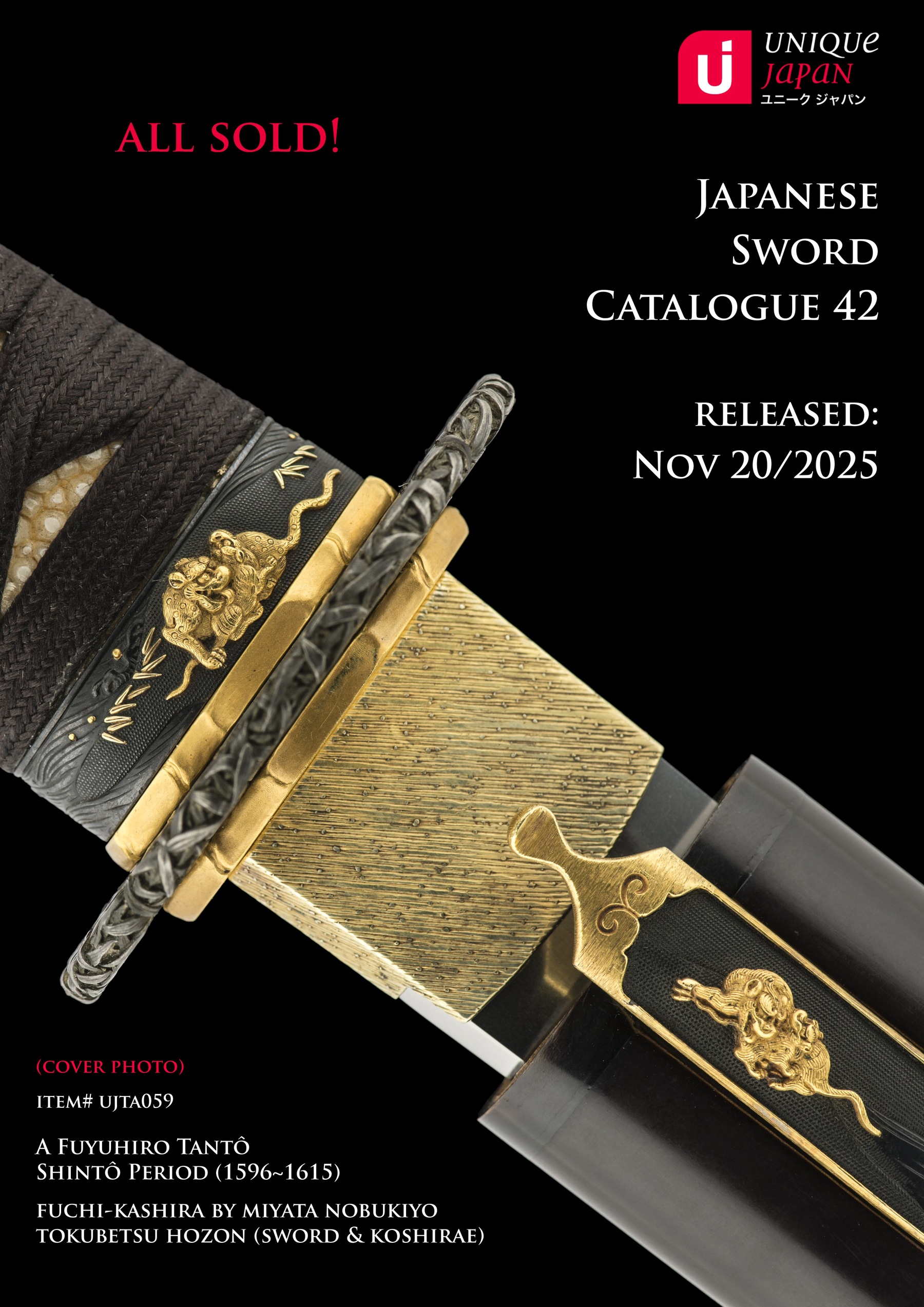
We stay in the Shintô period with an outstanding katana by nidai Kunishige, born Ôtsuki Denshichirô and student of Ichizô Kunishige — both known as Edo Mizuta. For those who love jihada, look no further: gorgeous whirlpools of ô-itame and mokume-hada illuminate this long 74cm blade with a thick blanket of winding suguha in nie-deki. A set of late Edo period koshirae tastefully complements the blade, featuring a leather-wrapped tsuka, a late Higo fuchi-kashira, and a beautiful Heianjô tsuba. Next is the superb tantô featured on the cover of the catalogue, crafted by Fuyuhiro who worked during the Momoyama period in Wakasa province. This long and wide tantô in hirazukuri shape carries a bright, shining ko-gunome hamon and an assertive funagata nakago paying respect to its Sôshû heritage. A spectacular set of koshirae focused on a fuchi-kashira crafted by master artisan Miyata Nobukiyo gloriously depicts a family of tigers and leopards.
Maestro Hizen swordsmith shodai Masahiro crafted the ensuing katana, featuring an absolutely gorgeous gunome-chôji-midare hamon that creates a nihôntô light show like few other blades can. The shirasaya is blessed with a sayagaki by Kunzan made for his sword friend Moriyasu Isao. A magnificent set of koshirae comprising a marvellous kage-makie lacquered theme of dragonflies, a unique geometric tsuba, and a lovely fuchi-kashira speaks of the heavenly courtesan Tennyo and the captivating Nôh play Hagoromo. Gold shisa lions further guard this spiritual treasure.
We move to the Shinshintô period for a terrific katana by Yasuuji, who counted himself as the 60th generation of the famed thousand-year-old Naminohira school from Satsuma on Kyûshû. This katana was crafted with pure Yamato-den characteristics: a bright suguha hamon in sparkling nie-deki with ashi that look like solar flares. A splendid Meiji period koshirae houses the sword with gorgeous fittings, including insects crawling over a realistic woodgrain tsuba and a fuchi-kashira featuring a chilled hermit and a jubilant scene of birds flying over waves.
We travel back to February 1498 — around the time Christopher Columbus was sailing the ocean blue — with the creation of a fiery tachi by Kanezumi, who worked in Seki during the tumultuous Muromachi period. This is a classic Mino-tradition creation with a Kanesada school influence, featuring a dazzling gunome-midare hamon with ôbusa-chôji reminiscent of the great Bizen Fukuoka-Ichimonji school. The sword is housed in a tasteful set of koshirae that imbues pure class — a rare 526-year-old dated reference piece that will touch your soul on several levels.
We zip forward to February 1866 for a magnificent katana by Katsumura Norikatsu, one of the most accomplished smiths of the Shinshintô period, crafted when he was working at the Koishikawa residence of the Mito domain. The workmanship is sublime: a beaming suguha hamon over glorious straight-grain masame-hada and sunagashi that is truly impressive. An excellent set of Edo period koshirae captures the beauty of a crisp autumn day, and a wonderful set of menuki depicts a predatory hawk stalking a bear cub. A first-class, highly collectible sword crafted for the prominent Mito family in the final years of the Tokugawa shôgunate.
Looking for a cutting-test sword? This very sharp piece was originally crafted as a curvy katate-uchi at the height of the Sengoku-jidai by jô-saku Jûrôzaemon Tadamitsu, who flourished during the Tenbun era (1532–1555). The sword underwent suriage to its now ô-wakizashi length of 54.9cm, with the carefully preserved signature retained as orikaeshi-mei. Inscribed in bright, well-preserved gold inlay on the nakago, it states that this sword was tested twice on a human body — severing through the centre of the chest (ichi no dô) and diagonally from the base of the neck to the opposite armpit, a vicious cut known as ô-kesa.
Our next katana is by the Yamato Tegai school, a prime example of the splendour of Kotô period swords from the Kamakura period. The sword’s elegant shape is indicative of its origins as a tachi, typically made for horseback warfare. A splendid iron-based dragon koshirae with a signed Sôten school fuchi-kashira houses this sword in a spirited manner. This is a refined and gracious sword from one of the most respected schools in Japanese sword history — it deserves a fine home.
We wind up the catalogue with two swords from Hizen province. First is a katana by talented swordsmith Yukihiro carrying his trademark abu nomefu with tremendous energy. Its koshirae features a mother-of-pearl lacquered saya called fuemaki — an extraordinarily demanding lacquerwork technique requiring exacting standards. We conclude with another beauty by shodai Masahiro, this time a dated wakizashi to August 1643. It is classic Masahiro in every way and comes with a rare certificate by Fujishiro Matsuo. Enjoy it in shirasaya or consider building a custom koshirae — or even a daishô koshirae with a well-suited katana.
Thank you for all your passion, trust, and confidence. We look forward to serving you. I wish you a great winter period, and to my American friends, a happy and safe Thanksgiving holiday.
Warm regards,
Pablo Kuntz
November 2024