
ITEM# UJKA453 – Catalogue 42 – Sold
A Tegai Katana (手搔)
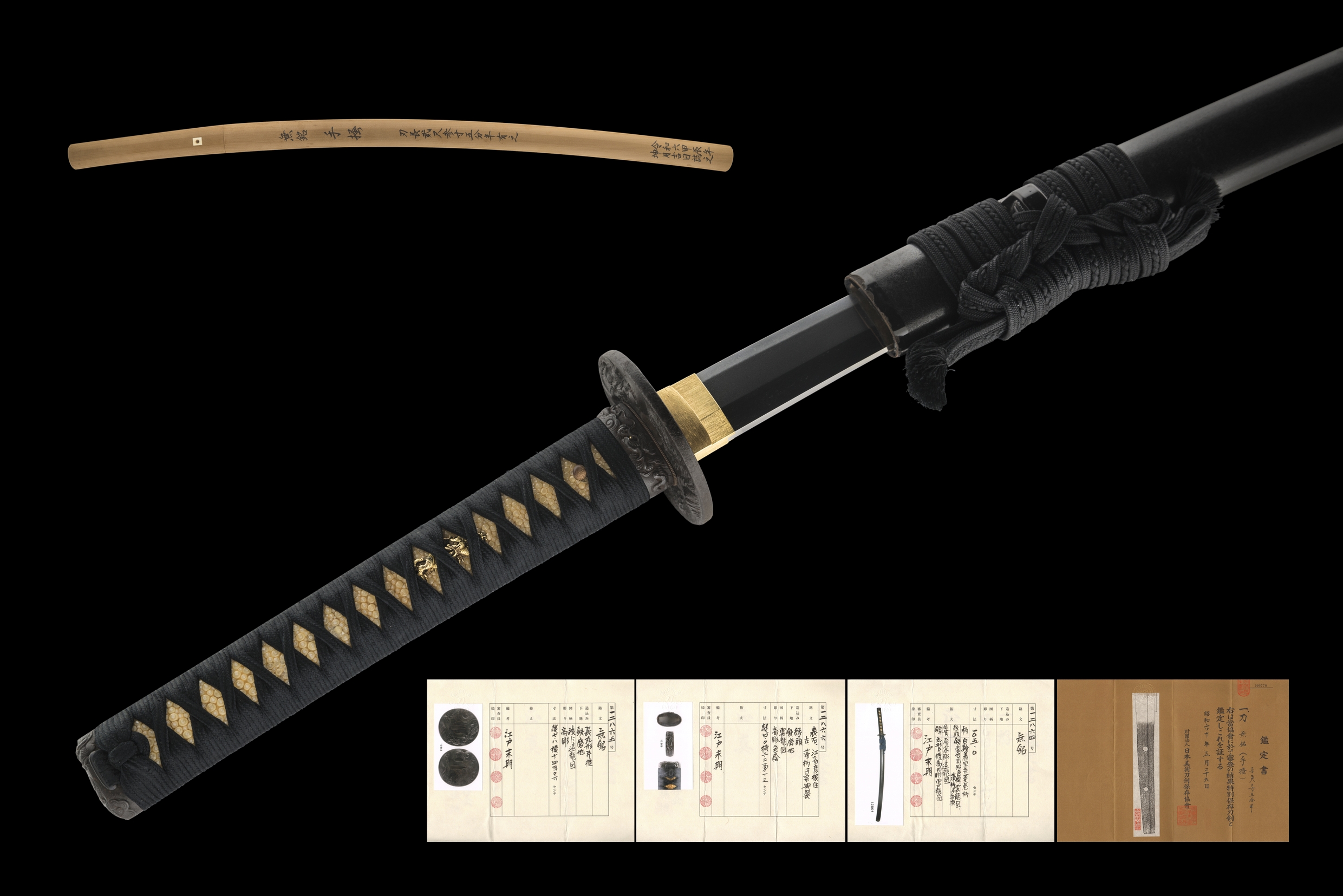
The Yamato Tegai school stands among the oldest and most revered traditions in Japanese sword history. Named for its workshop’s location before the Tengai-mon gate of Tôdaiji temple in Nara – once the very heart of Japanese culture – the school emerged in the late Kamakura period under its founder shodai Kanenaga, who worked around 1288~1293. Its smiths armed the great Buddhist temple complexes and their warrior monks, the sôhei, producing blades of exceptional dependability. The school flourished through the Nanbokuchô era, and its legacy lives on in a revived tradition known as Sue-Tegai. This katana dates to the school’s finest hours, circa 1300~1350, when Tegai craft was at its most authoritative.
The blade was originally forged as a tachi – the long sword designed for mounted warfare – and has since been shortened twice to its present length of 71.3cm (2-shaku 3-sun 5-bu han), a dimension known as jo-sun, the classical katana benchmark standardised in the early Edo period. Two mekugi-ana (peg holes) in the ô-suriage nakago confirm this history. The ji shimmers with dense ji-nie, highlighting a beautifully forged mix of ko-mokume and nagare-hada – the flowing, wavy grain synonymous with Yamato-den blades – with loads of chikei throughout. The hamon is a bright, consistent suguha in nie-deki, enriched by kinsuji and the presence of uchinoke, the coveted crescent-shaped formations that float just above the temper line and are a celebrated hallmark of the Tegai school. The bôshi is kaen – flame-tipped – with a short kaeri, entirely characteristic of this tradition. The sword’s registration dates to 1951 (Shôwa 26) in Niigata prefecture, with serial number 1498, placing it among the very first swords formally registered in Japan after the war – a strong indication it once resided with a family of considerable standing.
The sword is housed in a magnificent Edo-period uchigatana-koshirae lacquered in kuro-ishime-ji-nuri – black stone-surface texture – crafted during the Late Edo period (1780~1868). Every fitting carries the dragon motif with remarkable consistency and energy. The iron tsuba, attributed to Kanetane of the Chishiki school in Satsuma province, depicts a cloud dragon seizing a jewel above crashing waves; the NTHK-NPO certified fuchi-kashira is signed by Mogarashi Sôten, a resident of Hikone in Gôshû province working circa the early 1800s, and portrays a crawling dragon in polished iron with golden eyes; the menuki are gold crawling dragons; the tsuka is braided in deep navy silk over aged white samekawa. It is a koshirae of great coherence and spirit. A refined and gracious sword that quietly speaks of eras long past.
| Item Number | UJKA453 |
| Sword Type | Katana (ô-suriage) |
| Attribution | Tegai school (mumei) |
| School | Yamato Tegai |
| Province | Yamato |
| Period | Kotô – Late Kamakura to Nanbokuchô (c.1300~1350) |
| Nagasa | 71.3cm (2-shaku 3-sun 5-bu han) |
| Sori | 1.8cm |
| Moto-haba | 2.97cm |
| Saki-haba | 2.01cm |
| Kissaki | 3.30cm |
| Moto-kasane | 5.6mm |
| Saki-kasane | 5.0mm |
| Nakago | 18.9cm, ô-suriage, 2 mekugi-ana |
| Weight | 700g |
| Jihada | Ko-mokume and nagare-hada with chikei and ji-nie |
| Hamon | Suguha in nie-deki with uchinoke and kinsuji |
| Boshi | Kaen with short kaeri |
| Certificates | NBTHK Tokubetsu Hozon; NTHK-NPO Kanteishô (koshirae, fuchi-kashira, tsuba) |
| Sayagaki | Nozomi-san (shodô artist) – mumei Tegai, blade length noted, dated Reiwa 6 kinoe-tatsudoshi (October 2024) |
| Koshirae | Edo uchigatana-koshirae, kuro-ishime-ji-nuri saya (Late Edo period, 1780~1868) |
| Tsuba | Polished iron, cloud dragon with jewel among crashing waves; attributed to Kanetane, Chishiki school, Satsuma province; NTHK-NPO Kanteishô |
| Fuchi-kashira | Polished iron crawling dragon, signed Mogarashi Sôten (Hikone, Gôshû province, early 1800s); NTHK-NPO Kanteishô |
| Menuki | Gold crawling dragons |
| Tsuka | Navy blue silk braid over aged white samekawa (ray skin) |
| Catalogue | Catalogue 42 |
| Status | Sold |
| Includes | Shirasaya, Edo uchigatana-koshirae, fabric bags, stand, maintenance kit, printed description |