
Resource Article – Written by Pablo Kuntz, Founder of Unique Japan
NBTHK Certification Rankings for Japanese Swords (日本美術刀剣保存協会)
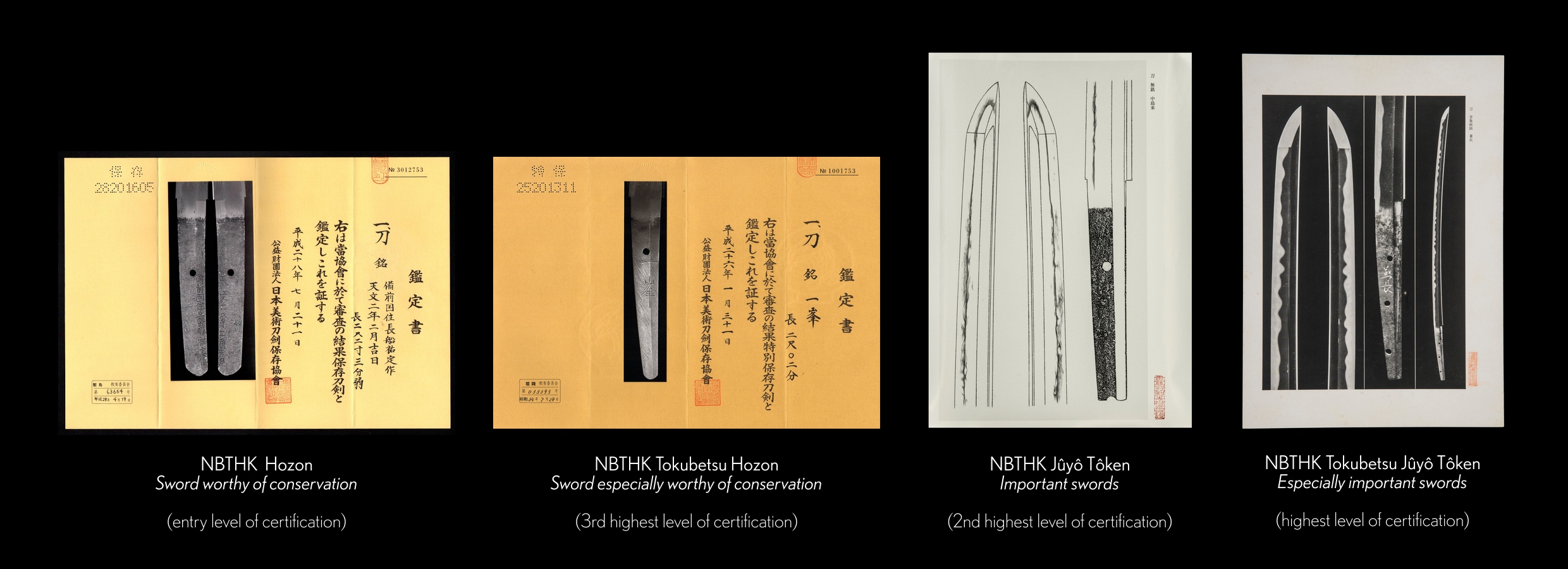
The NBTHK – Nihon Bijutsu Token Hozon Kyokai, or the Society for the Preservation of the Japan Art Sword – was founded in 1948 and remains the most respected organisation in the world for the authentication and certification of Japanese swords and fittings. Understanding their certification system is one of the most useful things a collector can do, and it is not as complicated as it first appears.
When a sword is submitted to the NBTHK for judgement – a process known as shinsa – the society’s panel of experts examines the piece and issues a certificate if it passes. The process is a serious and thorough one. Depending on the level being applied for, it can take anywhere from two to four months to receive a result. We at Unique Japan submit swords for NBTHK certification on behalf of clients regularly, and we are very familiar with the process.
There are two systems to understand: the current system introduced in 1982, and the older system that preceded it. Both are explained below.
| Quick Navigation – Current System (1982-present) | |
| Hozon | Worthy of Preservation (yellow paper) |
| Tokubetsu Hozon | Especially Worthy of Preservation |
| Jûyô Tôken | Important Work (with oshigata) |
| Tokubetsu Jûyô Tôken | Especially Important Work – the highest rank |
| Quick Navigation – Older System (1948-1982) | |
| Kichô Tôken | Precious (white paper) |
| Tokubetsu Kichô Tôken | Especially Precious (green paper) |
| Kôshû Tokubetsu Kichô Tôken | Extraordinarily Precious (blue paper) |
| Additional Reference | |
| Application Process | How to submit a sword – and how we can help |
| No NBTHK Certificate? | What it means when a sword is uncertified |
| Tôrokushô | The sword’s registration certificate |
Hozon – Worthy of Preservation
‘yellow paper’ · current system (1982-present)
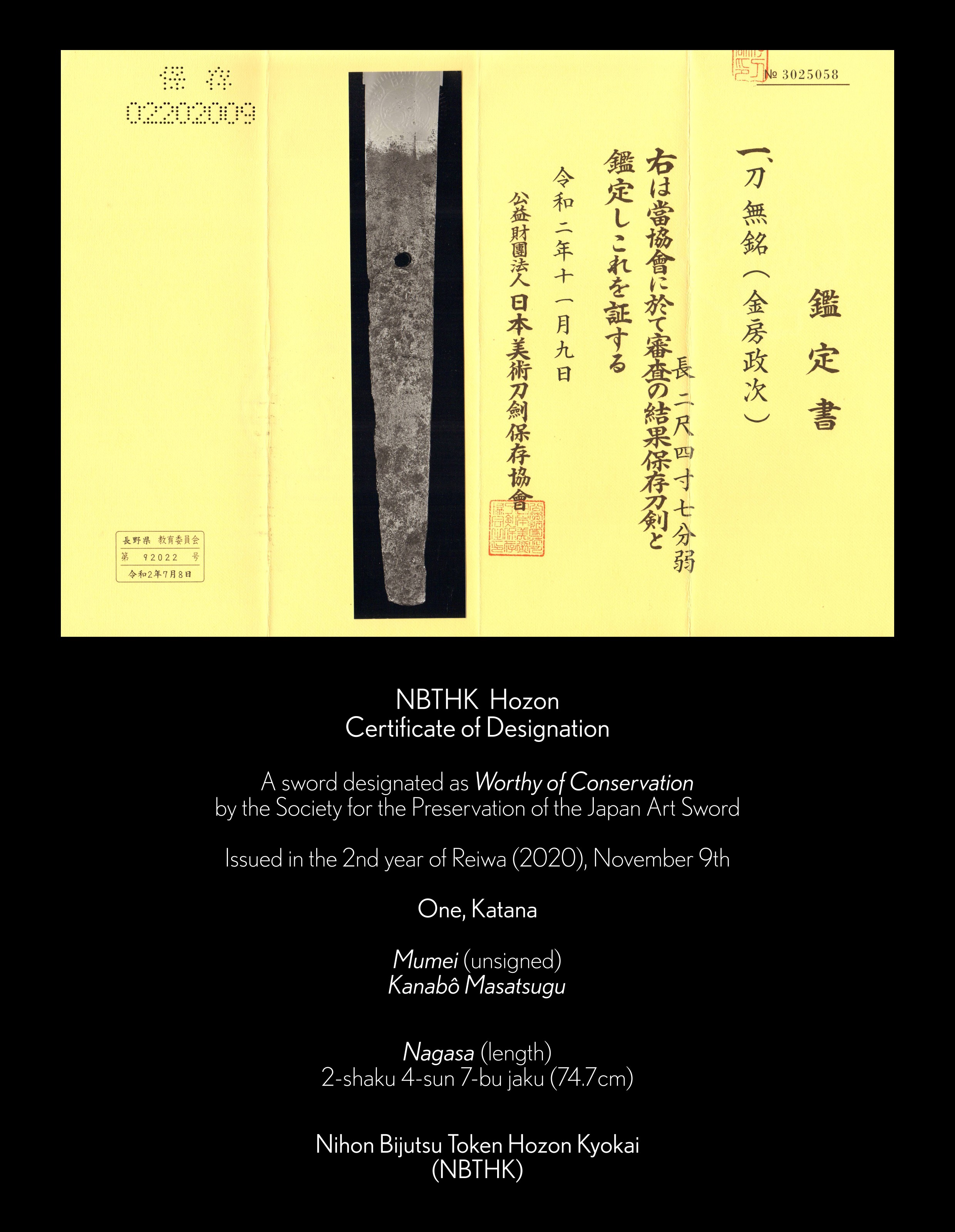
Hozon is the first and most accessible of the four current NBTHK certification levels. The word means “Worthy of Preservation” – a statement that should not be underestimated. It is no small achievement. A sword dealer can submit ten pieces for shinsa and come away with two Hozon certificates. The bar is genuine. I remember Tanobe-sensei (former judge at the NBTHK) once telling me that Hozon was the hardest level to judge due to the fact certain signatures were not so straightforward to pass, plus certain older unsigned blades were genuinely a challenge to figure out who may have crafted it.
The NBTHK’s unofficial criteria for Hozon distinction are as follows:
| 1. Signature | If the sword is signed (zaimei), the signature must be authentic. A sword with a gimei (fake signature) or one made to appear unsigned will not pass. If unsigned ( |
| 2. Aesthetic quality | The blade should be worthy of appreciation even if it shows some age or minor wear. |
| 3. Older swords | If the sword is unsigned and judged to have been crafted from the start of the Muromachi period onwards (1394~), then the highest level the sword can achieve is Hozon. |
| 4. Repairs | If the surface has been repaired, this should not detract from the blade’s original beauty. |
| 5. Modern swords | Swords from the Meiji onwards must be in good condition, crafted by traditional methods, signed (zaimei) and have an unaltered original tang (ubu nakago). |
| 6. Fatal flaw | A sword with a fatal flaw such as hagiri will not pass. |
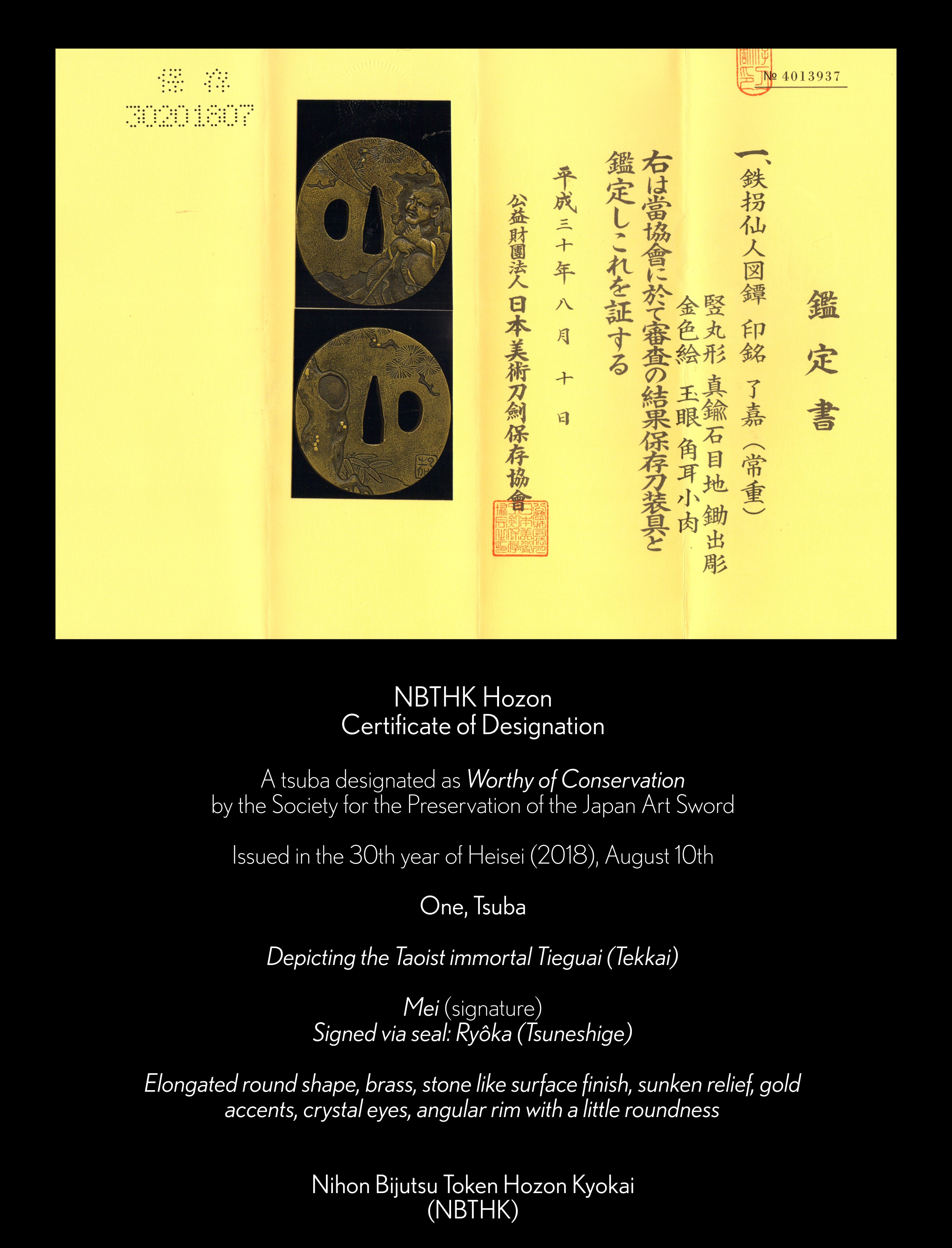
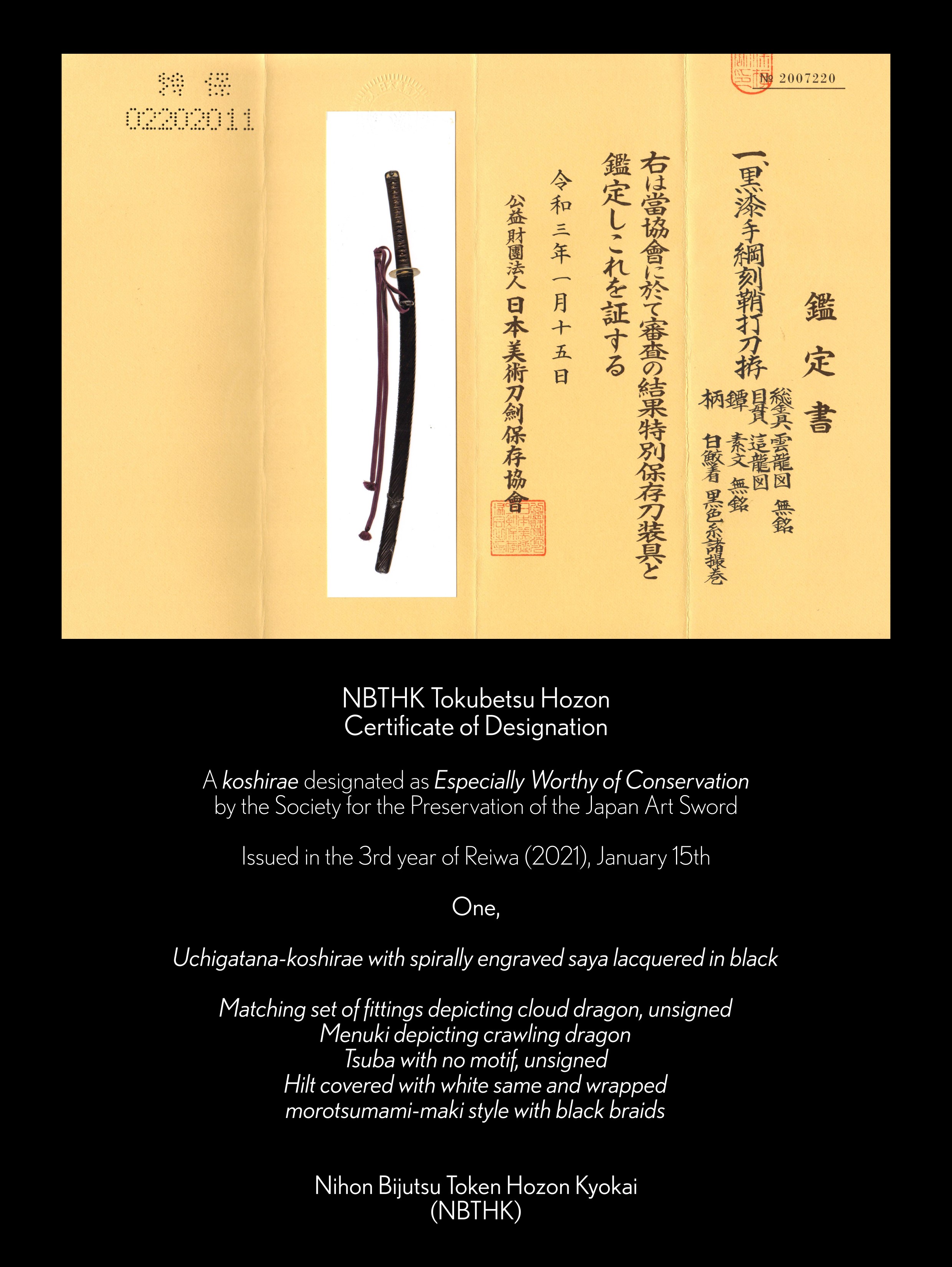
Hozon certificates are also issued for koshirae and individual fittings. A set of fuchi-kashira or a tsuba can carry its own Hozon paper, which adds both authentication and value to the piece independently of the sword it accompanies. Below is an example.
Tokubetsu Hozon – Especially Worthy of Preservation
Current system (1982-present)
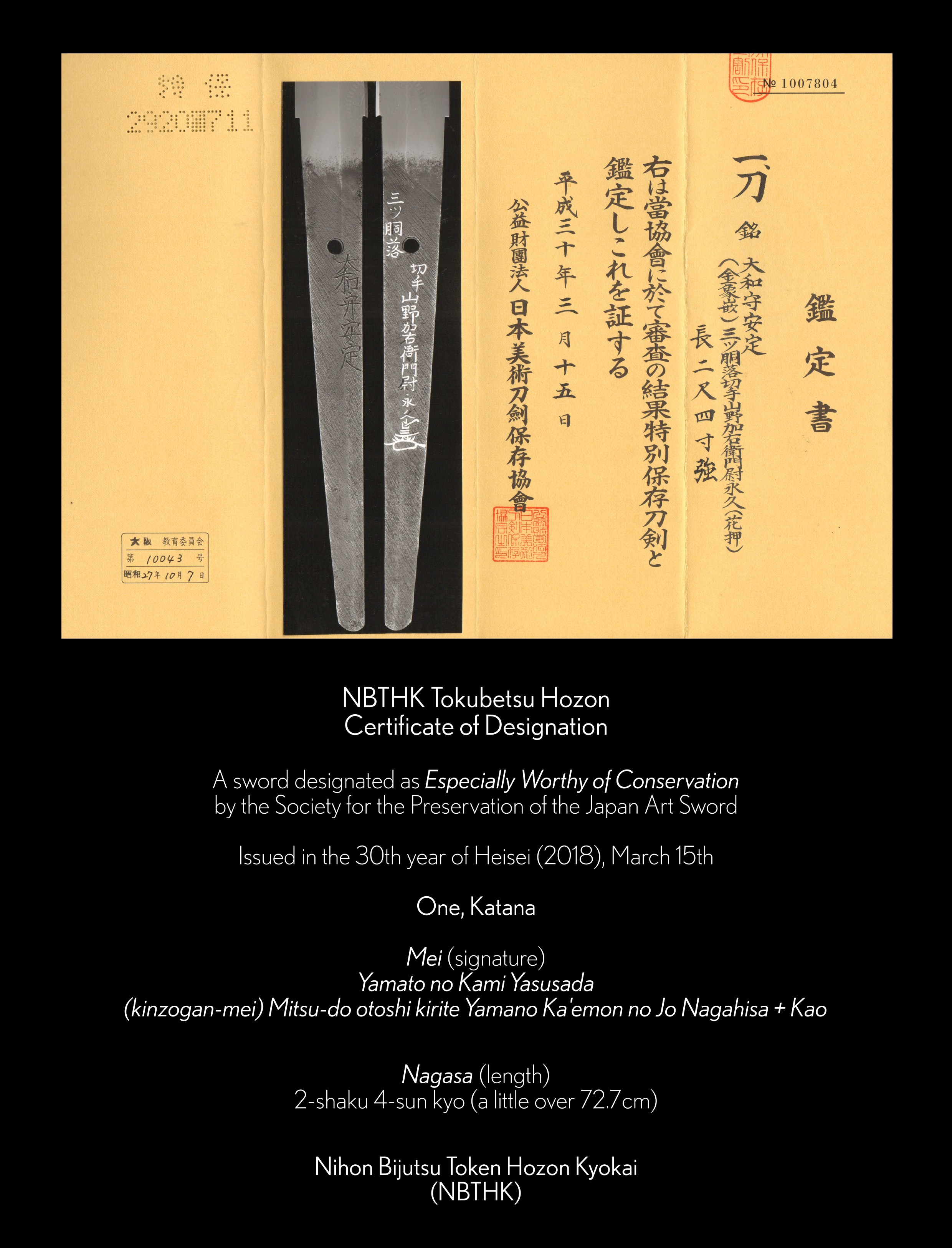
Tokubetsu Hozon – “Especially Worthy of Preservation” – is the second of the four current levels. A sword that receives this certificate has met the Hozon criteria but to a more exceptional degree. This level of certification comprises of the bulk of the swords that Unique Japan offers to clients. It’s an ideal place to start a collection, as the prices are reasonable and you can get an excellent sword at this level. The jump in value between Hozon and Tokubetsu Hozon is also not that significant. The bigger price jumps are from Tokubetsu Hozon to Jûyô and Jûyô to Tokubetsu Jûyô, or ‘TJ’ as I often call it.
One important point worth understanding: a Hozon certificate does not mean the sword was submitted for Tokubetsu Hozon and failed, and a Tokubetsu Hozon does not mean the sword was put forward for Jûyô and fell short. A sword may have been submitted for Hozon purely to authenticate the signature – nothing more. Pursuing higher certification costs money, takes many months, and requires specific submission windows. Some Japanese dealers, myself included, do not always feel the need to chase papers for every piece. For certain swords we give the client the option to submit for a higher level if we both feel it is worth pursuing. Many excellent swords sit at Tokubetsu Hozon simply because nobody has taken them further yet. Do not read too much into the absence of a higher certificate on a sword that may merit one.
As with Hozon, Tokubetsu Hozon certificates can be issued for fittings independently of the blade. An example is shown below.
Jûyô Tôken – Important Work
With oshigata and remarks · Introduced May 1958
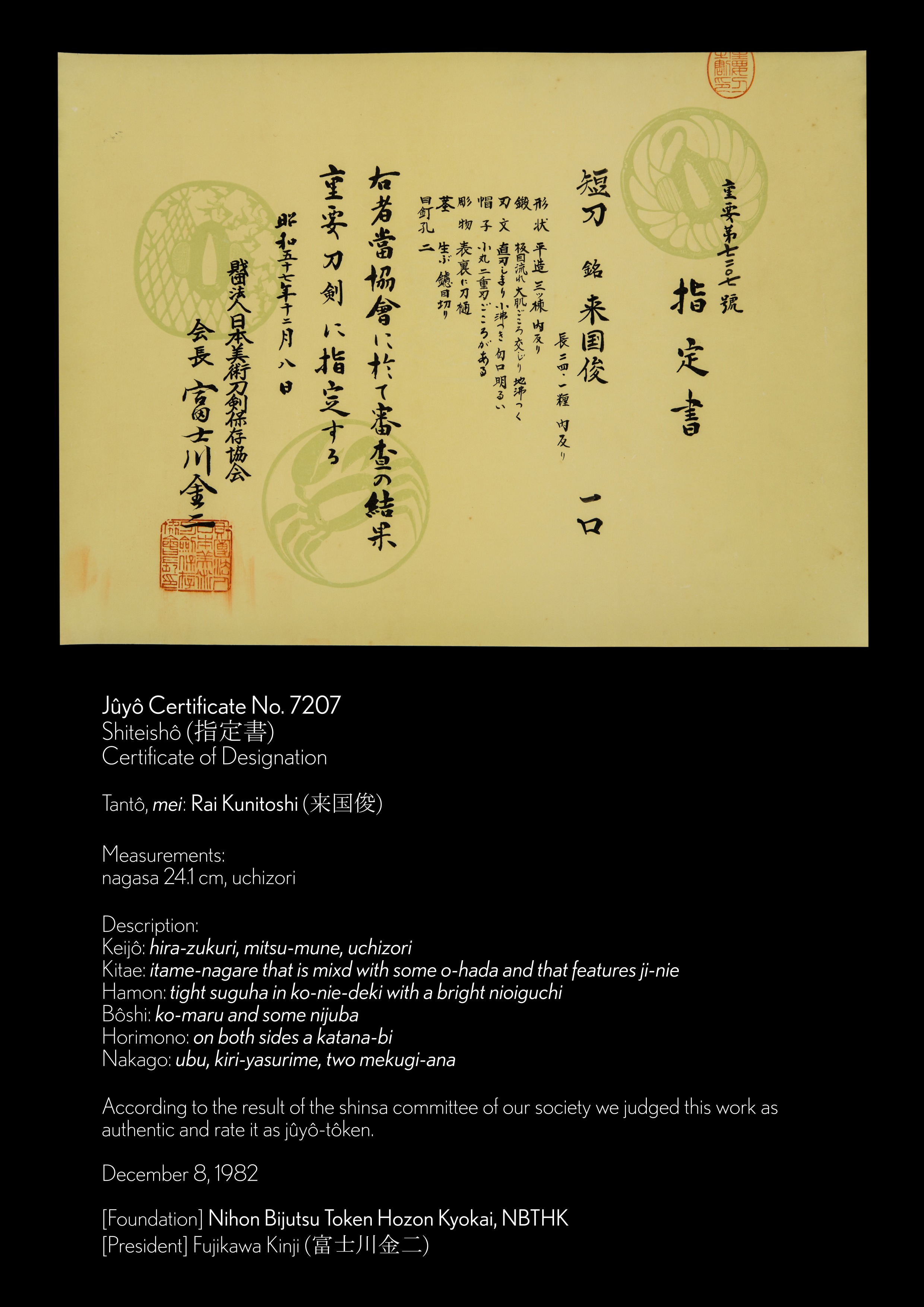
Jûyô Tôken – “important (or profound) work” – is the third and first of the two truly prestigious levels. There are approximately 14,000 Jûyô blades in existence. Given that roughly two million swords are registered in Japan, that is an extraordinarily small number – about a half a percent. To hold a Jûyô blade is to hold something genuinely exceptional.
An important procedural point: a sword must first hold Tokubetsu Hozon before it can be submitted for Jûyô consideration. There is no shortcut. Jûyô shinsa submissions are generally held in September each year. For all intents and purposes, this is a sword competition. If a sword acquires Jûyô status, and about 10% get ‘upgraded’ so to speak, then its value increases substantially – and that increase is well deserved.
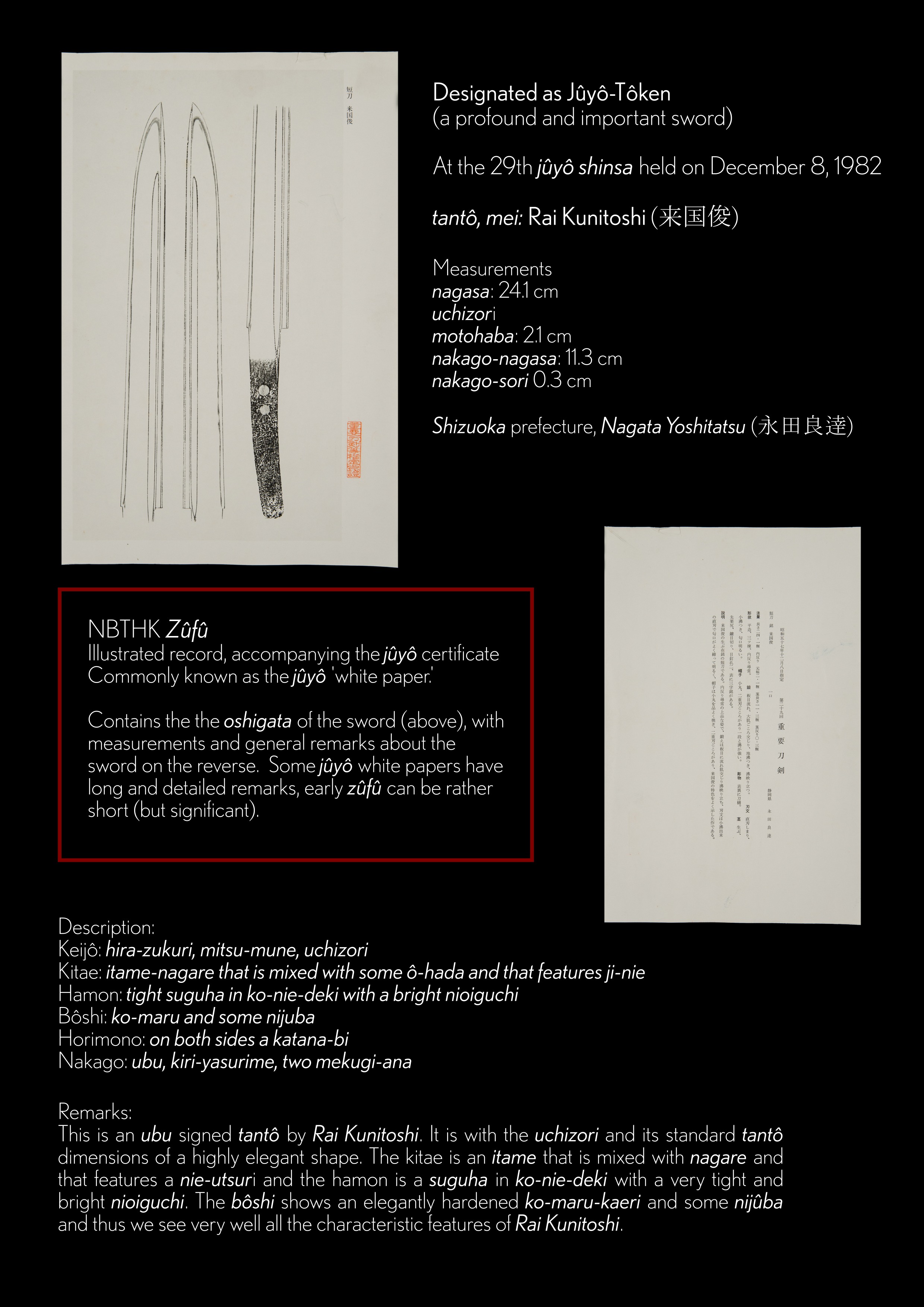
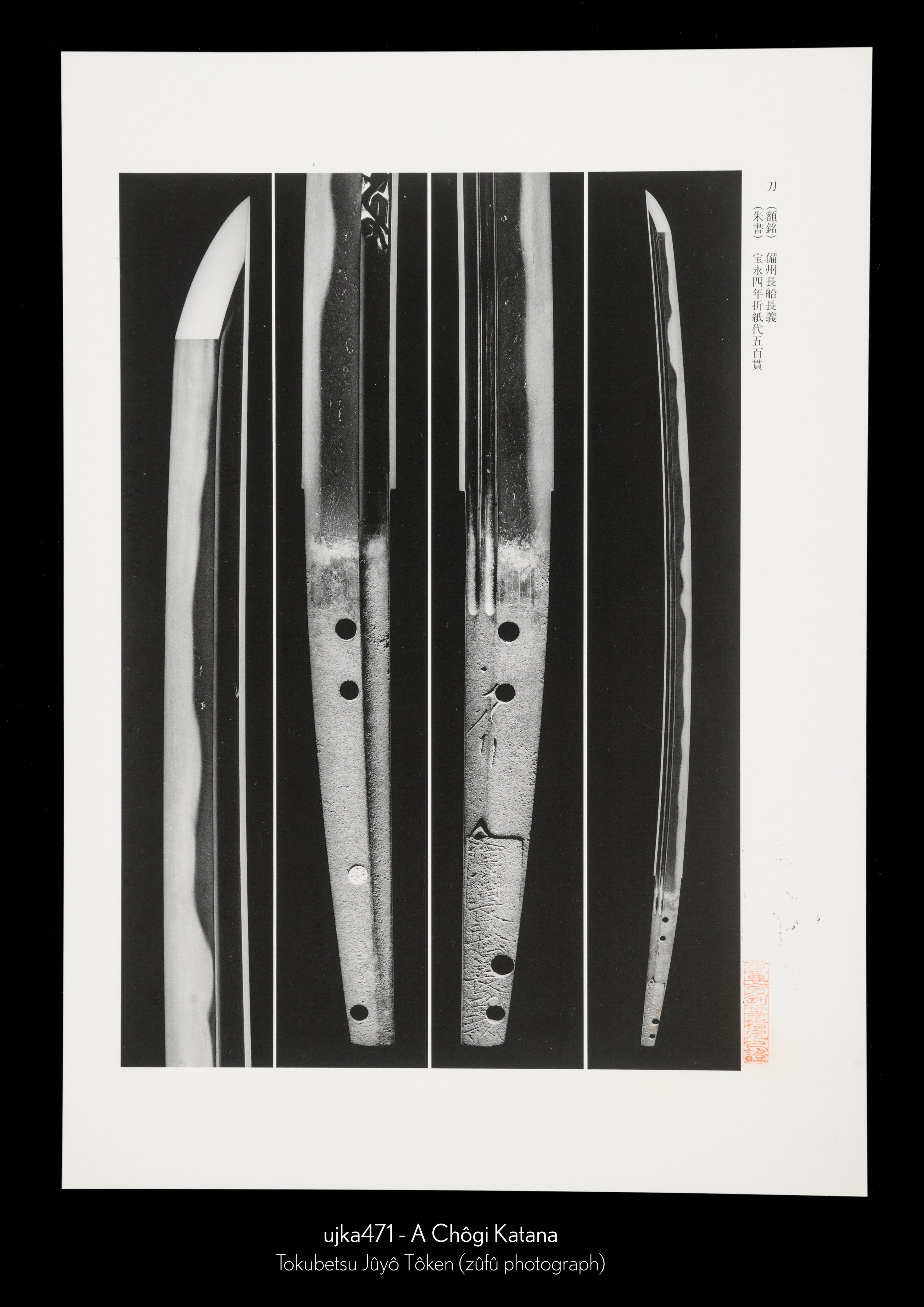
The Jûyô certificate includes a separate ‘zûfû’ (illustrated record) of an oshigata – a hand-drawn rubbing showing the nakage shape and any signature plus the outline of the hamon. These documents are beautiful objects in their own right. Each annual Jûyô session is numbered, and the session number appears on the certificate – so you know exactly when your sword was recognised.
Tokubetsu Jûyô Tôken – Especially Important Work
The highest NBTHK rank · Introduced 1971
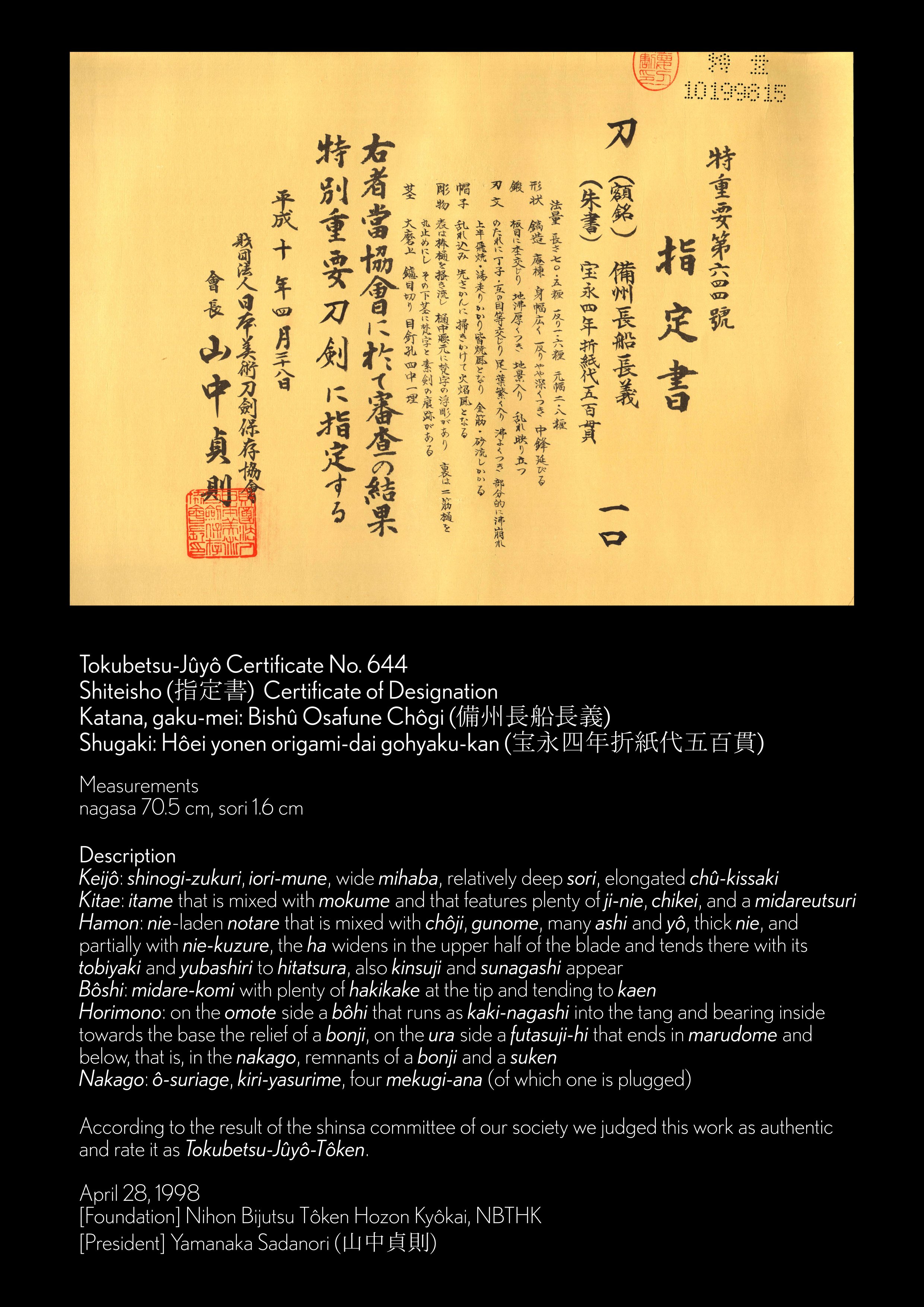
Tokubetsu Jûyô Tôken – “Especially Important and Profound Work” – or simply “TJ” or “TokuJu” as it is widely known – is the absolute pinnacle of NBTHK certification. Of the approximately 14,000 Jûyô blades in existence, only around 1,400 – roughly 10% – have achieved Tokubetsu Jûyô status. Just as a sword must pass Tokubetsu Hozon before being eligible for Jûyô, a sword must hold Jûyô before it can be put forward for TJ. This special shinsa takes place every two years in April – the most recent session concluded in April 2026.
The certificate itself is similar to jûyô, but it’s a darker yellow colour. The zûfû package contains a gorgeous photograph of the sword with a comprehensive write-up.
For Unique Japan, reaching this level has been an organic journey. Honestly, I was not ready to serve clients at the TJ level until around 2020 – and I say that straight up. It takes years of building relationships, both within the industry and with private collectors, before swords of this calibre are even offered to you. And then there is the financial reality – when a special TJ sword is presented to me, I need to be ready to move on it immediately, and at this level that is no small commitment.
We have handled several Tokubetsu Jûyô swords over the years and every single one has been a profound experience. I will admit that there have been Jûyô swords that have not personally moved me that much – but every TJ sword has impressed me without exception. That does not mean I acquire every one that comes my way. It is always a considered decision. But I have never once doubted that a sword awarded TJ status deserved it.
It is precisely this inherent exceptionalism that drives me to continue focusing on Tokubetsu Jûyô for clients who want the finest possible pedigree for their collections. At $120,000 to $500,000 and beyond, these are significant investments – but still a fraction of what a significant painting commands at auction. I know which one I would rather live with.
National Treasures and Important Cultural Properties
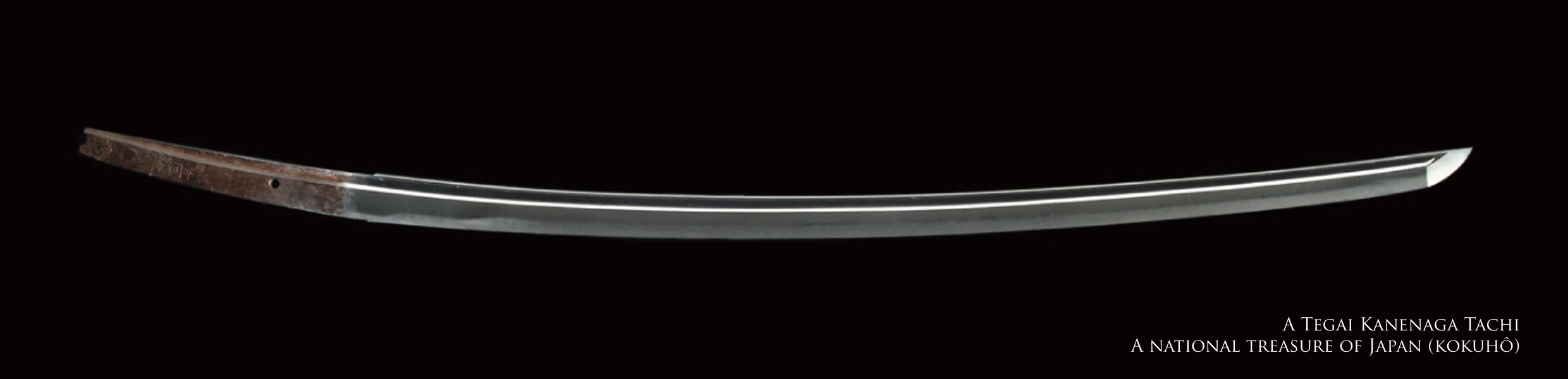
A common misconception among people who discover Japanese swords for the first time is that all swords are protected and cannot leave Japan. This is not the case.
There are approximately 110 swords – such as the Tegai Kanenaga Tachi illustrated above – that are designated by Japan’s Ministry of Education, Culture, Sports, Science and Technology as National Treasures, on the grounds that they possess especially high historical or artistic value. These pieces are protected and cannot leave Japan. Every other registered sword can be legally owned and exported by collectors around the world, and this is exactly what we do at Unique Japan every day.
For reference, the full list of National Treasure swords can be found on Wikipedia here.
The NBTHK Application Process – How Unique Japan Can Help
If you own a Japanese sword – whether purchased from us or from any other source – and you would like it certified by the NBTHK, Unique Japan offers a comprehensive submission service that handles every step of the process on your behalf. Clients around the world regularly entrust us with their swords for exactly this purpose, and we are very good at it.
The process is more involved than most people realise, and having someone on the ground in Tokyo who knows the system well makes an enormous difference. Here is how it works:
| Step 1 – Ship your sword to Japan | Your sword needs to be physically present in Japan for submission. If it is outside Japan, Unique Japan will manage the import process – handling all documentation, customs formalities and registration requirements. This is a service we carry out regularly and with complete confidence. |
| Step 2 – Online reservation | The NBTHK now requires online advance registration for each shinsa session – approximately one month before the submission dates. Slots are limited and fill up quickly. We monitor the booking calendar and secure your slot as soon as applications open. |
| Step 3 – Physical submission at the NBTHK | Shinsa sessions run over normally three consecutive days early in the month – for example June 1, 2 and 3. We bring your sword in person to the NBTHK in Tokyo on the designated days, handle all paperwork and fees, and manage communication throughout. |
| Step 4 – Results and collection | Results are posted to us in advance, typically around four months after submission. We collect the sword and accompanying paperwork approximately one week after results arrive and notify you immediately. At the time of collection we seek direct feedback from an NBTHK judge on your sword’s result – why it passed, what impressed, what fell short. Few dealers do this, but we do. It is honest feedback, occasionally blunt, and we always pass it along in full. We learn something every time. |
| Step 5 – Certificate | If the sword passes Hozon or Tokubetsu Hozon, the certificate is issued approximately two months after the result. Juyo Token and Tokubetsu Juyo Token certificates take considerably longer – allow up to a year. All certificates are translated into English for you by our team. |
A few important rules to understand about how the NBTHK certification ladder works:
| First submission | A sword submitted for the first time can only be considered for Hozon or Tokubetsu Hozon. There is no way to skip levels. |
| Path to Juyo | A sword must already hold Tokubetsu Hozon before it can be submitted for Juyo Token consideration. |
| Cost | Fees vary depending on the level applied for and whether the sword passes. We will provide a full cost estimate before you commit to anything. |
The NBTHK holds shinsa sessions on the following schedule:
| Hozon and Tokubetsu Hozon | Three to four sessions per year |
| Tosogu (fittings) certification | Three to four sessions per year |
| Juyo Token | Once per year, in September |
| Tokubetsu Juyo Token | Once every two years, in April. The next session is April 2028. |
For sword submissions, the NBTHK is the highest authority and our first recommendation – though it is worth noting that no organisation is infallible, and even the NBTHK does not always get it right. For fittings, koshirae, tsuba and individual tosogu, we regularly submit to the NTHK-NPO (Nihon Token Hozon Kai) which offers faster turnaround times, lower fees, and shinsa sessions almost every month. For exceptional fittings where the client is willing to wait, we submit to the NBTHK instead.
The NTHK-NPO is also an excellent source of a second opinion alongside NBTHK certification – particularly useful when a result is unexpected or contested. Additionally, the NTHK-NPO holds a special annual shinsa in December known as Yushusaku – Highly Excellent – which is a very worthwhile submission for swords that have passed Tokubetsu Hozon but have not yet been put forward for Juyo, or for swords that have attempted Juyo and fallen short. A Yushusaku result is a respected and desirable distinction in its own right.
For further information on the NTHK-NPO and its certification levels, see our NTHK-NPO Certification page.
If you have a sword or fittings you would like to submit – wherever in the world you are based, and wherever the piece was purchased – please get in touch. We will assess the piece, advise on the most appropriate organisation and level to pursue, and give you a clear picture of costs and timeline before you commit to anything.
Older Certificates (1948-1982)
Before the current system was introduced in 1982, the NBTHK operated an earlier certification structure that produced three levels: Kichô Tôken, Tokubetsu Kichô Tôken and Kôshû Tokubetsu Kichô Tôken. These certificates were issued by the NBTHK, and that origin is genuine. However, a scandal involving the regional satellite branches of the organisation compromised the integrity of the process – branches were issuing certificates without the same rigour as the main office in Tokyo. The NBTHK took decisive action, dissolved the satellite system and introduced the current four-tier structure in 1982. The main branch was not affected, which is why Jûyô Tôken and Tokubetsu Jûyô Tôken certificates from any era remain fully trusted and unchallenged.
The three older certificates listed below are therefore viewed with some caution by the NBTHK today – particularly Tokubetsu Kichô, the green paper, which was the most widely issued at branch level. This does not mean the sword is inauthentic, but it does mean the certificate alone carries less weight than it once did. If you own a sword with any of these older papers, our strong recommendation is to resubmit it under the current system to achieve Hozon or Tokubetsu Hozon certification. We can assist with that process – please get in touch.
Kichô Tôken – Precious
White paper · September 1948 to June 1982
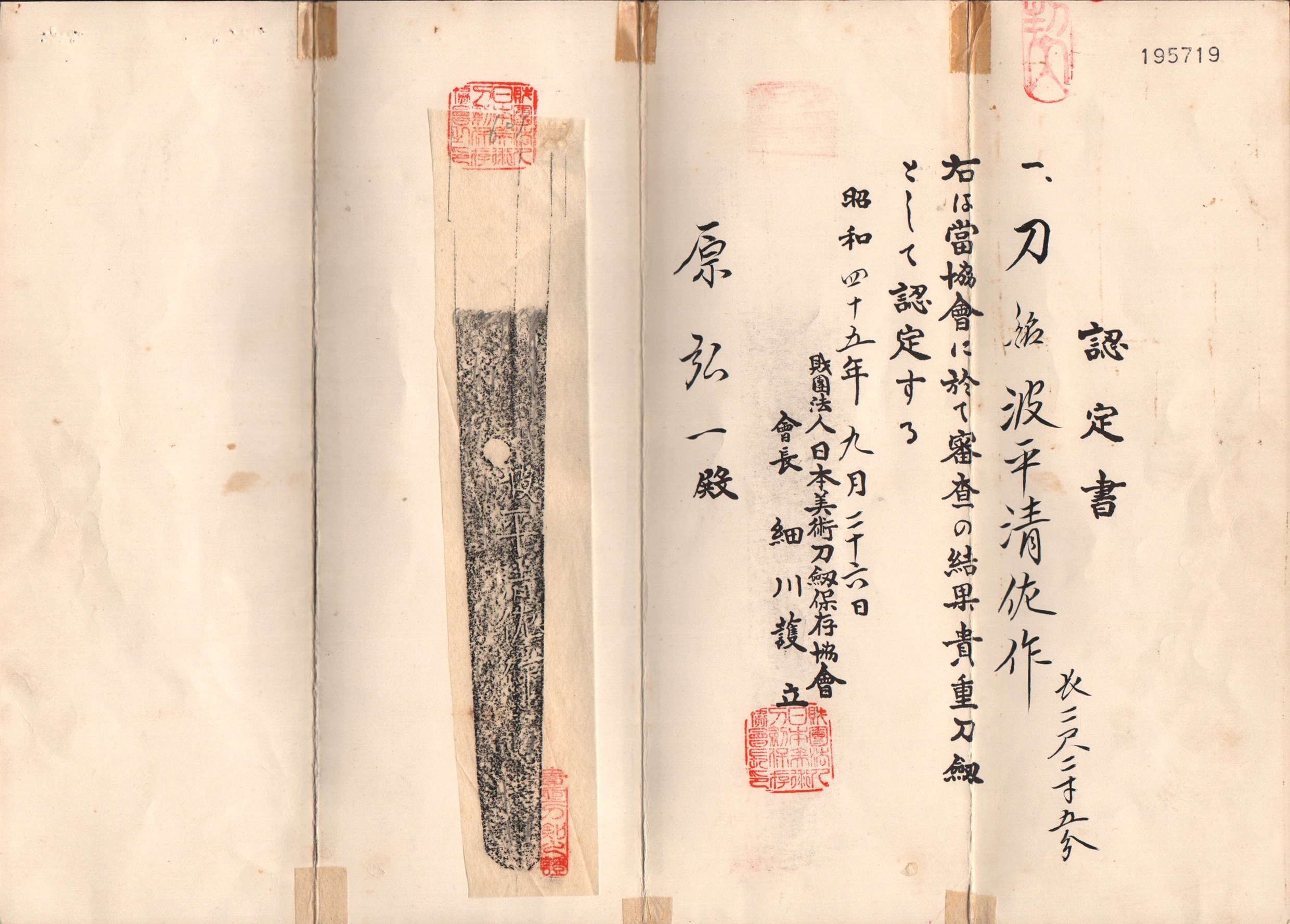
Kichô Tôken – “Precious” – was the entry-level certificate of the original system, issued from 1948 to 1982 at both the main NBTHK office and local branches. It is commonly referred to as the “white paper.” This was the only rank issued until 1950, when Tokubetsu Kichô was introduced as the tier above it.
Tokubetsu Kichô Tôken – Especially Precious
Green paper · March 1950 to June 1982
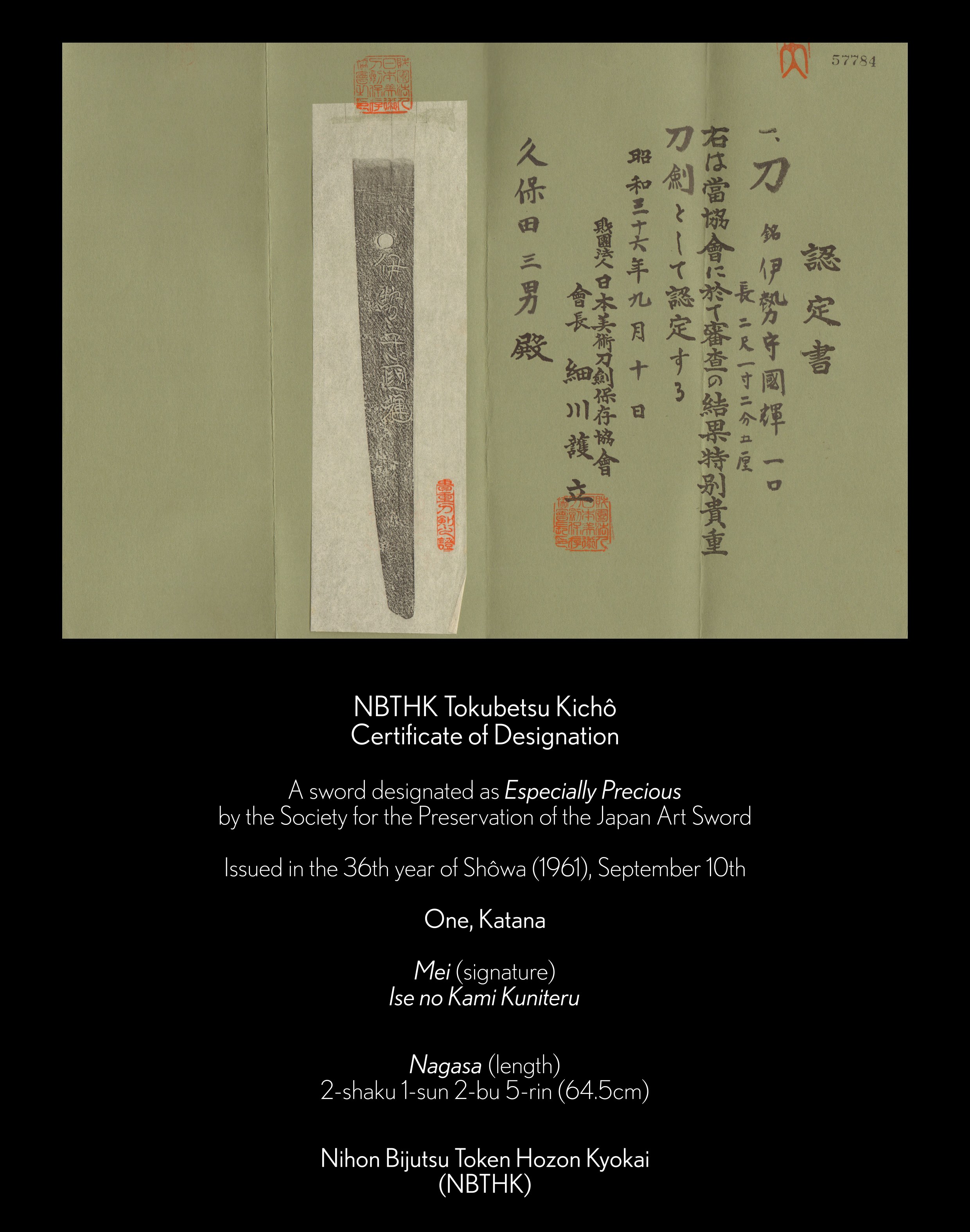
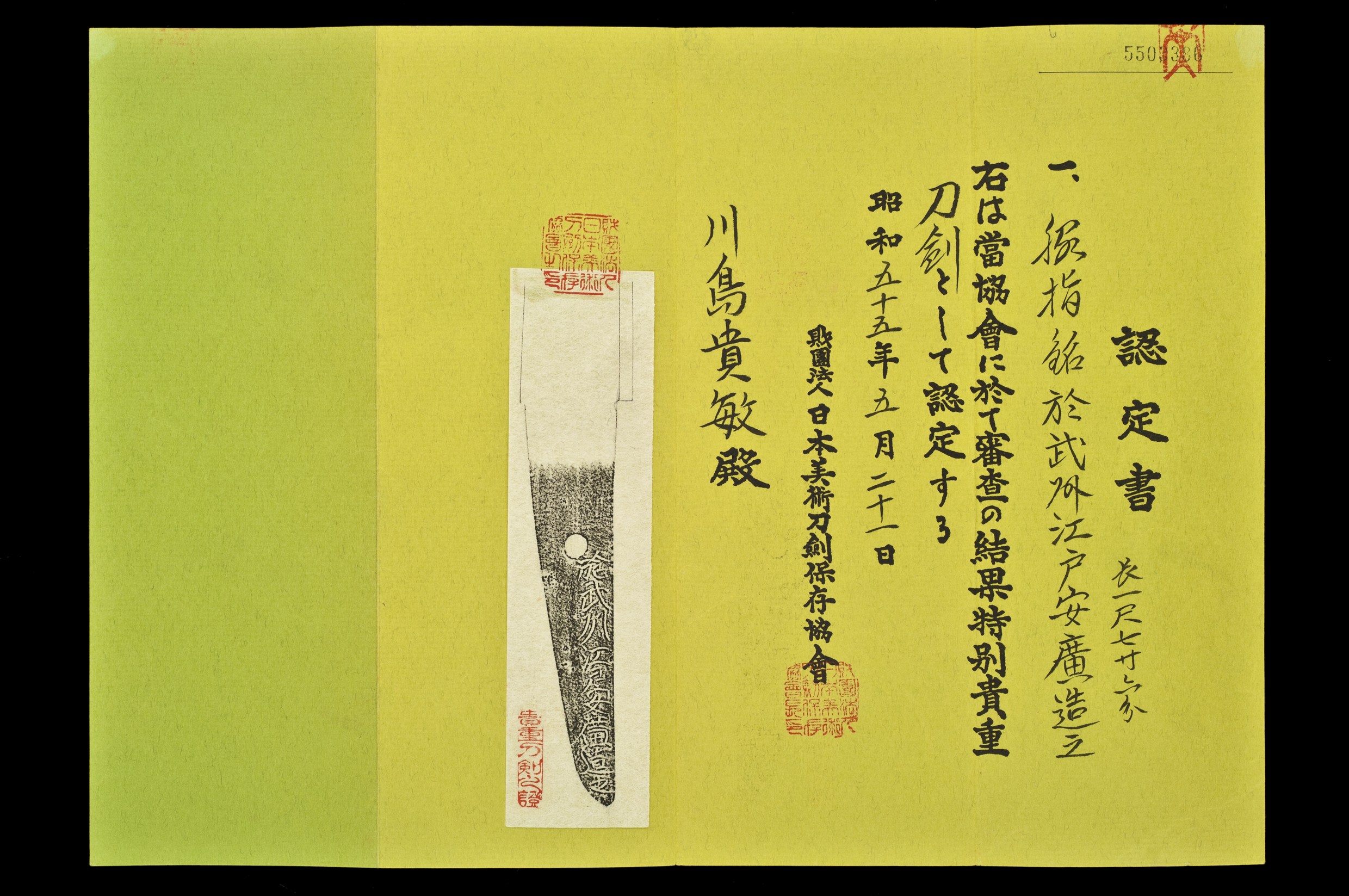
Tokubetsu Kichô – “Especially Precious” – was the iconic ‘green paper’, and the top rank available until Jûyô was introduced in 1958. It was issued at both the main office and local branches. The distinctive round seal bearing the kanji for “Toku” was added to the green paper from July 1950. I have a close friend in the UK who has been collecting and trading swords since the 1970s and he told me that (back then) when your sword came back with green TokuKichô, you were ‘well chuffed’ (happy, a British expression). So even though many people dismiss the green paper today, there was a time that it was well-regarded and not necessarily tainted. But in all fairness, one should upgrade to the new system if you have this certificate.
A rarer variant – the Tokubetsu Kichô issued jointly for both the USA and Japan – was produced between 1980 and 1982, and was the highest level awarded at the 1980 US NBTHK shinsa. Below is an example of this bright green paper. A wakizashi by Bushû Edo jû Yasuhiro.
Kôshû Tokubetsu Kichô Tôken – Extraordinarily Precious
Blue paper · 1973 to 1982
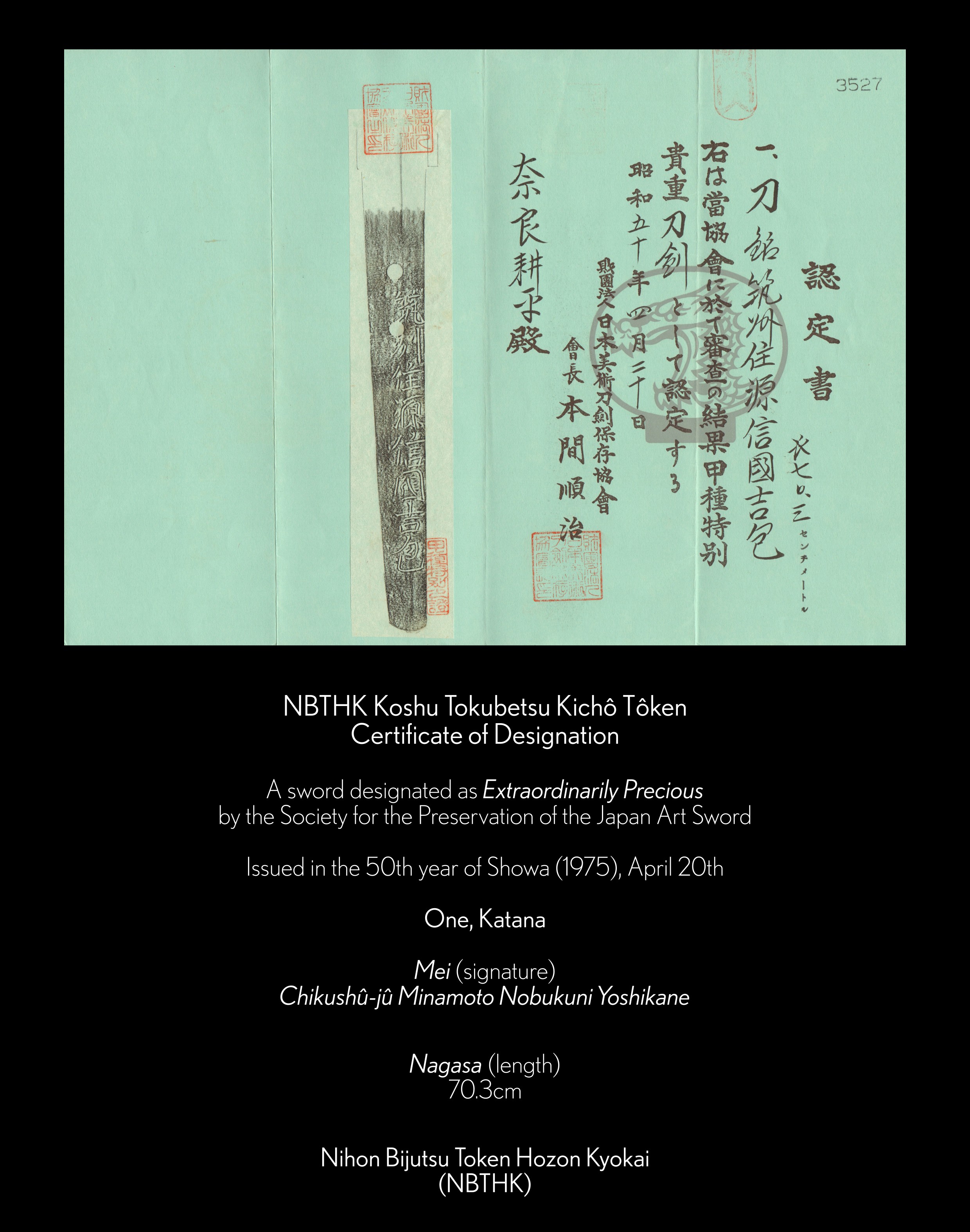
The Kôshû Tokubetsu Kichô – the blue paper – was introduced in 1973 as a rank above Tokubetsu Kichô but below Jûyô. It was issued only between 1973 and 1982 and only at the main NBTHK office, making it considerably rarer than the green paper. Only exceptional swords could hope to attain this level. It is personally one of my favourite levels of NBTHK distinction – not only for the rarity and the beautiful blue paper, but because every sword with this certificate was genuinely a good and impressive sword. Like the other older certificates, we recommend re-submitting any blue paper sword under the current system to obtain Hozon or Tokubetsu Hozon. In our experience, every blue paper sword we have re-submitted has passed Tokubetsu Hozon – and on one occasion the sword went on to achieve Jûyô Tôken. It tells you something about the quality of swords that earned this certificate in the first place.
What If a Sword Has No NBTHK Certificate?
There are two quite different reasons a sword might carry no NBTHK certificate, and it is worth understanding the distinction. The first is straightforward: the sword was never submitted. This is common among swords that left Japan during or after the Second World War and have remained in collections in the United States, Europe or elsewhere ever since. These swords simply never had the opportunity to go through shinsa, and an uncertified sword in that situation is not automatically a cause for concern.
The second reason is more significant: the sword was submitted and failed. If you are looking at a sword on a Japanese auction site without NBTHK certification, the honest reality is that this is often the case. A failed submission is most commonly due to a gimei – a false or suspect signature on the tang – or because the piece did not meet the standard required. The sword may still be genuine as a blade, but the absence of a certificate on the Japanese domestic market should prompt careful scrutiny. This does not apply to swords offered outside Japan through reputable salerooms or dealers, where the provenance and collecting history may fully account for the absence of papers.
There is also a category of swords that will never carry NBTHK certification regardless of their quality: work by living swordsmiths. The NBTHK does not certify the work of active smiths. A gendaito by a respected living maker may be an exceptional sword – but it will not carry an NBTHK origami until after the smith has passed.
Separate to this entirely, there are serious collectors who simply do not feel they need the NBTHK’s opinion on certain swords – living or deceased smith alike. One of my closest Japanese sword collector friends is a serious Gassan collector. He does not much care for the NBTHK at all when it comes to Gassan work. For him, whether the sword is by a current Gassan family member or by a Gassan master from generations past, a sayagaki from the Gassan family themselves is entirely sufficient. Fair enough!
Every sword sold by Unique Japan carries certification from either the NBTHK or the NTHK-NPO as standard. But if you own a sword from another source that has never been submitted – or if you are considering purchasing something uncertified and would like our assessment – please get in touch. We will give you an honest opinion on the piece and advise on whether it is worth pursuing certification and at what level.
Tôrokushô – The Registration Certificate
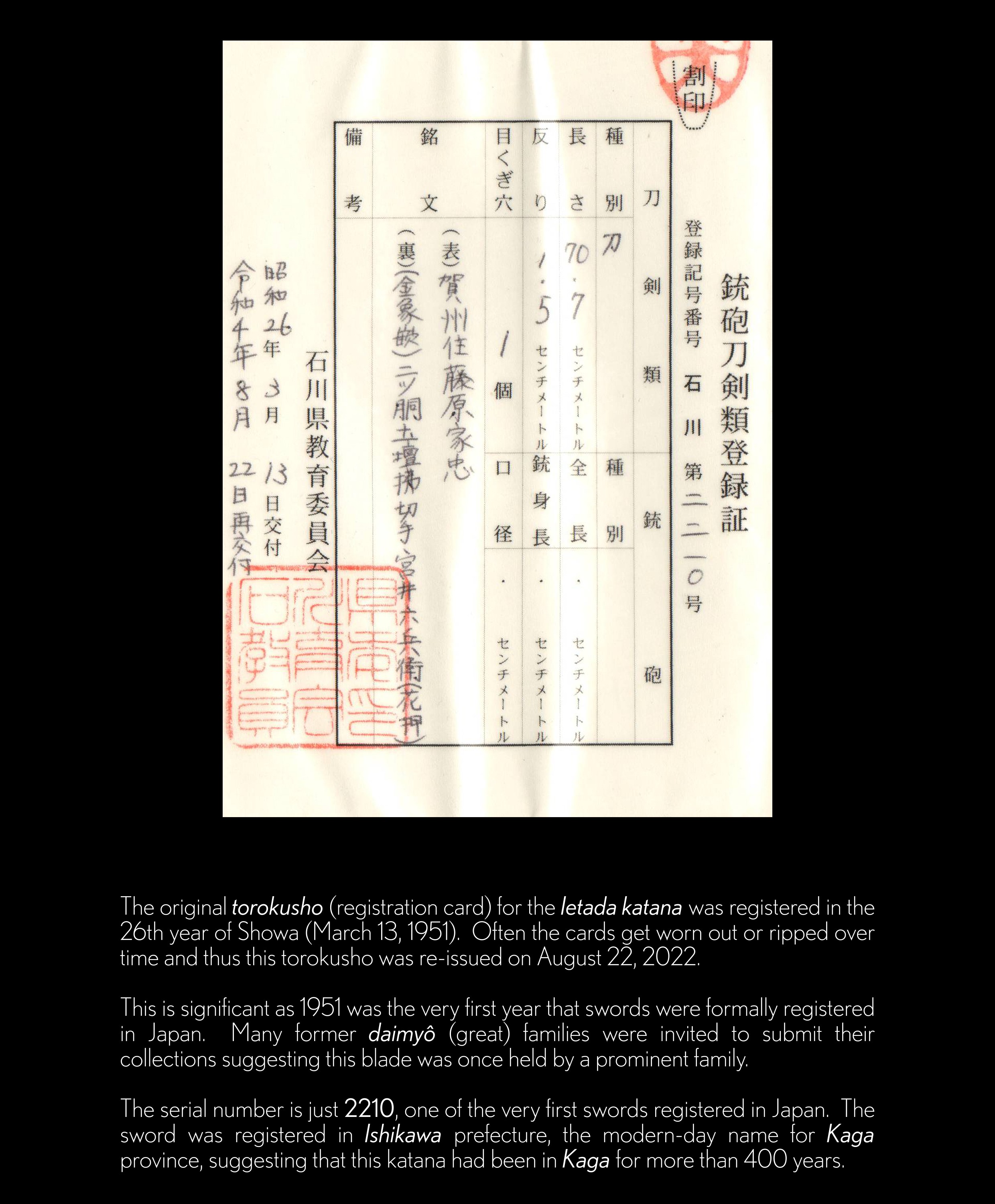
Every sword registered in Japan has a tôrokushô – a registration certificate that serves as the sword’s official passport. It documents the blade’s length, curvature, number of holes in the tang, and any signature present. Each blade carries a unique registration number and the tôrokushô is typically kept with the sword at all times, wrapped around the saya.
The administration of sword registrations in Japan has historically been handled at prefectural level, though the system has undergone changes in recent years and registration responsibilities are now managed by a centralised body. When a sword changes ownership or leaves Japan, the registration must be updated accordingly. This is something we handle on behalf of all our clients as part of the export process – you do not need to navigate the Japanese bureaucracy yourself.
The tôrokushô is an administrative document, not an aesthetic judgement – it says nothing about the quality or importance of the sword. But it is essential. A sword that cannot account for its tôrokushô should be approached with caution, and all swords sold by Unique Japan are fully registered and documented.
| Further Reading | |
| NTHK-NPO Certification Rankings | The companion organisation to the NBTHK and their certification system |
| 7 Points to Consider When Choosing Your Japanese Sword | A practical guide covering all key factors in sword selection |
| 5 Steps to Owning a Japanese Sword | How the purchase and export process works from start to finish |
| Available Swords | Current inventory – all pieces guaranteed authentic with full certification |