
ITEM# UJKA433 – Catalogue 42 – Sold
A Kinmichi Katana (伊賀守藤原金道)
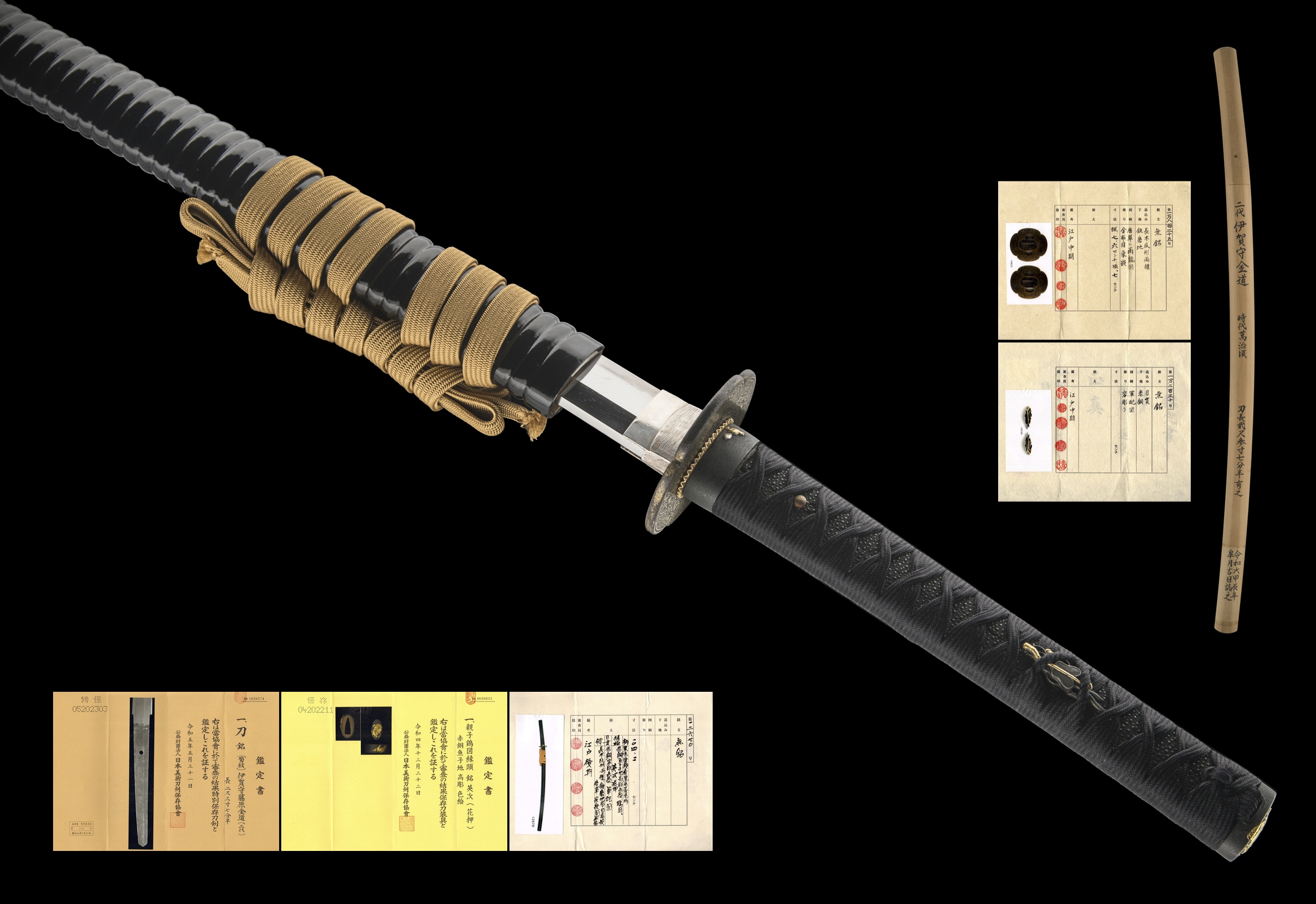
This stately katana was crafted by nidai (2nd generation) Iga no Kami Kinmichi, who worked in Yamashiro province (Kyôto) during the Manji era. Born Mishina Kanbei, he is the first son of shodai Kinmichi and elder brother of Izu no Kami Fujiwara Kinmichi. The Mishina school was a prestigious and powerful family with deep connections to the ruling Tokugawa family and the imperial court, their swordsmiths active across several generations throughout the Edo period.
The historical weight of this blade’s lineage is considerable. Prior to the Battle of Sekigahara in 1600, Tokugawa Ieyasu ordered no fewer than 1,000 tachi from shodai Kinmichi. For his skilled management of that commission – and Tokugawa’s eventual victory – Kinmichi was granted the honorary title Nihon-kaji-sôshô, meaning “Master swordsmith of Japan.” Second generation Kinmichi assumed these responsibilities from his father and was the first smith to sign Nihon-kaji-sôshô on his swords, accompanied by a stylised chrysanthemum crest (kiku-mon) granted by the Imperial family – an honour and privilege unique to the Mishina school.
Structurally, the blade is long and wide with a nagasa of 72.0cm, a lovely curvature and a robust weight approaching 800 grams. The hamon opens with a straight kyô-yakidashi before exploding into an energetic $1 with box-shaped hako-midare elements inherited from his father, and abundant sunagashi resembling sweeping strokes over sand – a textbook display of Mishina brilliance. The bôshi resolves into the characteristic Mishina bôshi with hakikake. The koshirae is exceptional: a kyô-kenjô tsuba with gold nunome-zôgan arabesque and rain-dragon motifs, a magnificent signed fuchi-kashira by Ômori Terutsugu depicting a rooster, hen and chicks, and gunbai menuki attributed to Gotô Unjô. The kizami saya (ribbed scabbard) lacquered in glossy black completes an ensemble that is as cohesive as it is beautiful.
| Item Number | UJKA433 |
| Sword Type | Katana |
| Swordsmith | Nidai Iga no Kami Kinmichi |
| Swordsmith (JP) | 二代伊賀守金道 |
| Signature | Iga no Kami Fujiwara Kinmichi (nidai) |
| School | Mishina |
| Province | Yamashiro |
| Period | Shintô – Early Edo period (Manji era: 1658~1661) |
| Nagasa | 72.0cm |
| Sori | 1.7cm |
| Moto-haba | 3.00cm |
| Weight | 790g |
| Nakago | Ubu (original, unaltered); sujikai-yasurime (diagonal file marks); kengyô-jiri (sword-shaped butt); kiku-mon (chrysanthemum crest) |
| Jihada | Well-forged itame and mokume-hada with ji-nie and plenty of chikei |
| Hamon | Kyô-yakidashi opening into gunome-midare with hako-midare, sunagashi, and ashi |
| Boshi | Mishina-bôshi with hakikake |
| Certificates | NBTHK Tokubetsu Hozon; NBTHK Hozon (fuchi-kashira); NTHK-NPO Kanteishô (koshirae, fuchi-kashira, menuki, tsuba) |
| Fujishiro Rank | Chûjô-saku |
| Sharpness Rating | Wazamono |
| Sayagaki | Nozomi-san (shodô artist) — inscribed in the 5th month, Reiwa 6 (May 2024) |
| Koshirae | Kuro-ronuri nibu-kizami saya uchigatana-koshirae (黒呂塗二分刻鞘打刀拵); Late Edo period (1780~1867) |
| Tsuba | Kyô-kenjô tsuba; polished iron with gold nunome-zôgan karakusa and unryû design; NTHK-NPO Kanteishô (mid-Edo period, circa 1700~1780) |
| Fuchi-kashira | Signed Ômori Terutsugu; shakudô with nanako ground, relief with colour accents; rooster, hen and chick motif; NBTHK Hozon; NTHK-NPO Kanteishô |
| Menuki | Gunbai (war fan) motif; attributed to Gotô Unjô; NTHK-NPO Kanteishô (middle Edo period) |
| Habaki | Silver habaki with horizontal file marks |
| Catalogue | Catalogue 42 |
| Status | Sold |
| Includes | Shirasaya, Edo-koshirae, fabric bags, stand, kit, printed description |