
ITEM# UJKA417 – Catalogue 42 – Sold
A Masatoshi Katana (坂倉関正利)
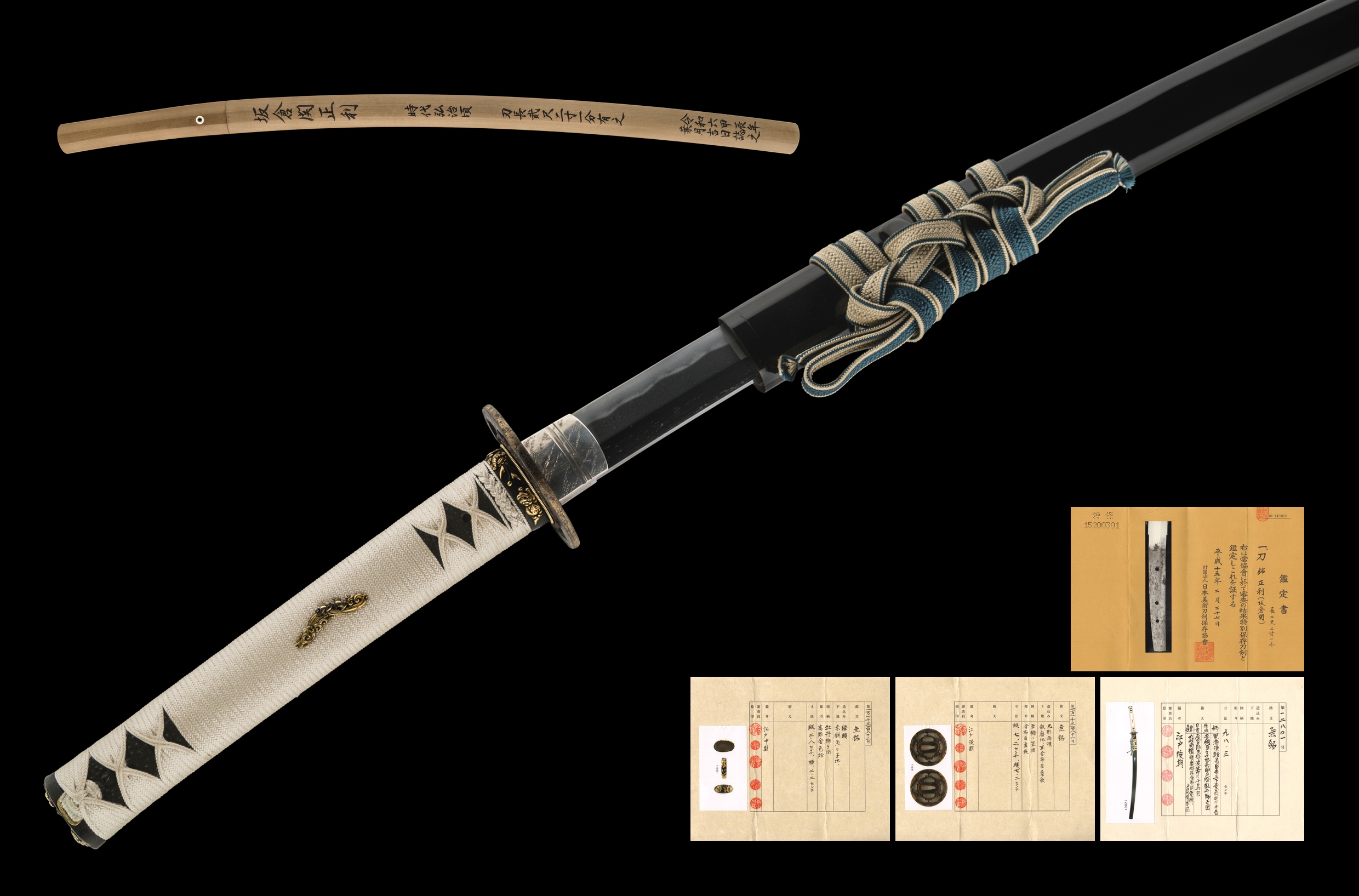
This muscular katana was forged by second-generation Sakakura no Seki swordsmith Masatoshi, who flourished at the close of the warring Muromachi period during the Kôji era (1555~1558), as Japan was consumed by the Sengoku-jidai. His father, shodai Masatoshi, was the son of Masayoshi who founded the school in the late 1400s. The chiselled character for ‘Masa’ bears a striking resemblance to signatures found on blades of the Sôshû Sengo Muramasa school – giving weight to the theory that Masatoshi was the son, or direct student, of the Eishô-era Masazane who worked also in Ise.
A warrior energy pulses through this freshly polished blade, showcasing both Sôshû and Mino influences at their most vivid. The jihada presents as a fine mixture of nagare-hada and itame-hada, alive with ji-nie and chikei. The hamon runs in a vibrant $1 punctuated by leaping tobiyaki, droplet-like yô, pointed togari, streaming sunagashi and bright kinsuji. The bôshi closes in a striking jizô form – a profile strongly associated with the Sengo Muramasa school, and perhaps the most telling fingerprint of Masatoshi’s lineage. The nakago is shortened (suriage) but retains the characteristic funagata profile of the Sôshû Sengo tradition.
Unique Japan assembled a handsome set of antique Edo-period koshirae to complement this blade. The saya is a kuro-ronuri uchigatana-koshirae lacquered in glossy black (late Edo, 1780~1868). The polished iron tsuba from the Sho-ami school of Kyôto features a snowflake design encircled by woven hats, with crosshatched gold inlay along the rim. The fuchi-kashira, attributed to the Shônai Shôami school (mid-Edo, 1700~1780), depict shishi lions and peonies in bold relief. The pure white silk tsuka is wrapped in naka katatemaki over black-lacquered samekawa, with courageous chidori plover birds flying over waves as the menuki. Masatoshi is ranked ryô-wazamonô for the consistently excellent sharpness of his blades – a ranking this sword has evidently earned in full.
| Item Number | UJKA417 |
| Sword Type | Katana |
| Swordsmith | Masatoshi (nidai, 2nd gen.) |
| Swordsmith (JP) | 坂倉関正利 |
| Signature | Masatoshi (Sakakura no Seki) |
| School | Sakakura no Seki |
| Province | Mino |
| Period | Sue-kotô – Kôji era (1555~1558) |
| Nagasa | 67.0cm (suriage) |
| Sori | 1.4cm |
| Moto-haba | 2.96cm |
| Weight | 780g |
| Nakago | Suriage (shortened); katte-sagari yasurime (sloping file marks); 3 mekugi-ana; nagasa 17.8cm |
| Jihada | Masame-nagare-hada and itame-hada with ji-nie and chikei |
| Hamon | Gunome-midare with tobiyaki, yô, togari, sunagashi and kinsuji |
| Boshi | Midare-komi to saki-jizô |
| Certificates | NBTHK Tokubetsu Hozon; NTHK-NPO Kanteishô (koshirae, fuchi-kashira and tsuba certified as Authentic) |
| Fujishiro Rank | Chûjô-saku |
| Sharpness Rating | Ryô-wazamonô |
| Sayagaki | Nozomi-san (shodô artist) – Sakakura no Seki Masatoshi, around Kôji period (1555~1558), blade length 67.0cm, dated Reiwa 6 (August 2024) |
| Koshirae | Kuro-ronuri uchigatana-koshirae (black lacquer); late Edo period (1780~1868) |
| Tsuba | Polished iron, Sho-ami school, Kyôto; snowflake and woven hat design with crosshatched gold inlay on rim; NTHK-NPO Kanteishô; late Edo period (1780~1867) |
| Fuchi-kashira | Attributed to Shônai Shôami school; shishi and peony motif; NTHK-NPO Kanteishô; mid-Edo period (1700~1780) |
| Menuki | Chidori (plover birds) over waves |
| Tsuka | Pure white silk, naka katatemaki over black-lacquered samekawa |
| Habaki | Silver habaki with falling rain file marks |
| Catalogue | Catalogue 42 |
| Status | Sold |
| Includes | Shirasaya, Edo koshirae, fabric bags, stand, kit, printed description |