
⇩ Download Catalogue 44 (236MB)
Free to download. All swords in this catalogue are sold.
Index of Swords
Opening Remarks
Hi everyone, I hope you are all doing great and enjoying the warmer weather as we march on into 2025. We’ve had a wonderful spell of sunshine here in the UK, and I have been taking Barney out for fairly long walks, feeding my growing passion for hiking. Feels good. Congratulations to all those who have claimed swords in Catalogue 43 and to the numerous private sales of late – now it’s time to take a stroll into some brilliant Japanese swords on offer in Catalogue 44. Let’s go!
We kick off the catalogue with a long and graceful tachi by the Ko-Naminohira school that instantly transports you to the beaches of Satsuma province from the late 1200s. Dr. Kanzân Satô dates and attributes this blade to the work of Naminohira Yukiyasu. According to the sayagaki, this particular piece was passed down within the Date family in Yoshida province as a family heirloom. A long bô-hilightens the blade just right – it’s easy to envision a samurai on horseback galloping with this dependable tachi by his side. The hamon is a straight laser beam of hosô-suguha, synonymous with the Kamakura period, with contrasting kinsuji and bright shirake-utsuri. A wonderful set of koshirae depicts Enoshima shrine on the fuchi-kashira and has a glorious tachi tsuba making reference to Japan’s literary masterpiece of the 11th century, The Tale of Genji. On a personal note, I have a Ko-Naminohira tachi in my own collection that will eventually go to our eldest son, Lennon.
We remain in the glorious Kamakura period with a sword attributed to one of Japan’s finest swordsmiths. Norishige was a fellow student of Masamune under Shintôgo Kunimitsu. Among the early great Sôshû masters, his workmanship is closest to that of Masamune. The major difference is that the kitae produced by Norishige stands out more visibly – resulting in his iconic matsukawa-hada, a spiralled grain pattern resembling the bark of old pine trees. This is a relatively short katana that feels agile in hand, taking you back some seven hundred years with an elegant jihada that will absolutely capture your heart. This is what collecting nihôntô is all about. Claim it in shirasaya, or let’s build a top-class custom koshirae with the finest craftsmen in Japan.
Now hold on to your hats with this next sword. This remarkable katana has been attributed to the Echizen-Seki school – its name originating from a group of swordsmiths who migrated to Echizen from Seki city in Mino province. The sword features an incredible gunome-midare hamon that swells dramatically into dove-tail wave formations known as yahazu-ba, harmonising beautifully with the dragon and wave fittings. A series of extreme tameshigiri tests were performed on this blade. On June 22, 1753, Yamada Genzaemon tested it in Asakusa by severing through two bodies in one stroke and into the earthen mound below. Then on March 13, 1756, Ijima Jûdayû tested the blade at Denmachô prison by severing three times through a body at armpit height, before proceeding to execute a further 73 prisoners by severing their heads one after another. Samurai intensity like no other.
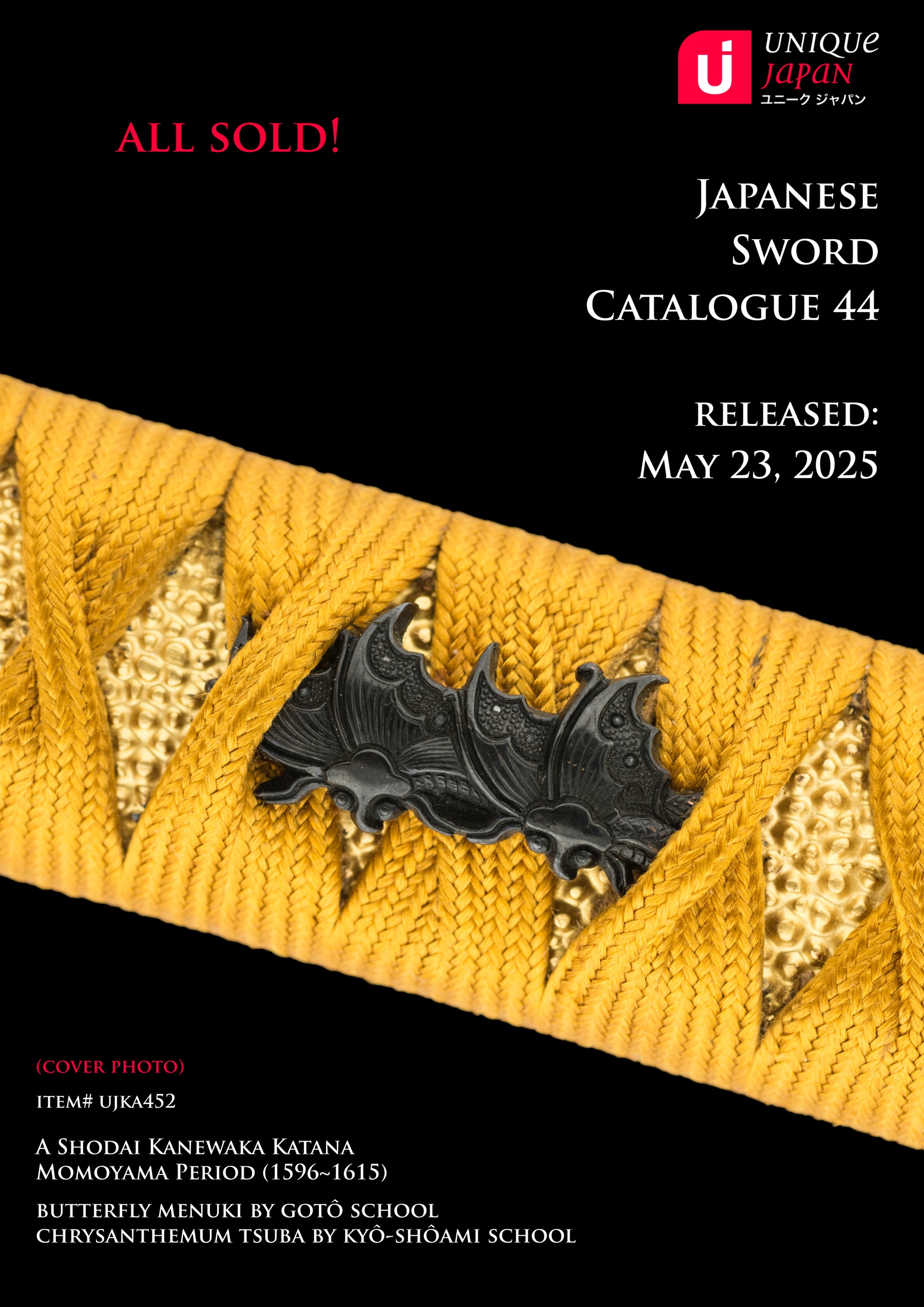
This brings us to a terrific katana by shodai Kanewaka – sandai Kanewaka’s grandfather. Born Tsujimura Jinroku, shodai travelled to Kaga province, founded the Kaga Kanewaka school, and became so highly esteemed that he was referred to as Kaga Masamune. This fine ubu-nakago katana exudes a proud Keichô Shintô shape with a well-forged jihada containing a great amount of chikei, and a bright gunome-midare hamon that dramatically hugs the ha-saki in parts. In wealthy Kaga province, ruled by the powerful Maeda clan and renowned for its gold leaf artistry, the samekawa wrapping the tsuka was specially lacquered in gleaming gold and juxtaposed with meaningful butterflies reflecting the region’s rich heritage. A rare, celebratory samurai sword to be cherished within your family for generations to come.
We stay within the Kanewaka family for a splendidly sharp katana crafted by Tsujimura Shirô’emon Kanewaka, third generation and shodai’s grandson. An awe-inspiring mountain range comes to mind when admiring the splendid peaks and valleys of its gunome-midare hamon. Adding to the ferocity of this katana, sword tester Matsunami Toki’emon performed a tameshigiri test, severing through a human body at armpit level and directly into the earthen mound below – one senses this blade could have easily cut multiple bodies in a single stroke. The sword has sayagaki potential with Tanobe sensei and will definitely make for a superb custom koshirae project.
Talented swordsmith Izumi no Kami Morikuni was a student of Izumi no Kami Kaneshige during the Shintô period, later becoming known as Edo Senjuin. Such great energy is packed into this statuesque katana – expertly forged mokume and itame-hada provide the foundation for a brilliant gunome-midare hamon with impressive sawtooth-like ashi that bite into the blade. A comparison is often drawn between Morikuni and grandmaster Nagasone Kotetsu, as they both shared the same sensei in Kaneshige. A terrific set of koshirae features a wonderfully wise tsuba by Mogarashi Sôten, a detailed fuchi-kashira depicting rats attributed to Ishiguro Masaaki, and a delightful trio of butterflies forming the menuki on the regal jabara-maki braided silk – representing joy and longevity.
Our third shirasaya-only sword is by shodai Yoshikado, a prominent Shintô swordsmith descended from the lineage of Zenjô Kaneyoshi. His career advanced significantly when in 1672 he became an official swordsmith of the Mito domain under Tokugawa Mitsukuni, receiving a stipend supporting seven people and relocating to Mito’s Daimachi district. This highly energetic katana is a prime example from the later years of his storied career. The blade’s vibrant hamon in nie-deki is an ô-midare with notare elements and even hako-midare reminiscent of the famed Kanewaka school – a swordsman’s sword, just the right length to manoeuvre with samurai fluidity.
We cap off the catalogue with four recently sold reference pieces. The first is a kogatana by Sumitani Masamine – a miniature masterpiece forged in pure masame-hada with a bright gunome-midare hamon, housed in a beautiful maki-e-decorated koshirae and charming storage box. Next is an exceptional wakizashi by grandmaster Hankei with his iconic ro-mata signature from his prime years – a particularly rare and significant collector’s item with a glorious custom koshirae with Mino school fittings. Following Hankei is a powerful katana attributed to wazamono-ranked Yasushige of the Shitahara school, carrying a three-body gold-inlay cutting test by Yamano Ka’emon no Jô Nagahisa at age 62, sold at a private meeting at our studio in Tokyo. Our final piece is a Ko-Mizuta Sandai Kunishige katana commissioned for Nakayama Gen’ue no Jô and dated to February 1590 during the Momoyama period, housed in a lovely tachi koshirae with matching silver fittings and a powerful Fudô Myô’ô tsuba.
Thank you all for your passion, trust, and continued confidence in our ability to serve you in this wonderful world of Japanese samurai swords. It means a lot to me and the team. Have a great summer ahead!
Warm regards,
Pablo Kuntz
May 2025