
ITEM# UJKA441 – Catalogue 44 – Sold
A Ko-Naminohira Tachi (古波平)
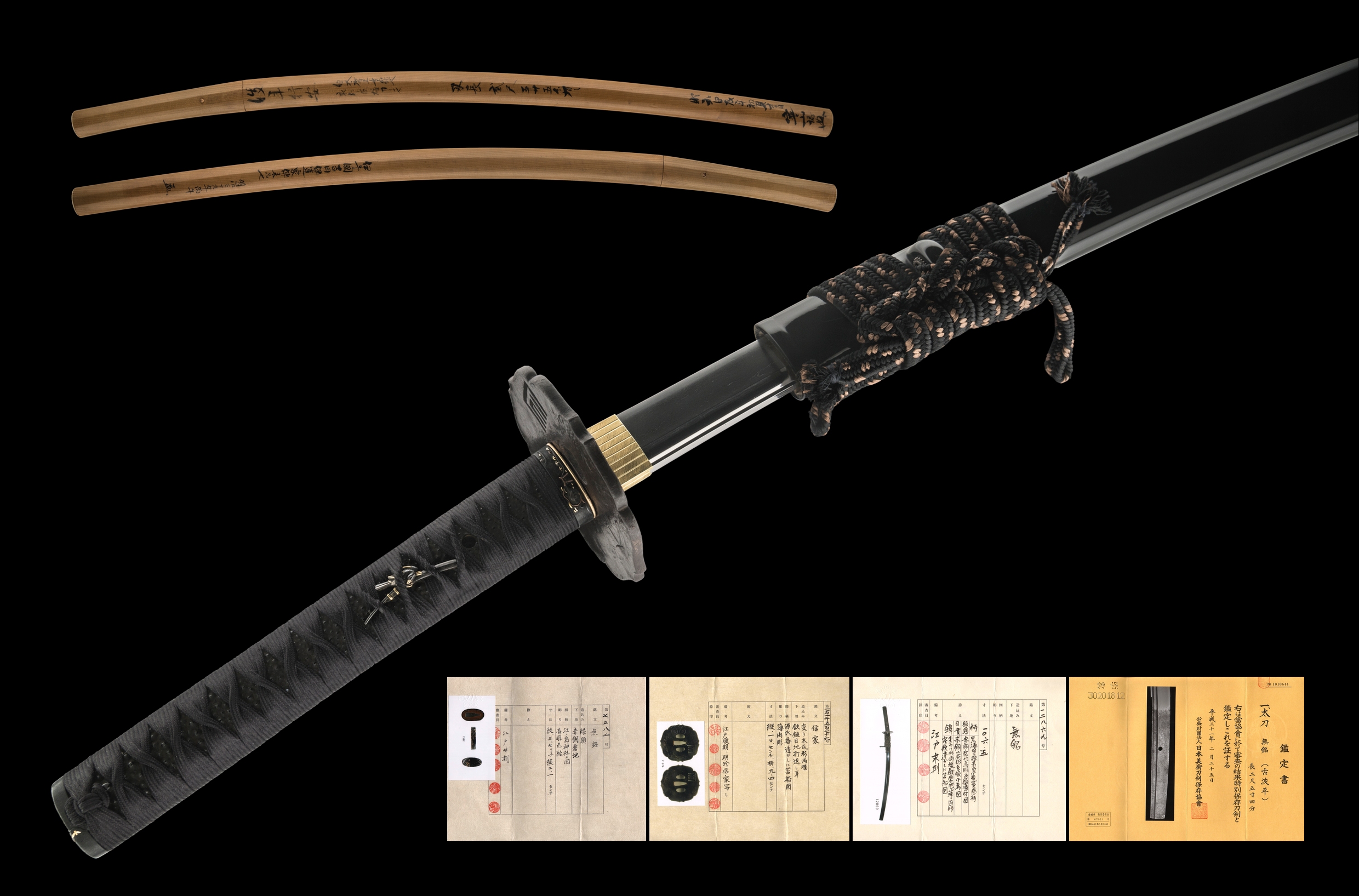
The Naminohira school is one of the oldest sword-making traditions in Japan, said to have begun working in Satsuma province as early as 987 AD. Its founding smiths originally came from Yamato province — present-day Nara prefecture — and the school continued working uninterrupted right through to the end of the Edo period in 1868. The two kanji that form the name Naminohira translate as nami (wave) and hira (flat), meaning calm seas, and swords of the school were said to have been prized by the Japanese navy for the good omen this name carried. This long and graceful tachi has been attributed to Naminohira Yukiyasu by the great scholar Dr. Satô Kanzan, who inscribed his sayagaki in 1964 during the Year of the Tiger. Kanzan also records that this piece was passed down within the Date family — a branch of the famous Date Masamune lineage — in Yoshida of Iyo province as a treasured family heirloom.
The blade is ô-suriage: the tang was greatly shortened at some point in its long life, which is entirely normal for a sword of this age, and the signature was lost in the process. A full-length bo-higroove runs through to the shortened nakago in what is known as kaki-toshi (no end), lightening the blade just right. The original length would have been closer to 90cm — an impressive weapon indeed. Despite over 700 years of existence and the polishes that come with them, the essential character of the steel remains vivid. The jihada is a flowing nagare-hada mixed with itame and ayasugi, with plentiful chikei throughout. Held at the correct angle under the light, a bright shirake-utsuri reflects the hamon back through the dark jigane — a key fingerprint of the Naminohira, Kongobyôe, Enju and Mihara schools. The hamon is a precise, disciplined hoso-suguha with contrasting lines of kinsuji. The boshi is a beautifully brushed hakikake. This is the quiet, confident temperament of the Kamakura period at its finest.
The accompanying late Edo period koshirae is a cohesive and literary ensemble centred on a maritime theme. The oversized tachi tsuba is by Nobuie of Kashû province, inspired by the master metalsmith Myôchin Nobuie, and features the Genji-kô symbol for the 51st volume of the Tale of Genji — Ukifune (a floating boat) — worked into a design featuring waves, rocks and a small vessel. The fuchi-kashira, attributed to Yasufusa (1700s), a student of Shodai Tsuchiya Yasuchika, depicts the revered Enoshima shrine with gold colour inlay on shakudô. A charming menuki of a bird surfing on an oar echoes the boat theme, and the tsuka is beautifully braided in black silk by an expert craftsman in Japan.
| Item Number | UJKA441 |
| Sword Type | Tachi |
| Attribution | Ko-Naminohira, attributed to Yukiyasu (Kanzan sayagaki) |
| School | Ko-Naminohira |
| Province | Satsuma |
| Period | Kotô, Late Kamakura period (Einin era: 1293-1299) |
| Nagasa | 77.2cm (ô-suriage) |
| Sori | 2.4cm |
| Moto-haba | 2.93cm |
| Weight | 745g |
| Nakago | Ô-suriage, bo-hi kaki-toshi, 1 mekugi-ana |
| Jihada | Nagare-hada mixed with itame and ayasugi, plentiful chikei, shirake utsuri |
| Hamon | Hoso-suguha with kinsuji |
| Boshi | Hakikake boshi |
| Certificates | NBTHK Tokubetsu Hozon (sword); NTHK-NPO Kanteishô (koshirae, fuchi-kashira and tsuba) |
| Fujishiro Rank | Jô-saku (Naminohira Yukiyasu is ranked as a superior swordsmith) |
| Sayagaki | Kanzan-sensei (Dr. Satô Kanzan) — Ko-Naminohira, attributed to Yukiyasu, passed down within the Date family in Yoshida of Iyo province; dated Shôwa, Year of the Tiger (1964), with kaô |
| Koshirae | Late Edo period (1780-1868) kuro-roiro-nuri saya uchigatana-koshirae, glossy black lacquer (NTHK-NPO Kanteishô) |
| Tsuba | By Nobuie of Kashû province; iron; Genji-kô Ukifune symbol with wave, rock and boat motif (NTHK-NPO Kanteishô) |
| Fuchi-kashira | Attributed to Yasufusa (1700s), student of Shodai Tsuchiya Yasuchika; shakudô, depicting Enoshima shrine with gold colour inlay (NTHK-NPO Kanteishô) |
| Menuki | Bird surfing on an oar |
| Tsuka | Black silk braiding over samekawa (ray skin) |
| Habaki | Gold with vertical file marks |
| Catalogue | Catalogue 44 |
| Status | Sold |
| Includes | Shirasaya, Edo koshirae, fabric bags, stand, kit, printed description |