
ITEM# UJKA362 – Catalogue 44 – Sold
A Yasushige Tameshigiri Katana (下原康重)
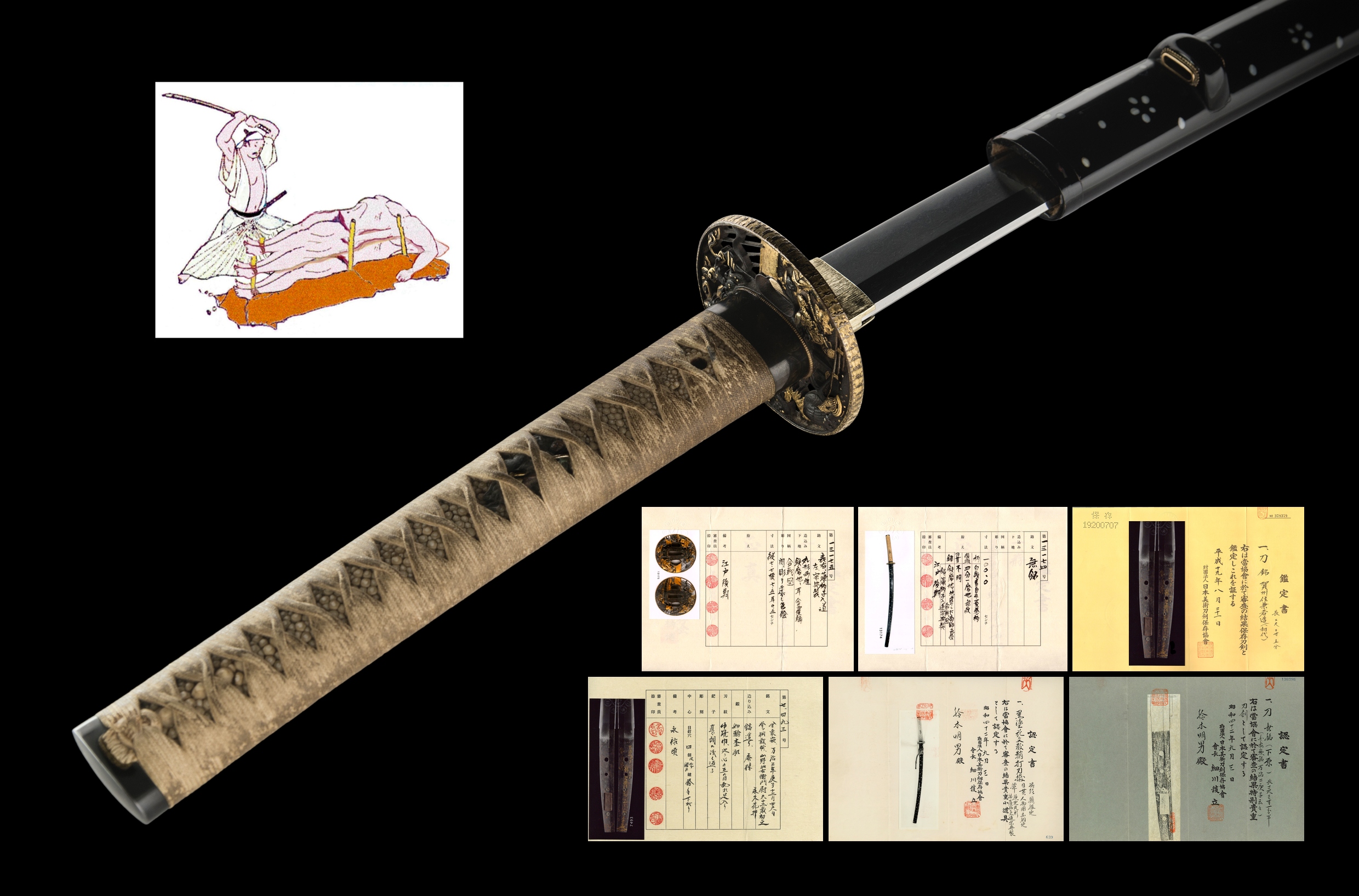
The Shitahara school traces its roots back five centuries to Chikashige, who worked in the Hachioji area of Musashi during the Daiei period. After the fall of their early patrons, the school became the official smiths of the Tokugawa family, producing swords and spears from the late Muromachi period through to the close of the Edo period. They were the only school working in what is now Tokyo prior to the 1600s, and earned a reputation for forging blades that samurai warriors could trust with their lives. This katana is attributed to Yasushige, eldest son of Chikashige and first generation of the name, who received the character “Yasu” as a gift from Hôjô Ujiyasu, third head of the Go-Hôjô clan. His prime working period falls squarely within the Eiroku era, circa 1558–1570.
The blade rewards close inspection. Characteristic shitahara-hada swirls across the surface — a compelling mix of mokume, itame and nagare-hada grain patterns that converge towards the central area of the blade, with gorgeous chocolatey chikei throughout. The hamon is a bright $1 with ko-notare undulation, pointed togari and well-defined ashi; impressive lines of kinsuji and brushed sunagashi thread through it for the full length of the blade in crisp nie-deki. The tip resolves into a lively kaen-boshi. The blade is an ô-suriage nakago, shortened from its original length during the late Muromachi to early Edo period; what remains of the tang retains a distinctive katte-sagari file pattern and a gaku-mei window, from which a spurious earlier signature was removed prior to resubmission to the NBTHK — which duly awarded Hozon certification attributing the blade to Shitahara Yasushige, a strong and accurate assessment.
Backing up the school’s wazamonô reputation, this katana carries a gold-inlaid tameshigiri inscription on the nakago recording that Yamano Ka’emon no Jô Nagahisa severed three stacked bodies in a single stroke on December 26th, 1660, when he was 62 years old. Nagahisa is the foremost name in Japanese sword testing, and it is notably rare for a Muromachi-period blade to bear his certification — the great majority of his tests were performed on early shintô blades from the 1600s. Accompanying the sword is a superb late Edo period koshirae centred on a celebrated Mogarashi Sôten tsuba — densely carved iron with gold inlay depicting warriors in combat and a phoenix in the lower left, certified by the NTHK-NPO. The silk braiding of the tsuka survives in beautifully preserved condition from the Edo period, and the habakiis gold foil over copper.
| Item Number | UJKA362 |
| Sword Type | Katana |
| Swordsmith | Attributed to Yasushige (mumei) |
| School | Shitahara |
| Province | Musashi (Tokyo) |
| Period | Sue-kotô, Late Muromachi period (Eiroku era: 1558-1570) |
| Nagasa | 70.3cm (ô-suriage) |
| Sori | 1.9cm |
| Moto-haba | 2.82cm |
| Weight | 660g |
| Nakago | Ô-suriage, katte-sagari yasurime, 2 mekugi-ana, gaku-mei window |
| Jihada | Mokume-hada mixed with itame and nagare-hada, abundant chikei |
| Hamon | Gunome-midare with ko-notare, togari, kinsuji, sunagashi and ashi, nie-deki |
| Boshi | Kaen-boshi |
| Certificates | NBTHK Hozon (sword); NBTHK Kichô and Tokubetsu Kichô (koshirae and sword); NTHK-NPO Kanteishô (koshirae and tsuba) |
| Fujishiro Rank | Chûjô-saku |
| Sharpness Rating | Wazamonô |
| Tameshigiri (JP) | (金象嵌)万治三庚子十二月廿六日 参ツ胴截断 山野加右衛門尉六拾三歳ニテ切之永久(花押) |
| Koshirae | Late Edo period uchigatana-koshirae, black lacquer with flying flowers pattern (NBTHK Kichô) |
| Tsuba | Mogarashi Sôten; iron, warriors in combat with phoenix motif, Ômi-bori style with gold inlay (NTHK-NPO Kanteishô) |
| Fuchi-kashira | Shibuchi |
| Menuki | Shôki (the demon queller) |
| Tsuka | Silk braiding, Edo period |
| Habaki | Gold foil over copper |
| Catalogue | Catalogue 44 |
| Status | Sold |
| Includes | Shirasaya, Edo koshirae, fabric bags, stand, kit, printed description |