
ITEM# UJKA477 – Catalogue 44 – Sold
A Ko-Mizuta Kunishige Katana (備中国呰部住大月又三郎国重作)
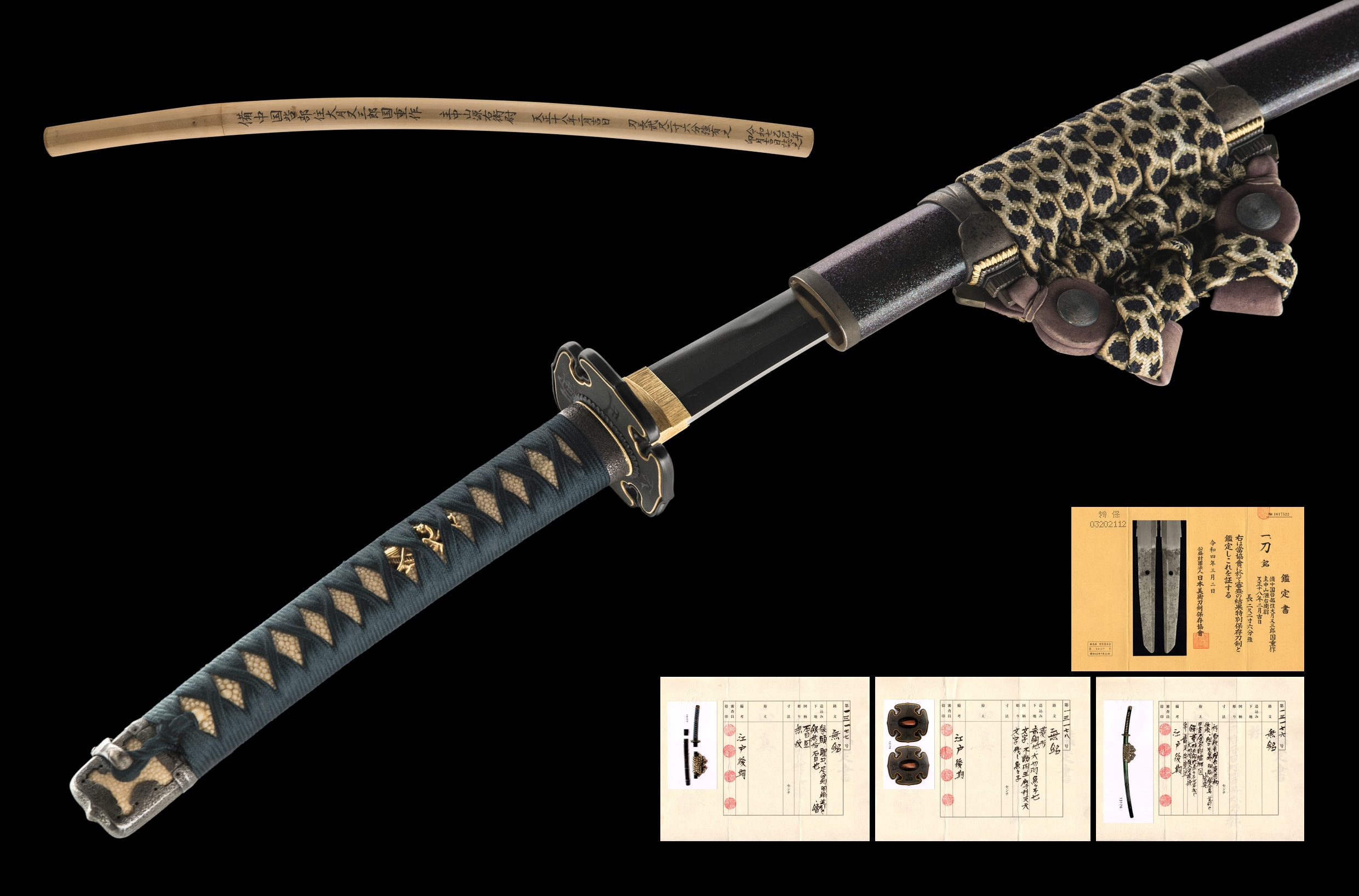
The Ko-Mizuta (古水田) school was founded when Kunishige (国重) of the Bingo Tatsufusa (備後辰房) school relocated to Bitchû province around the Eishô period (1504-1521). Their blades quickly earned a reputation among the warlords of the Chûgoku region – prized above all for their sharpness. The school flourished throughout the shintô period and produced many master smiths. Katana by the Ko-Mizuta school are exceptionally rare; only a handful survive, making this signed and dated example from the height of the Momoyama period an outstanding find.
This splendid blade was crafted by Sandai (third generation) Kunishige, whose secular name was Ôtsuki Sahyô, eldest son of the second generation. He initially worked in Bitchû Matsuyama before moving to Azae village in the second year of Tenshô. The nakago carries a full long signature identifying him as a resident of Azae in Bitchû province, and records that the sword was commissioned for Nakayama Gen’ue no Jô – almost certainly a vassal of a warlord from Bitchû – and dated to a lucky day in the second month of Tenshô 18 (February 1590). The well-forged, swirling mokume-hada with plentiful chikei gives this curvy blade an elegant, restless energy, and the gunome chôji-midare hamon – with its thick chôji at the base evolving into wispy flames and a tight ko-gunome crowded with falling yô (leaves) toward the tip – is a display of considerable technical mastery.
The late Edo tachi koshirae (銀無垢石目地皆具太刀拵) is presented with fully matching silver fittings throughout. The iron tsuba in aoi-gata shape – bearing the inscription of Fudo Myô-ô (不動明王) on the obverse and Marishiten on the reverse – was crafted by Ô-oka Tadatoshi, a student of Ôoka Masatoshi, official craftsman of the Owari Tokugawa family, and carries both NBTHK Tokubetsu Hozon and NTHK-NPO Kanteishô. The fuchi-kashira, with its distinctive sarude (monkey hand) motif in silver, is attributed to a Tachi Kanagu-shi of the same late Edo period. Gold praying mantis menuki – the kamakiri, an emblem of the weak challenging the strong – sit beneath the teal braided tsuka. A fine ensemble by any measure, and a rare survivor of Momoyama-period workmanship at its most purposeful.
| Item Number | UJKA477 |
| Sword Type | Katana |
| Swordsmith | Kunishige (Ôtsuki Matasaburô, third generation, Ko-Mizuta school) |
| Swordsmith (JP) | 大月又三郎国重 |
| Signature | Bitchû no kuni Azae-jû Ôtsuki Matasaburô Kunishige saku / Shu Nakayama Gen’ue no Jô / Tenshô jûhachinen nigatsu kichijitsu |
| Date | Tenshô 18 (February 1590) |
| School | Ko-Mizuta (古水田) |
| Province | Bitchû |
| Period | Sue-Kotô – Momoyama period (Tenshô era: February 1590) |
| Nagasa | 68.6cm (ubu) |
| Sori | 1.8cm |
| Moto-haba | 3.04cm |
| Weight | 695g |
| Nakago | Ubu (original, unaltered tang); katte-sagari-yasurime (slanting file marks); 1 mekugi-ana; nakago length 17.8cm |
| Jihada | Well-forged mokume-hada mixed with itame, with plentiful chikei |
| Hamon | Gunome chôji-midare mixed with yô and long ashi; thick chôji at base, evolving to ko-gunome with yô toward the monouchi |
| Certificates | NBTHK Tokubetsu Hozon (sword and tsuba); NTHK-NPO Kanteishô (koshirae, tsuba and soroi kanagu) |
| Sayagaki | Kanzan-sensei (Dr. Satô Kanzan) |
| Koshirae | Ginmuku ishime-ji kaigu tachi-koshirae (銀無垢石目地皆具太刀拵); tachi-koshirae with fully matching silver fittings; late Edo period (1780-1868); NTHK-NPO Kanteishô |
| Tsuba | By Ô-oka Tadatoshi (student of Ôoka Masatoshi, Owari Tokugawa craftsman); iron, aoi-gata shape; Fudo Myô-ô inscription (obverse), Marishiten inscription (reverse); NBTHK Tokubetsu Hozon; NTHK-NPO Kanteishô |
| Fuchi-kashira | Attributed to Tachi Kanagu-shi; sarude (monkey hand) motif; matching silver; late Edo period (1780-1868) |
| Menuki | Kamakiri (praying mantis); gold |
| Habaki | Gold nijû-habaki with file marks |
| Catalogue | Catalogue 44 |
| Status | Sold |
| Includes | Shirasaya, Edo tachi koshirae, fabric bags, stand, kit, printed description |