
ITEM# UJWA173 – Catalogue 44 – Sold
A Hankei Wakizashi (繁慶)
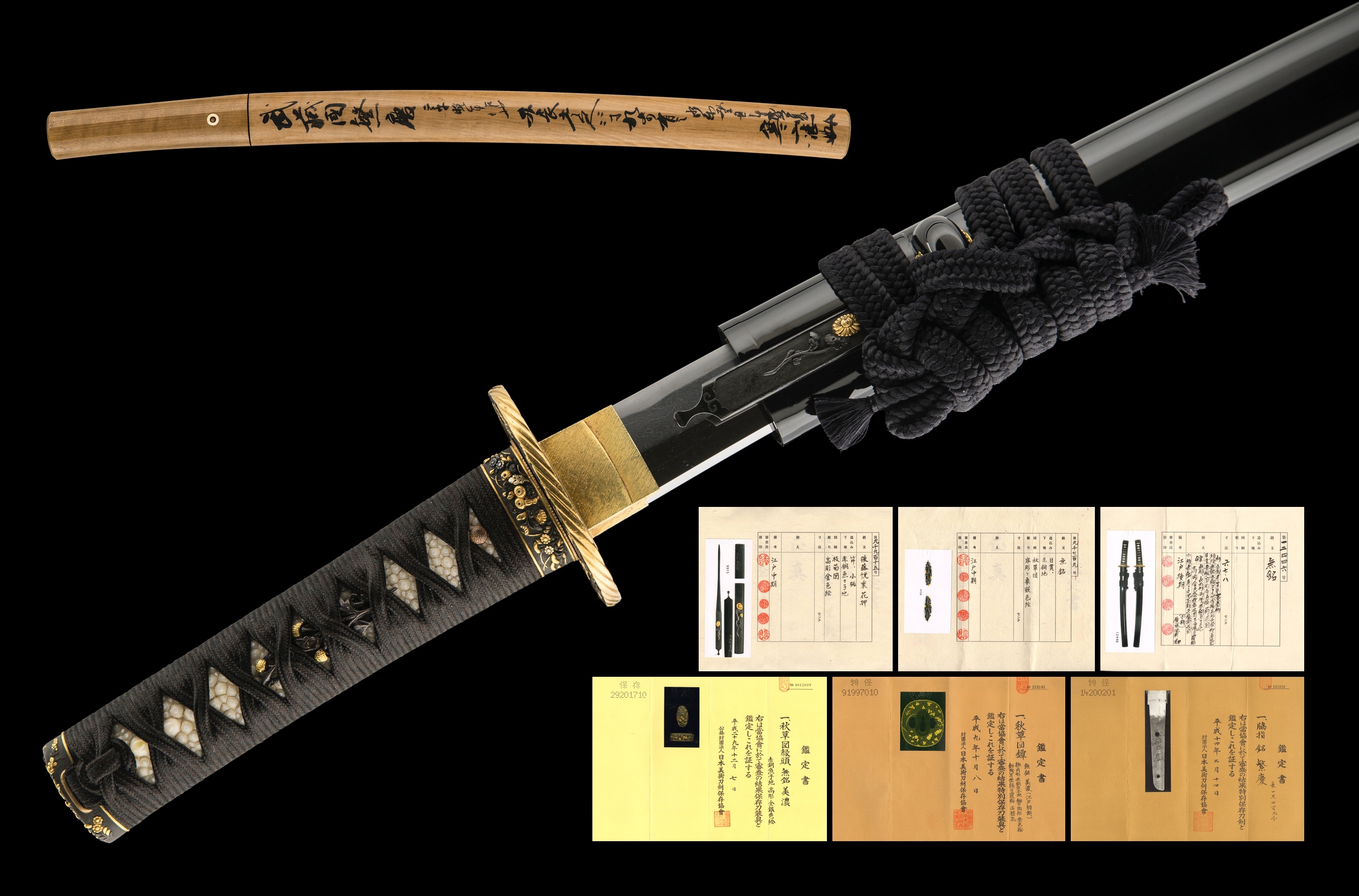
Grandmaster swordsmith Hankei was born Noda Zenshirô Kiyotaka in Mikawa province. He began his career as a gunsmith in service to the Tokugawa family, with shogun Tokugawa Ieyasu having provided him with charcoal in the amount of 1,000 hyô every year. Following the death of Ieyasu in 1616, Hankei relocated to Edo and transitioned to the art of sword making – a career shift that established him, alongside first generation Yasutsugu, as one of the premier swordsmiths of Edo and the shintô period.
While historical accounts have sometimes cited Masamune as Hankei’s stylistic inspiration, careful examination of his surviving works indicates he more closely resembles the style of Norishige, Masamune’s star student. This is nowhere more evident than in the jihada of this wakizashi, where a spectacular ô-hada surges with plentiful chikei. The hamon is a gleaming thick suguha mixed with wavy notare in nie-deki, alive with kinsuji, sunagashi, and long ashi – an unmistakable signature of Hankei’s genius. The nakago carries the “ro-mata” form of his signature, associated with his prime working years.
The sword is accompanied by a magnificent chiisagatana-koshirae of the late Edo period, dressed throughout in an autumn theme. The tsuba is a certified NBTHK Tokubetsu Hozon work attributed to the Mino school, its shakudô surface alive with gold autumn flowers and foliage. The fuchi-kashira, certified NBTHK Hozon, continue the theme in shakudô with nanako ground and gold and silver accents. The kozuka and kogai set, signed by Gotô Etsujô, depicts a chrysanthemum theme – a fitting complement to this extraordinary ensemble. Authentication is by sayagaki of the late great Kanzan-sensei (Dr. Satô Kanzan), one of the most revered sword scholars of the 20th century.
| Item Number | UJWA173 |
| Sword Type | Wakizashi |
| Swordsmith | Hankei (shodai, first generation) |
| Swordsmith (JP) | 繁慶 (初代) |
| Signature | Hankei (ro-mata style) |
| School | Edo school |
| Province | Musashi (Edo) |
| Period | Shinto – Early Edo period (Genna era: 1615~1624) |
| Nagasa | 45.2 cm |
| Sori | 0.6 cm |
| Moto-haba | 3.0 cm |
| Saki-haba | 2.2 cm |
| Kissaki | 3.77 cm |
| Moto-kasane | 6.8 mm |
| Saki-kasane | 5.0 mm |
| Nakago | 13.5 cm |
| Nakago | Ubu; o-sujikai-yasurime; 2 mekugi-ana (one filled) |
| Weight | 490 g |
| Jihada | Rich o-hada mixed with mokume with plentiful chikei |
| Hamon | Suguha mixed with notare in nie-deki, with kinsuji, sunagashi and ashi |
| Habaki | Gold habaki with rainfall file marks |
| Certificates | NBTHK Tokubetsu Hozon (sword and tsuba); NBTHK Hozon (fuchi-kashira); NTHK-NPO Yushusaku (sword); NTHK-NPO Kanteisho (koshirae, menuki, kogai/kozuka) |
| Fujishiro Rank | Saijo-saku (grandmaster swordsmith) |
| Sayagaki | Kanzan-sensei (Dr. Sato Kanzan) — Musashi no kuni Hankei, niji bannen saku nari, dated Showa 48 (1973) |
| Koshirae | Chiisagatana-koshirae; kuro-ro-nuri saya (black glossy lacquer); Late Edo period (1780~1868); NTHK-NPO Kanteisho certified |
| Tsuba | Mino school (Edo-shoki, early 1600s); autumn leaves design; shakudo with nanako ground, relief, gold accents, raised rim with golden rope-style trimming, two hitsu-ana; mumei; NBTHK Tokubetsu Hozon |
| Fuchi-kashira | Mino school; autumn leaves design; shakudo with nanako ground, relief, gold and silver accents; mumei; NBTHK Hozon |
| Menuki | Mino school (Middle Edo period, 1700s); autumn leaves theme; NTHK-NPO Kanteisho certified |
| Kozuka | Signed Goto Etsujô + kao; chrysanthemum theme; NTHK-NPO Kanteisho certified (as kogai/kozuka set) |
| Catalogue | Catalogue 44 |
| Status | Sold |
| Includes | Shirasaya with Kanzan-sensei sayagaki, custom chiisagatana-koshirae, fabric bags, stand, kit, printed description |