
ITEM# UJKA461 – Catalogue 44 – Sold
A Sandai Kanewaka Tameshigiri Katana (賀州住兼若)
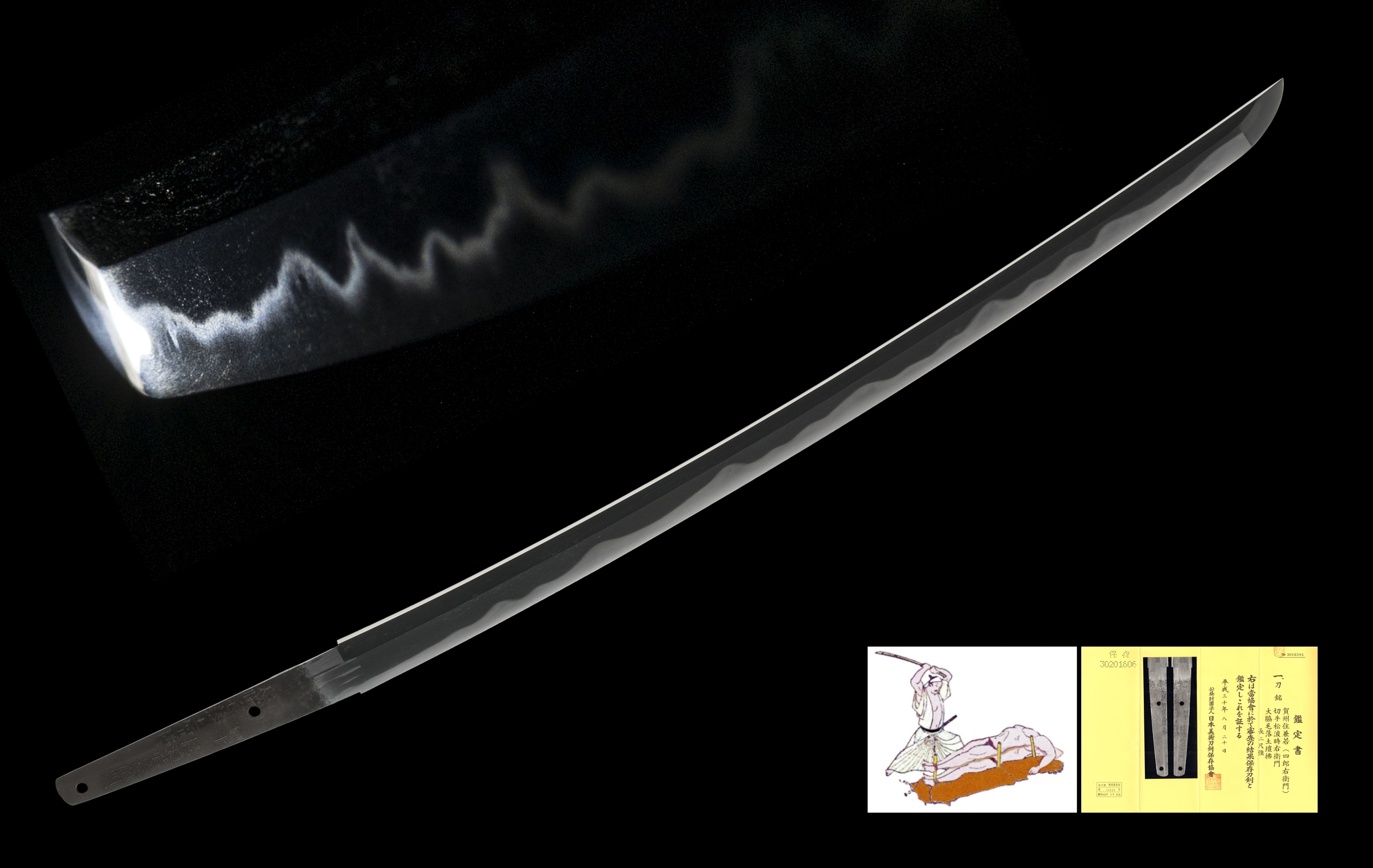
The Kanewaka family were among the most celebrated smiths of the Edo period, forging in Kaga province under the patronage of the powerful Maeda Daimyô clan. The family’s prestige was such that the first generation was dubbed Kaga Masamune – a tribute of the highest order. This wide and splendidly sharp katana was made by the third generation, Tsujimura Shirô’emon Kanewaka, who succeeded as head of the family in 1677 following his father’s death, and led it with distinction until his own death in May 1711. Rated jô-saku by Fujishiro, he is rightfully regarded as a superior swordsmith.
The blade commands immediate attention through its energetic gunome-midare hamon – a bright, pulsating ridge of peaks and valleys that brings an awe-inspiring mountain range to mind. Within the hamon, a distinctive pattern called kanitsume (“crab claws”) appears in the upper cutting zone, and togari spikes add further intensity throughout. The jihada is a well-forged blend of itame and masame with lively chikei, while the tip resolves into a fine midare-komi boshi with a modest kaeri. From every angle, this sword radiates health and vibrancy – a well-deserved Tokubetsu Hozon result.
Adding considerable historical weight to this blade, sword tester Matsunami Toki’emon – a vassal of the Kaga domain who worked primarily during the Enpô era – performed a tameshigiri cutting test, severing through a human body at the armpit level and directly into the earthen mound below. The full inscription of this test remains on the nakago reverse, alongside a hikae-mekugi-ana (extra peg hole) added for reinforcement during the test. The original torokusho (registration card), issued by Ishikawa prefecture in 1969, accompanies the sword and suggests this blade was cared for by Kaga-area samurai families for some three hundred years before registration.
| Item Number | UJKA461 |
| Sword Type | Katana |
| Swordsmith | Sandai Kanewaka (Tsujimura Shirô’emon) |
| Swordsmith (JP) | 賀州住兼若(四郎右衛門) |
| Signature | Gashû-jû Kanewaka (Shirô’emon) |
| School | Kanewaka |
| Province | Kaga |
| Period | Shintô – Early Edo period (Enpô era: 1673-1681) |
| Nagasa | 60.7cm (ubu) |
| Sori | 1.20cm |
| Moto-haba | 3.04cm |
| Weight | 615g |
| Nakago | Ubu, sujikai-yasurime, 16.8cm, 2 mekugi-ana (including hikae-mekugi-ana) |
| Jihada | Well-forged itame-hada and masame-hada with chikei |
| Hamon | Gunome-midare with wide yaki, kanitsume, togari and midare-komi; ôsaka yakidashi at base; shining ji-nie |
| Boshi | Midare-komi with modest kaeri |
| Certificates | NBTHK Tokubetsu Hozon |
| Fujishiro Rank | Jô-saku |
| Tameshigiri (JP) | 大脇毛落土壇拂 切手松波時右衛門 |
| Habaki | Gold habaki with Kaga-yasuri design |
| Catalogue | Catalogue 44 |
| Status | Sold |
| Includes | Shirasaya, fabric bag, stand, kit, printed description, original torokusho |