
ITEM# UJKA440 – Catalogue 44 – Sold
An Echizen Seki Tameshigiri Katana (越前関)
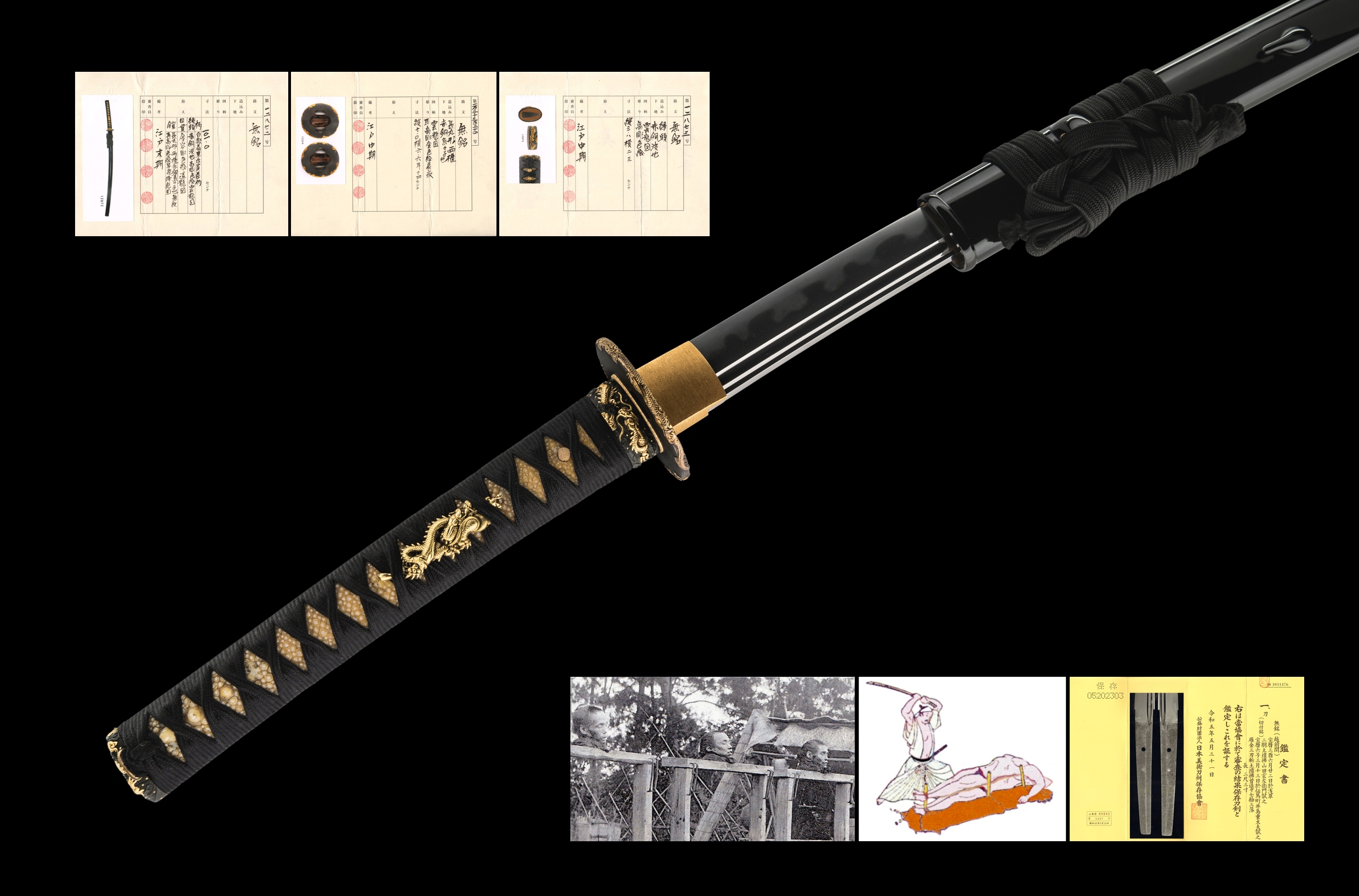
In the late 16th century, Echizen province was conquered by Oda Nobunaga and later developed on a grand scale under Shibata Katsuie, drawing swordsmiths from Ômi, Yamashiro, Mino and elsewhere. The group that migrated from Seki city of Mino province — modern-day Gifu prefecture — became formally known as the Echizen Seki school, and this remarkable shintô katana carries their attribution. The blade is ubu: the original, unaltered tang survives intact, which is a particularly welcome feature on a sword of this character. A full-length bo-higroove runs the length of the blade, aiding its cutting performance and contributing to its clean, purposeful lines.
Placing the sword under the light explains immediately why this blade commands attention. The hamon is a spectacular wide ô-gunome midare that swells the full width of the body into dramatic dove-tail formations known as yahazu-ba — a reference to the notched nock of an arrow. The effect is deeply energetic, and it harmonises beautifully with the dragon-and-wave theme running through every element of the koshirae. The steel itself is well-forged itame-hada with areas of nagare-hada, displaying a darkish, characterful tone with fine chikei activity throughout.
It is the tameshigiri record, however, that truly sets this katana apart. Two separate cutting-test inscriptions are chiselled onto the nakago. The first records that on June 22, 1753, Yamada Genzaemon tested the blade in Asakusa by severing through two bodies in one stroke and into the earthen mound below. Then, on March 13, 1756, Ijima Jûdayû tested it at Denmachô prison by cutting three times through a body at the height of the armpits and into the mound below — and then proceeded to execute a further 73 prisoners, severing their heads one after another. Scholar Markus Sesko, on translating this record, noted it was the first time he had seen a cutting test performed on so many heads. The accompanying late Edo period koshirae is a cohesive dragon-themed ensemble: the tsuba is attributed to the prestigious Yoshioka Inaba no Suke family — official craftsmen of the Tokugawa shogunate — in shakudô with nanako ground and gold-accented cloud dragon rim; the fuchi-kashira is attributed to Yanagawa Naotsune in the same spirit; and gold crawling dragon menuki complete the set. The saya is lacquered in a deep, glossy kuro-roiro-nuri black.
| Item Number | UJKA440 |
| Sword Type | Katana |
| Attribution | Echizen Seki school |
| School | Echizen Seki |
| Province | Echizen |
| Period | Shintô, Edo period (Hôreki era: 1751-1753) |
| Nagasa | 69.7cm (ubu) |
| Sori | 1.5cm |
| Moto-haba | 2.93cm |
| Weight | 705g |
| Nakago | Ubu, katte-sagari yasurime, 1 mekugi-ana |
| Jihada | Itame-hada with nagare-hada, darkish steel, chikei |
| Hamon | Ô-gunome midare with wide yaki, yahazu-ba and ashi, nie-deki |
| Certificates | NBTHK Hozon (sword); NTHK-NPO Kanteishô (koshirae, fuchi-kashira and tsuba) |
| Tameshigiri (JP) | 宝暦三酉六月廿二日於浅草二胴土壇拂山田玄左衛門試之 / 宝暦六子三月十三日於伝馬町井島重太夫試之雁金三刃斬土壇拂首追々七拾三落 |
| Koshirae | Late Edo period (1780-1868) kuro-roiro-nuri saya uchigatana-koshirae, glossy black lacquer (NTHK-NPO Kanteishô) |
| Tsuba | Attributed to Yoshioka Inaba no Suke family; shakudô with nanako ground, cloud dragon motif with gold colour accents on rim (NTHK-NPO Kanteishô) |
| Fuchi-kashira | Attributed to Yanagawa Naotsune; shakudô, cloud dragon motif in relief with gold colour accents (NTHK-NPO Kanteishô) |
| Menuki | Gold crawling dragon |
| Tsuka | Black silk braiding over aged white samekawa (ray skin) |
| Habaki | Gold with horizontal file marks |
| Catalogue | Catalogue 44 |
| Status | Sold |
| Includes | Shirasaya, dragon koshirae, fabric bags, stand, kit, printed description |