
⇩ Download Catalogue 36 (150MB)
Free to download. 209 pages. All swords in this catalogue are sold.
Index of Swords
Opening Remarks
Hello everyone,
I hope you are all in fine spirits. Well, 2021 has been an eventful year thus far. At the end of January, Donna and I contracted Covid-19 and spent much of February regaining our energy levels. I had a strange vinegar taste and smell that took a while to shake off; Donna had more of a persistent tickling cough. We had prepared ourselves for this possibility by eating well, getting good rest, going for walks, and taking daily cold showers in the morning — well, only I do that! The old adage that the best defence is a good offence. It all helped, and we have both essentially recovered. Then on March 4th I hit 50 years of age — ouch! No matter what anyone says, this is a big year mentally. I shall strive to keep healthy, enjoy family and friends, and serve you all with evermore love and appreciation.
Ten swords make up Catalogue 36, and each one of them means business. No weak swords here, my friends. I think that with all this ‘be scared’ narrative that the media tends to project on us, I am fighting back with collectible swords that marry exquisite form with serious function. When a sword calls your name, reach out to me to claim it.
We start off with a katana by jô-saku swordsmith Kiyomitsu from Etchû province, crafted during the mid-1600s. This handsome blade features a bright chû-suguha with the unique Yamato-den characteristic of kuichigaiba. Its antique koshirae carries a message of personal rebirth through the fiery phoenix, and the value of perseverance via the four gentlemen depicted on the tsuba. A wise and inspirational sword that resonates particularly well today.
Tantô crafted during the Shintô period (1600–1780) are extremely rare. Crafted by Hizen maestro shôdai Masahiro, the next sword features a magnificent gunome-chôji-midare hamon over a tightly forged konuka-hada. It is housed in a gorgeous matching wave-themed late Edo period koshirae with a tsuka wrapped in baleen — a mark of the high social status of the samurai it once belonged to. Don’t miss this chance.
Sword number three is a powerful and prized Jûyô Tôken katana by Rai Kuniyasu, originally from Yamashiro province (Kyôtô), who founded the Chiyozuru school in beautiful Echizen province in 1337. Its wide mihaba extending the full length of the blade, combined with a substantial koshizori, gives an overall sense of grandeur. The jigane carries a mysteriously dark tone with a beaming suguha hamon ready for action — a healthy katana approaching 700 years of age that is ripe for collectability.
The next piece is a meaty katana by Katsubei Kunishige, the final working smith of the Mizuta school’s Ôtsuki branch. The aggressive hamon exudes a grittiness rich in sunagashi and kinsuji that can best be described as Mizuta-Sôshû. The new caretaker will be given the option to select the lacquer finish on the custom scabbard we will build for the sword — a personal touch for a terrific samurai sword.
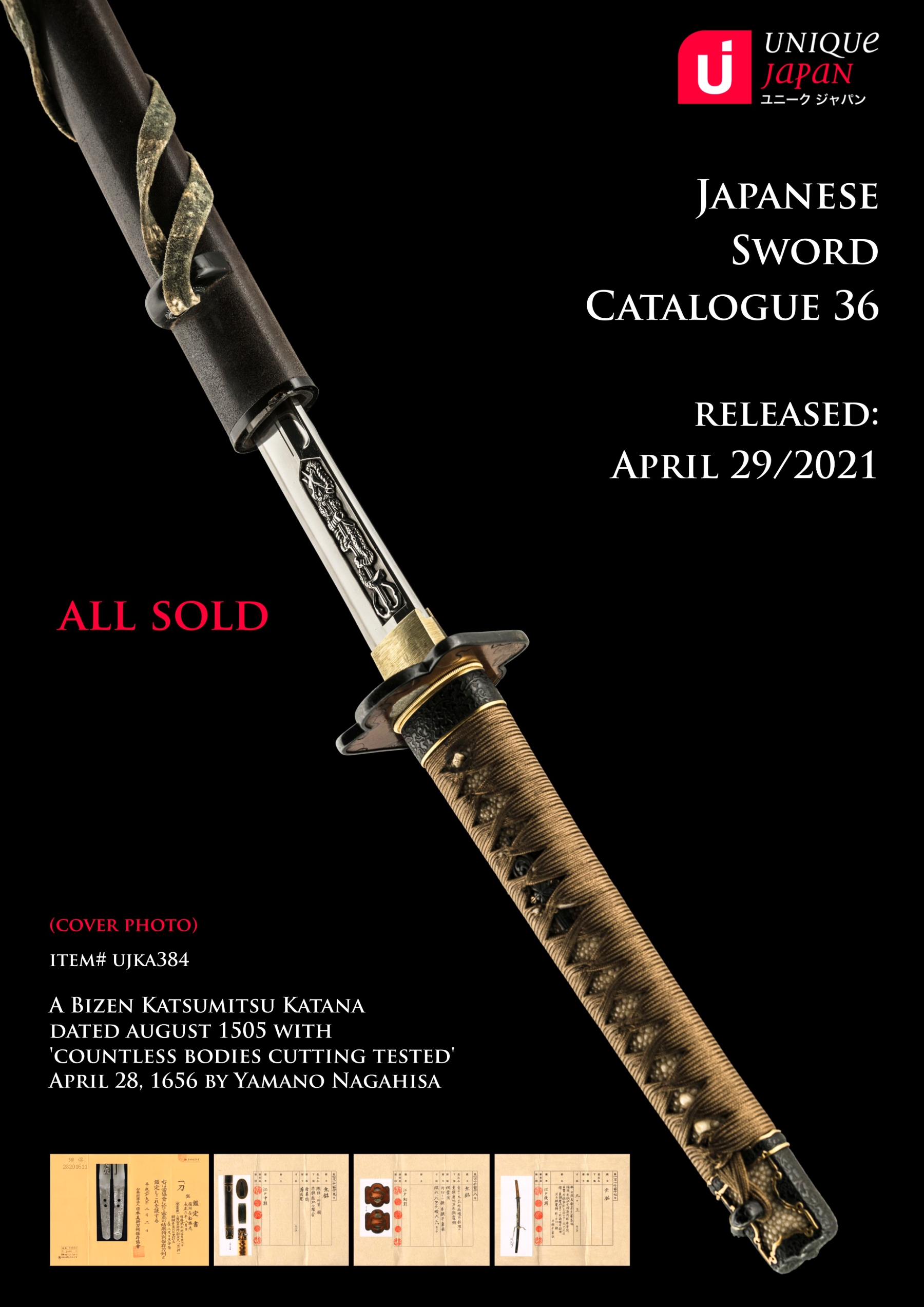
A fearless katana signed and dated to August 1505 by Bizen Katsumitsu is the sword featured on the cover of this catalogue. On April 28, 1656, master sword tester Yamano Ka’emon no Jô Nagahisa severed through countless bodies with ease using this very blade. It features a bright suguha hamon with razor-like ko-ashi and illuminating midare-utsuri, housed in a splendid handachi koshirae with matching late Edo period fittings. A super sharp and wickedly rare tameshigiri sword that takes no prisoners.
For those seeking a Kamakura period classic, look to the Jûyô Tôken ô-wakizashi attributed to the famed Fukuoka-Ichimonji school, circa mid-1200s. The NTHK-NPO took the attribution a step further to Ichimonji Norifusa — a national treasure swordsmith. The sword features a beautiful swirling itame-hada overlaid with midare-utsuri and an icy blue jigane. Holding it quietly under the light captures both heart and imagination.
The following sword switches gears to June 1995 with a faithful Bizen utsushi of maestro Minamoto Kiyomaro by Akamatsu Tarô Kanetsugu. It is a big, healthy sword with a huge kissaki and an attractive spider tsuba koshirae. The final available sword is a wakizashi crafted by shôdai Tadayuki, who worked in Bungo province during the Hôei era (1704–1711), housed in a unique 300-year-old inrô-kizami koshirae. The last two entries are sold reference pieces: a superstar Hizen Yukihiro katana and a splendid Shinshintô cutting-test katana by Fujishima Tomoshige.
Thank you as always for your genuine support and passion for life. We look forward to serving you.
Warm regards,
Pablo Kuntz
April 2021