
ITEM# UJKA384 – Catalogue 36 – Sold
A Katsumitsu Tameshigiri Katana (備州長船勝光)
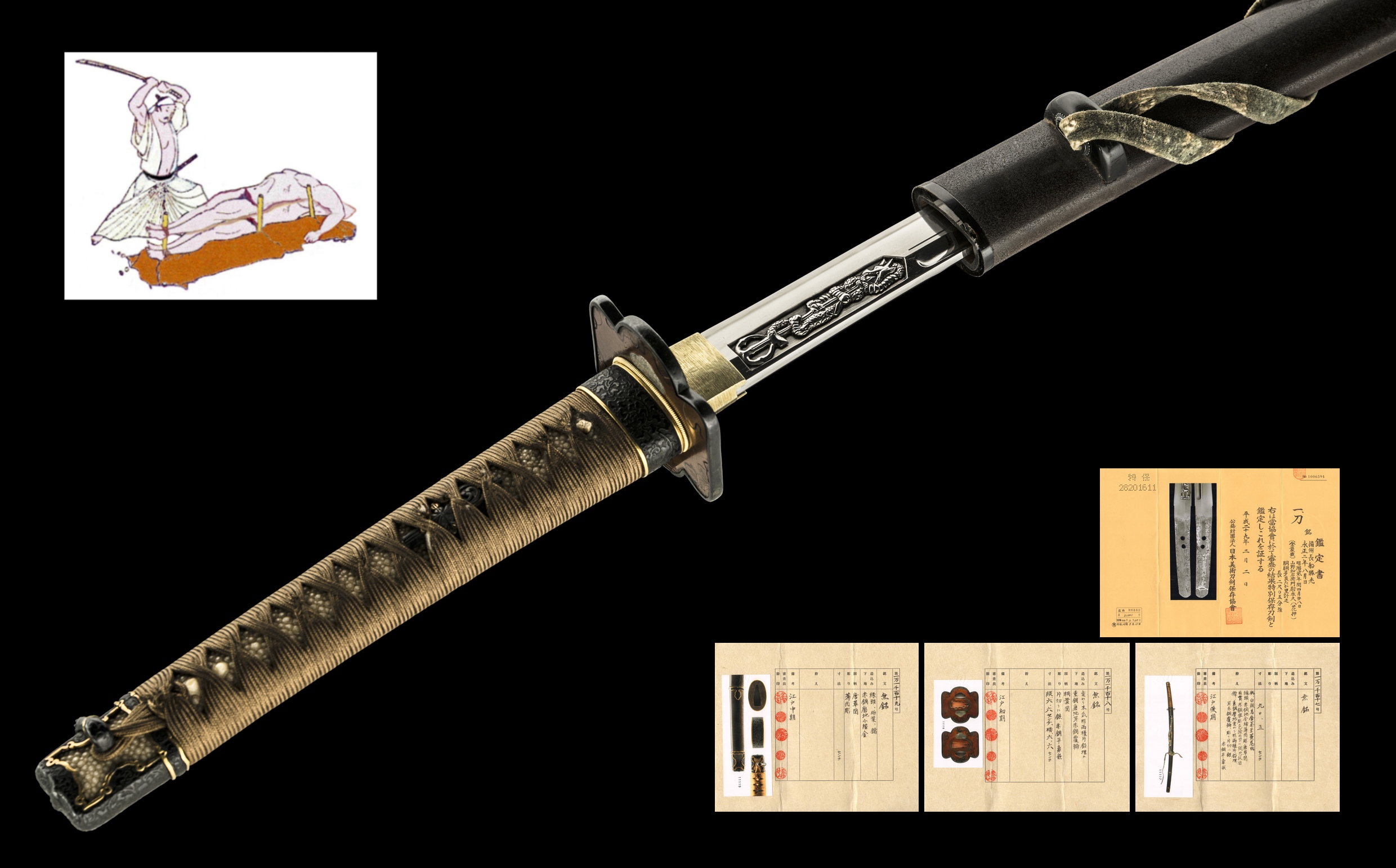
The Katsumitsu family of smiths from Bizen province began in the Ôei era (1394-1428) after the vicious Nambokucho period came to an end. Just after the sengoku jidai (the warring states period) broke out with the Onin war in 1467, 4th generation Katsumitsu took centre stage in 1487 and elevated the school to new heights. This fearless katana is signed and dated to August 1505, during the 2nd year of the Eishô era (1504-1521), placing it squarely with 5th generation Bizen no Kuni-jû Osafune Jirôzaemon no Jô Katsumitsu, who flourished throughout the Eishô era. Jirôzaemon Katsumitsu is ranked saijô-saku (grandmaster) and ô-wazamono for the extraordinary sharpness of his blades. The nakago features a beautifully carved kenmaki-ryû horimono – a dragon winding around a sword – which Katsumitsu is known to have incorporated, and which serves here as a fitting emblem of what this blade is capable of.
What makes this katana extraordinary is the gold-inlaid cutting test inscription on the reverse of the nakago. On the 28th day of the 4th intercalary month of Meireki 2 (April 28, 1656), master sword tester Yamano Ka’emon no Jô Nagahisa severed through countless bodies with ease – a result so rare that sword testing expert Markus Sesko, author of Tameshigiri – The History and Development of Japanese Sword Testing, confirmed he had not encountered a similar inscription. Single and double body cutting tests exist, but a blade that explicitly records it severed through numerous bodies without hesitation speaks to a level of sharpness that is almost beyond reckoning. There is sharp, and then there is sharp.
The blade itself is everything you’d expect: a bright suguha hamon with razor-like ko-ashi vibrating along the edge, vivid midare-utsuri – the iconic shadow hamon of the Bizen tradition – and a wicked line of kinsuji wrapping itself around the apex of the soe-bi. The sword is further housed in a splendid Late Edo period handachi koshirae, lacquered brown in cha-ishime-ji-nuri finish with a complete matching set of soroi-kanagu fittings attributed to the Mino school, all certified by the NTHK-NPO. The kashira features sculpted hands clasped in a gesture of mercy, with karakusa vine designs symbolising health and longevity – a profound counterpoint to the blade’s history of lethal efficiency. Authenticated by sayagaki on both sides of the shirasaya, written by both Kanzan Satô and Tanobe Michihiro.
| Item Number | UJKA384 |
| Sword Type | Katana |
| Swordsmith | Bishû Osafune Katsumitsu |
| Swordsmith (JP) | 備州長船勝光 |
| Signature | Bishû Osafune Katsumitsu |
| Date | Eishô 2 (August 1505) |
| School | Osafune, Bizen |
| Province | Bisshû (Okayama prefecture) |
| Period | Sue-Kotô · Late Muromachi (Eishô era: 1504-1521) |
| Nagasa | 62.3cm (ubu-nakago) |
| Sori | 1.5cm |
| Moto-haba | 2.66cm |
| Weight | 440g |
| Nakago | Ubu (original, unaltered tang), 14.0cm, 1 mekugi-ana. Kenmaki-ryû horimono (dragon engraving). |
| Jihada | Ko-itame hada with chikei and vibrant midare-utsuri |
| Hamon | Bright suguha with kinsuji and ko-ashi |
| Boshi | Ko-maru |
| Certificates | NBTHK Tokubetsu Hozon (issued Heisei 29, February 2017); NTHK-NPO Kanteisho (koshirae); NTHK-NPO Kanteisho (soroi-kanagu); NTHK-NPO Kanteisho (tsuba) |
| Fujishiro Rank | Saijô-saku (Jirôzaemon ranked as a grandmaster swordsmith) |
| Sharpness Rating | Ô-wazamono (highest sharpness rating) |
| Sayagaki | Kanzan (Satô Kanzan) – on one side of the shirasaya, undated / Tanobe Michihiro (Tanzan-sensei) – Bizen no Kuni Osafune Katsumitsu, dated Year of the Dog, June 2018 (Heisei 30) |
| Tameshigiri (JP) | (金象嵌)明暦貮年閏四月廿八日 山野加右衛門尉永久(花押) 胴胴多良たか里計之 |
| Koshirae | Late Edo period handachi-koshirae (1780-1867); soroi-kanagu-tsuki cha-ishime-ji-nuri saya; brown lacquered scabbard with stone-like surface and matching set of fittings attributed to the Mino school, certified NTHK-NPO |
| Tsuba | Rare polished copper mokko (lobe) shaped tsuba with shakudo rim; paulownia leaf motif; early Edo period (circa 1600-1700); certified NTHK-NPO |
| Fuchi-kashira | Polished shakudo with gold trim; kashira with sculpted clasped hands and karakusa (vine) design; attributed Mino school, Mid-Edo period; certified NTHK-NPO |
| Menuki | Kiri (paulownia) and tomoe symbol combination |
| Habaki | Gold habaki with horizontal file marks |
| Catalogue | Catalogue 36 |
| Status | Sold |
| Includes | Shirasaya, Edo period koshirae, fabric bags, stand, kit, booklet, description |