
⇩ Download Catalogue 38 (195MB)
Free to download. 352 pages. All swords in this catalogue are sold.
Index of Swords
Opening Remarks
Thank you as always for downloading the Unique Japan sword catalogue. I would like to dedicate this catalogue to my wife Donna. Tomorrow, July 9th, marks our 20th wedding anniversary. We actually got married in Tokyo, at the local Minato-ku ward office — just the two of us, with no witnesses apart from the people working at the desk. It was cute and perfect. We rode off on my 90cc Honda scooter from the rather dreary-looking office building, full of hopes and dreams. Now, with three great kids, we have many chapters ahead. I love you, babe.
Catalogue 38 is our biggest to date, with fifteen pieces inside including three tantôs. We start off with an exceptional katana by third generation Shirô’emon Kanewaka. The family’s trademark hako-midare with plentiful kinsuji can be thoroughly enjoyed, and the sword comes with an elegant, fully matching Edo period koshirae attributed to the Kumagai school in Higo province. The following piece is a slender, shortened tachi crafted by Ryôkai over 700 years ago. The hamon features an eclectic mix of suguha with ko-gunome and ko-chôji, and plenty of ko-ashi, kinsuji, and sunagashi. It comes with a gorgeous aoi-gai uchigatana koshirae from the Edo period that shines like bright stars in the night sky.
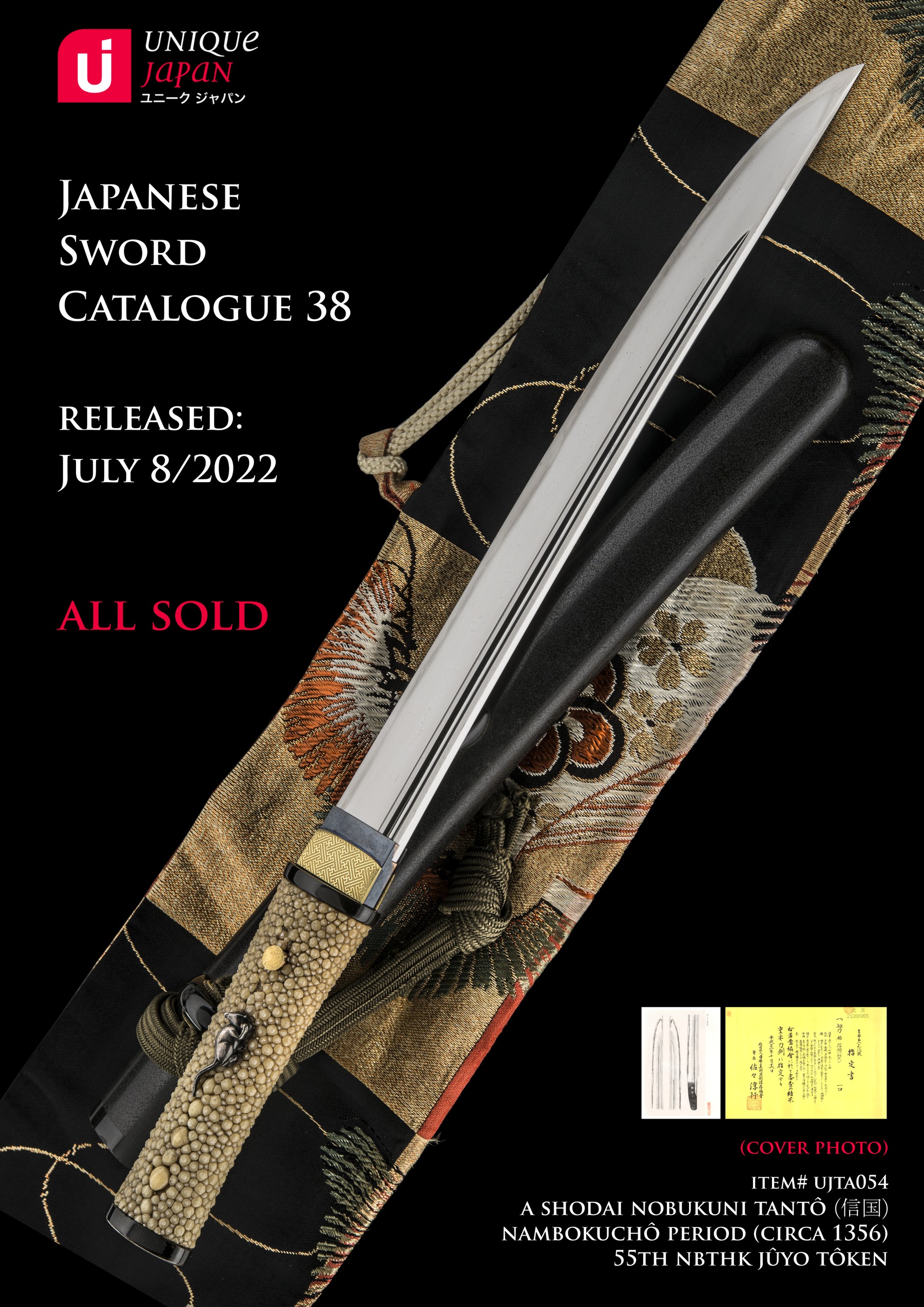
The third sword is a Jûyô Tôken masterpiece by first generation Nobukuni — a signed, museum-worthy tantô that is simply spectacular. It is an important reference piece that unifies the Nambokuchô period in its wide commanding shape and horimono, the Ryôkai lineage via its nagare-hada within the Rai school, and the eye-catching Sôshû qualities of kinsuji and sunagashi inherited from his sensei Sadamune. It is housed in a beautiful aikuchi-koshirae. Next is a katana crafted in August 1850 by Masatsugu showing a strong Yamashiro-den influence, forged in a bright chû-suguha with a wonderful amount of channelling chikei. Its Edo period koshirae combines the beauty of aoi-gai with muscular iron fittings bearing a silver arabesque design.
We travel back to the Nambokuchô period for the next two swords. First is a powerful katana by Nakajima-Rai with a vicious character — a wide blade with slight curvature giving it a brutal stabbing temperament, housed in a handsome matching antique handachi-koshirae. Following it is a glorious tantô by Bitchû no Kuni jû Tsuguyoshi, considered the finest swordsmith of the Chû-Aoe school. Beautifully forged in itame and mokume-hada with a snow-white hamon glistening with ji-nie, it is accompanied by a spectacular aikuchi-koshirae with matching silver fittings in a rolling wave theme signed by metalsmith Anjû.
Morihiro, son of Rai Kuniyasu, who worked at the very start of the Muromachi period, provides the following katana. The swirling chikei is breathtaking on this sword. Rare gold-inlaid characters on the nakago state that this katana has been handed down from one generation to the next — an ancestral sword most worthy of collecting and preserving. For those who love dragons and extra sharpness, the wakizashi by saijô-ôwazamono swordsmith Miyoshi Nagamichi is worth checking out seriously. Nicknamed Aizu-Kotetsu, some of his masterworks rivalled that of grandmaster Kotetsu himself. Our ninth sword is a rare tachi by Bizen Osafune Ietsugu, signed and dated to August 1408. The jihada has deep swells of nagare-hada bordering on ayasugi-hada, and comes with a beautiful koshirae that rejoices in the natural world with flowers, spiders, ants, and aged wood.
The third tantô in the catalogue is a marvellous piece by the Ko-Gassan school featuring a dazzling display of ayasugi-hada. Its exquisite aikuchi-koshirae pays tribute to the Yamabushi mountain monks and contains a base layer of rare kinkarakawa decorated leather — a crafting technique that originated with the Medici family in Italy circa the 1400s — further decorated with the Chiba family kamon depicting a moon and star. The final available sword is an extra-long, freshly polished katana by Masamori of the famed Hosokawa family of smiths. Battle-ready since the autumn of 1862 for the Tsuyama domain of the Matsudaira shôgunate, its handsome koshirae showcases prosperous koi (carp), a nature scene of bees pollinating a sakura tree by the Ishiguro school, and menuki depictions of bow and arrows.
The last three reference pieces comprise a superb Naoe-Shizu custom daishô koshirae with a rabbit and moon theme produced by Unique Japan, a ‘No Enemy’ katana by maestro Koyama Munetsugu with custom koshirae, and an excellent Muromachi period katana by Wakasa Tsuguhiro.
Thank you as always for your genuine support and passion for life. We look forward to serving you. Have a great summer!
Warm regards,
Pablo Kuntz
July 2022