
ITEM# UJKA408 – Catalogue 38 – Sold
A Tsuguhiro Katana (次広)
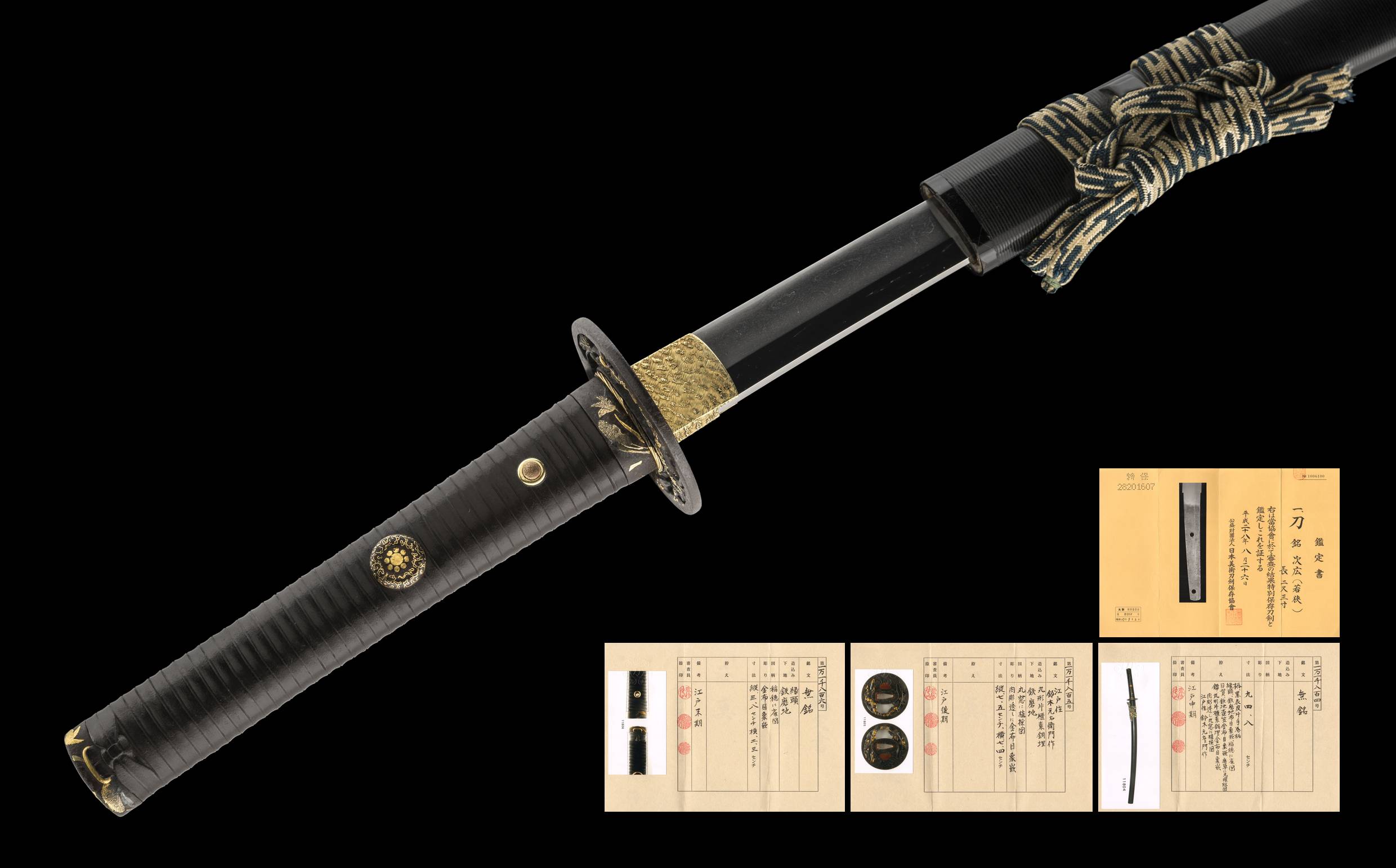
First generation Tsuguhiro is said to have been the student or son of first generation Fuyuhiro, both travelling from Sagami province in the Kamakura area to Wakasa province, carrying the Sôshû tradition of sword-making with them. This blade is most likely the work of third generation Tsuguhiro, known by the personal name Saemon no Jô, who forged swords from the end of the Tenbun era (~1550) through the Eiroku era (1558-1570) at the very close of the Muromachi period. Tsuguhiro received the honorary title Iga no Kami on October 21, 1559, though no extant blades are known signed with this title.
The blade carries a striking suguha hamon with a hint of ko-midare wave pattern, bright and lively with clear nijuba – the hallmark doubling of the temper line seen on top-quality blades forged in suguha. The jihada is a characteristic Wakasa-school hadamono: an impressive mix of o-hada, itame, mokume-hada and masame that was developed by smiths in this northern coastal region to produce blades with superior flexibility, strength and sharpness in frigid winter conditions. Chikei is visible running through the steel. The nakago is suriage (shortened), with katte-sagari-yasurime file marks and two mekugi-ana – the second added when the blade was shortened in the early Edo period, approximately 8.5cm having been removed from an original nagasa of around 78cm.
The sword comes in a handsome Middle Edo period uchigatana-koshirae with a sendan-kizami kuro-nuri saya – a black-lacquered scabbard finely carved in the “thousand-steps” style by a master craftsman of the 1700s. The leather-wrapped tsuka carries menuki bearing the kuyô-mon family crest, associated with the powerful daimyô Hosokawa Tadaoki (1563-1646). The fuchi-kashira are attributed to Den Aizu Shôami and are decorated with sparrows and ears of rice – a prosperity motif from the Late Edo period. The tsuba is a polished iron example by Suzuki Moto’emon, a resident of Edo, worked in openwork with gold-inlaid plants and vines through a window design, with the kogai-hitsu filled in copper. A gold-wrapped habaki with cloud and rain design accompanies the blade in shirasaya.
| Item Number | UJKA408 |
| Sword Type | Katana |
| Swordsmith | Tsuguhiro (3rd generation) |
| Swordsmith (JP) | 次広 (三代) |
| Signature | Tsuguhiro |
| School | Wakasa Tsuguhiro |
| Province | Wakasa (Fukui prefecture) |
| Period | Sue-Kotô · Late Muromachi (Tenbun-Eiroku era: 1550-1570) |
| Nagasa | 69.7cm |
| Sori | 1.97cm |
| Moto-haba | 2.83cm |
| Weight | 615g |
| Nakago | Suriage (shortened); katte-sagari-yasurime; 2 mekugi-ana |
| Jihada | Hadamono – o-hada, itame, mokume-hada and masame with chikei |
| Hamon | Suguha with ko-midare; nijuba present |
| Certificates | NBTHK Tokubetsu Hozon; NTHK-NPO Kanteisho |
| Koshirae | Sendan-kizami kuro-nuri saya uchigatana-koshirae (千段刻黒塗鞘打刀拵) – Middle Edo period (1700-1780) |
| Tsuba | Polished iron, openwork plants and vines through window design, gold inlay; by Suzuki Moto’emon (Edo-jû); NTHK-NPO Kanteisho |
| Fuchi-kashira | Attributed to Den Aizu Shôami; sparrows and ears of rice motif; Late Edo period (1780-1867); NTHK-NPO Kanteisho |
| Menuki | Kuyô-mon (nine-planet family crest associated with Hosokawa Tadaoki) |
| Tsuka | Leather-wrapped |
| Habaki | Gold-wrapped, cloud and rain design |
| Catalogue | Catalogue 38 |
| Status | Sold |
| Includes | Shirasaya, koshirae, koshirae bag, NBTHK Tokubetsu Hozon certificate, NTHK-NPO Kanteisho certificates |