
ITEM# UJKA130 – Catalogue 38 – Sold
A Sandai Kanewaka ‘Shirôemon’ Katana (賀州住兼若造)
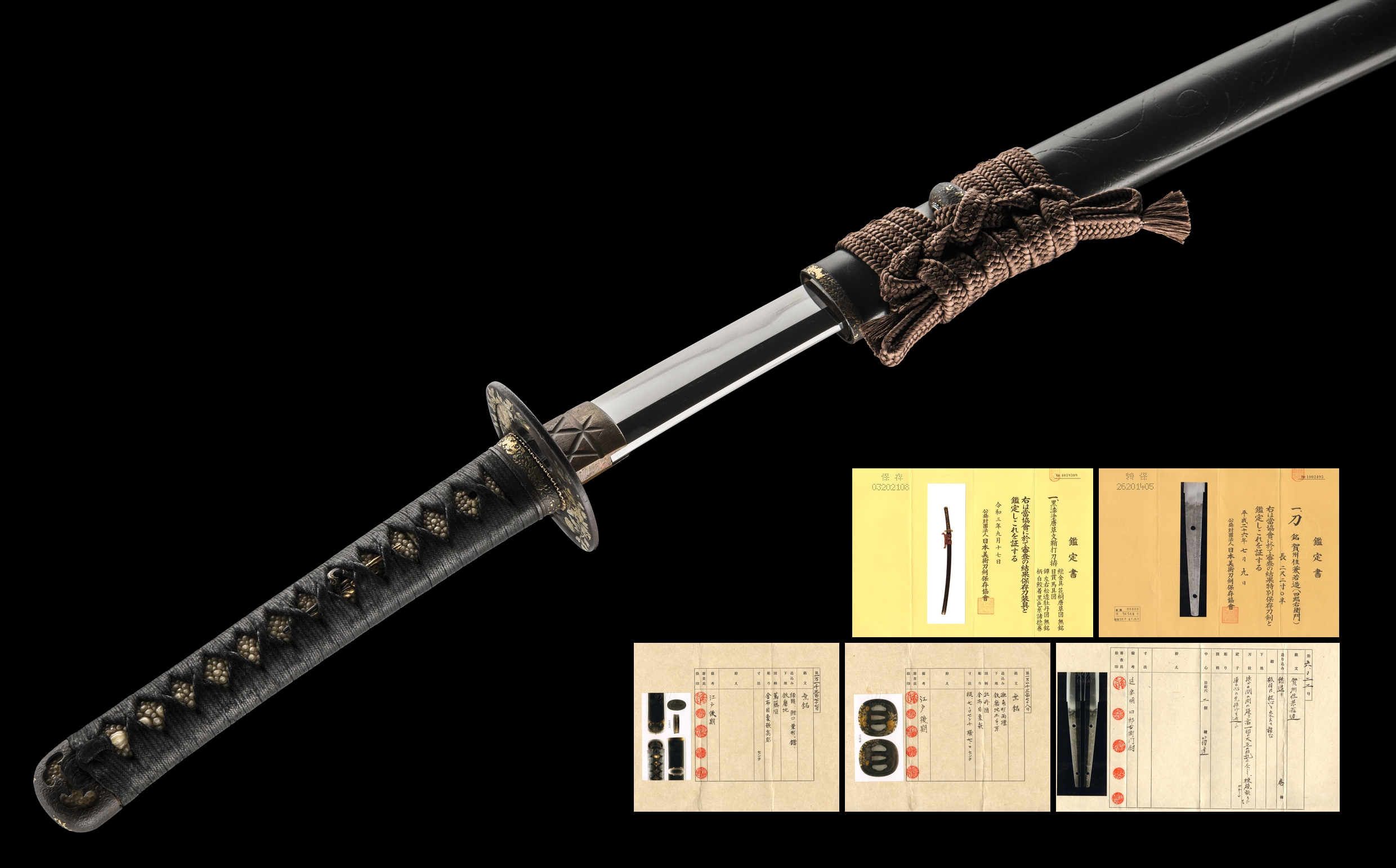
The Kanewaka family held close ties with the Maeda Daimyô family in Kaga province, as the castle town of Kanazawa grew to immense prominence and wealth during the Edo period. Top samurai held great admiration for swords from this lineage, and first generation Kanewaka was so highly esteemed that he was referred to as Kaga Masamune – in tribute to one of Japan’s most celebrated swordsmiths. Traditional Japanese gold leaf production and numerous high-quality crafts made Kaga famous throughout the nation.
This exceptional katana was crafted by third generation Kanewaka, born Tsujimura Shirô’emon, oldest son of the second generation. He died in the fifth month of the eighth year of Hôei era (May 1711), and was rated jô-saku – the mark of a superior swordsmith – by Fujishiro. The brilliant and iconic Kanewaka family hako-midare (square-shaped hamon) with plentiful kinsuji hataraki can be thoroughly enjoyed on this blade, and it has been certified by both NBTHK and NTHK-NPO at their highest levels. Recently polished, this sword lifts the spirits in a very big way.
The sword is accompanied by a fully matching Edo period koshirae attributed to the Kumagai school of Higo province – an elegant kuro kawari-nuri uchigatana-koshirae lacquered in black with a unique texture, crafted during the Late Edo period (1780-1867). The matching fittings depict kiri (paulownia) entwined within an arabesque design, and carry their own NTHK-NPO Kanteisho certificates. The characteristic Kaga-style copper habakiwith its deeply grooved criss-cross pattern remains faithfully in place, entirely appropriate for a smith who lived and worked in Kaga province.
| Item Number | UJKA130 |
| Sword Type | Katana |
| Swordsmith | Shirôemon Kanewaka (3rd generation) |
| Swordsmith (JP) | 賀州住兼若(四郎右衛門) |
| Signature | Kashû-jû Kanewaka tsukuru (Shiroemon) |
| School | Kanewaka |
| Province | Kaga |
| Period | Shintô – Early Edo period (Enpô era: 1673-1681) |
| Nagasa | 66.8 cm (ubu) |
| Sori | 1.40 cm |
| Moto-haba | 2.99 cm |
| Weight | 745 g |
| Nakago | Ubu-nakago (original, unaltered tang), sujikai-yasurime (diagonal file marks), 18.6 cm, 2 mekugi-ana |
| Jihada | Tight ko-itame hada with masame, ji-nie and chikei |
| Hamon | Nie-deki gunome-midare with hako-midare, kinsuji and sunagashi, muneyaki |
| Boshi | Hakikake (sweeping) |
| Certificates | NBTHK Tokubetsu Hozon (blade); NTHK-NPO Yûshû-saku (blade); NBTHK Hozon (koshirae); NTHK-NPO Kanteisho (tsuba and matching fittings) |
| Fujishiro Rank | Jô-saku |
| Koshirae | Kuro kawari-nuri uchigatana-koshirae, Late Edo period (1780-1867), attributed to the Kumagai school, Higo province |
| Tsuba | Iron, kin-nunome-zôgan peony design (botan), attributed to Higo Kumagai school, Late Edo period, NTHK-NPO Kanteisho |
| Fuchi-kashira | Matching set depicting kiri (paulownia) and arabesque design, unsigned, attributed to Kumagai school |
| Menuki | Horse gear (kurabane – Japanese saddle tree), gilt |
| Habaki | Copper, Kaga-style criss-cross file marks |
| Catalogue | Catalogue 38 |
| Status | Sold |
| Includes | Shirasaya, Edo koshirae, fabric bags, stand, kit, booklet, description |