
ITEM# UJKA399 – Catalogue 38 – Sold
A Suishinshi Masatsugu Katana (水心子正次)
Born Kawabe Hokushi, Masatsugu was the son of the 2nd generation Masahide and grandson to arguably the most important swordsmith in the shinshintô period, Suishinshi Masahide. Masatsugu is thus referred to as the 3rd generation Masahide. Suishinshi Masahide mourned the disappearance of the old traditional Kotô methods and advocated passionately for their restoration – a seed that blossomed into the fukkoto movement. Due to the early passing of his father, Masatsugu completed his studies under grandmaster swordsmith Taikei Naotane, whose daughter he would eventually marry. Masatsugu died on March 11, 1860.
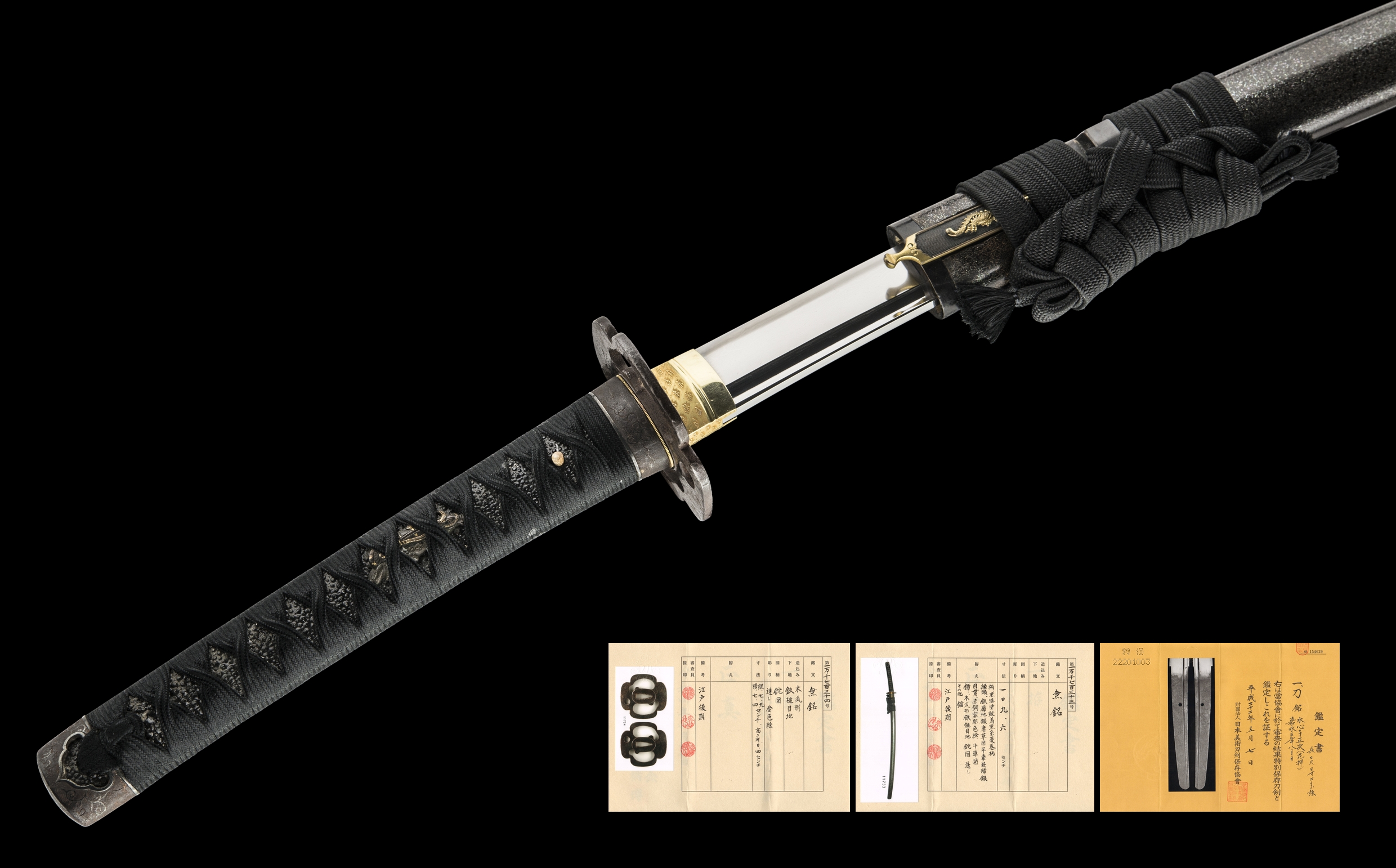
This elegantly curved katana shows a strong Yamashiro-den influence, forged in a bright chû-suguha with a wonderful amount of channelling chikei cascading through the jihada. A delightful mix of kinsuji and brushed sunagashi appears within the tempered area, and utsuri reflections come alive at certain angles in the light. The sword is signed on the tachi side – opposite to most katana – in keeping with the practice of his sensei, Taikei Naotane, who often signed tachi-mei. Notably rated jô-saku by Fujishiro, Masatsugu was highly skilled in the Bizen, Yamashiro, and Sôshû traditions, and a handful of his swords have attained NBTHK Jûyô Token status.
The Edo period koshirae is a standout ensemble. The saya has been lacquered in aoi-gai-mijin-nuri – crushed mother-of-pearl particles suspended in lacquer – and secured at both ends with muscular iron fittings carrying a silver arabesque design. The impressive multi-lobed hammered sukashi iron tsuba is attributed to the fourth generation of the Shimizu Jingo school from Higo province, circa 1800, and carries the refreshingly earthy motif of a nata – a traditional brush hatchet or machete – with small gold kin-iroe accents dotted across its surface. Kozuka and kôgai are en suite with a crawling dragon motif, and the menuki depict an ox-drawn carriage reserved traditionally for nobility and high-ranking samurai. The habakiis gold-wrapped with a cloud and rain design. A well-crafted ‘last samurai’ katana with loads of character and personality.
| Item Number | UJKA399 |
| Sword Type | Katana |
| Swordsmith | Suishinshi Masatsugu (3rd generation Masahide) |
| Swordsmith (JP) | 水心子正次 |
| Signature | Suishinshi Masatsugu (kaô) |
| Date | Kaei 3, 8th month (August 1850) |
| Province | Musashi |
| Period | Shinshintô – Late Edo period (Kaei era: 1848-1854) |
| Nagasa | 70.2cm |
| Sori | 1.8cm |
| Moto-haba | 2.92cm |
| Weight | 680g |
| Nakago | Ubu, keshô-yasurime, one mekugi-ana |
| Jihada | Ko-itame and mokume-hada mixed with utsuri and abundant chikei |
| Hamon | Suguha-chô in bright nioguchi, hotsure mixed with ko-ashi |
| Horimono | Bôhi on both sides with kaki-toshi running through the nakago |
| Certificates | NBTHK Tokubetsu Hozon (No. 154629, issued Heisei 22 / 2010); NTHK-NPO Kanteisho (tsuba and koshirae) |
| Fujishiro Rank | Jô-saku |
| Koshirae | Aogai-mijin-nuri uchigatana-koshirae, Late Edo period (1780-1867) |
| Tsuba | Multi-lobed hammered sukashi iron tsuba, nata motif with kin-iroe accents; attributed to 4th generation Shimizu Jingo school, Higo province, circa 1800. NTHK-NPO Kanteisho certified. |
| Fuchi-kashira | Iron with silver arabesque design |
| Menuki | Ox-drawn carriage (gissha) motif |
| Tsuka | Black lacquered samekawa (ray skin), black braid, kozuka and kôgai with crawling dragon motif |
| Habaki | Gold-wrapped with cloud and rain design |
| Catalogue | Catalogue 38 |
| Status | Sold |
| Includes | Shirasaya, Edo koshirae, fabric bags, stand, maintenance kit, booklet, description |