
⇩ Download Catalogue 37 (150MB)
Free to download. 278 pages. All swords in this catalogue are sold.
Index of Swords
Opening Remarks
Hello everyone,
Thank you as always for downloading the Unique Japan sword catalogue. I must say that pouring my heart into this catalogue is a welcomed escape — an opportunity to turn off the noise and immerse myself in centuries of history. I have always maintained that the Japanese sword stands for personal responsibility and disciplined commitment. As former Navy officer and SEAL Team 3 member Jocko Willink states, “Discipline Equals Freedom.” Amen to that.
A full 13 swords make up Catalogue 37. Some have been sold and are included here for reference and learning purposes. We kick off with a rare katana by shodai (first generation) Ippô from Ômi province — essentially flawless in Yamato-den qualities, with a gorgeous nakago and simply superb craftsmanship. A great candidate for a custom koshirae project. Interestingly, later in the catalogue you will find a long katana with an exuberant gunome-midare hamon by his son, nidai Ippô — a terrific sword with a great set of koshirae featuring snarling dragons, waves, peonies, and protective shisa lions.
A wonderful katana by Chikuzen-Nobukuni Yoshimasa follows shodai Ippô. This sword sings yin-yang qualities, with a tight ko-midare hamon over an expertly forged ko-mokume jihada. The koshirae that comes with it is stunning — inherited through the Owari Tokugawa family, the aoi-mon crests speak to class and authority. We then move on to a robust katana by Hôki no Kami Hirotaka, a strong sword built for action. Crafted in the province of Echizen, it comes with an old set of Edo period koshirae that is pure zen.
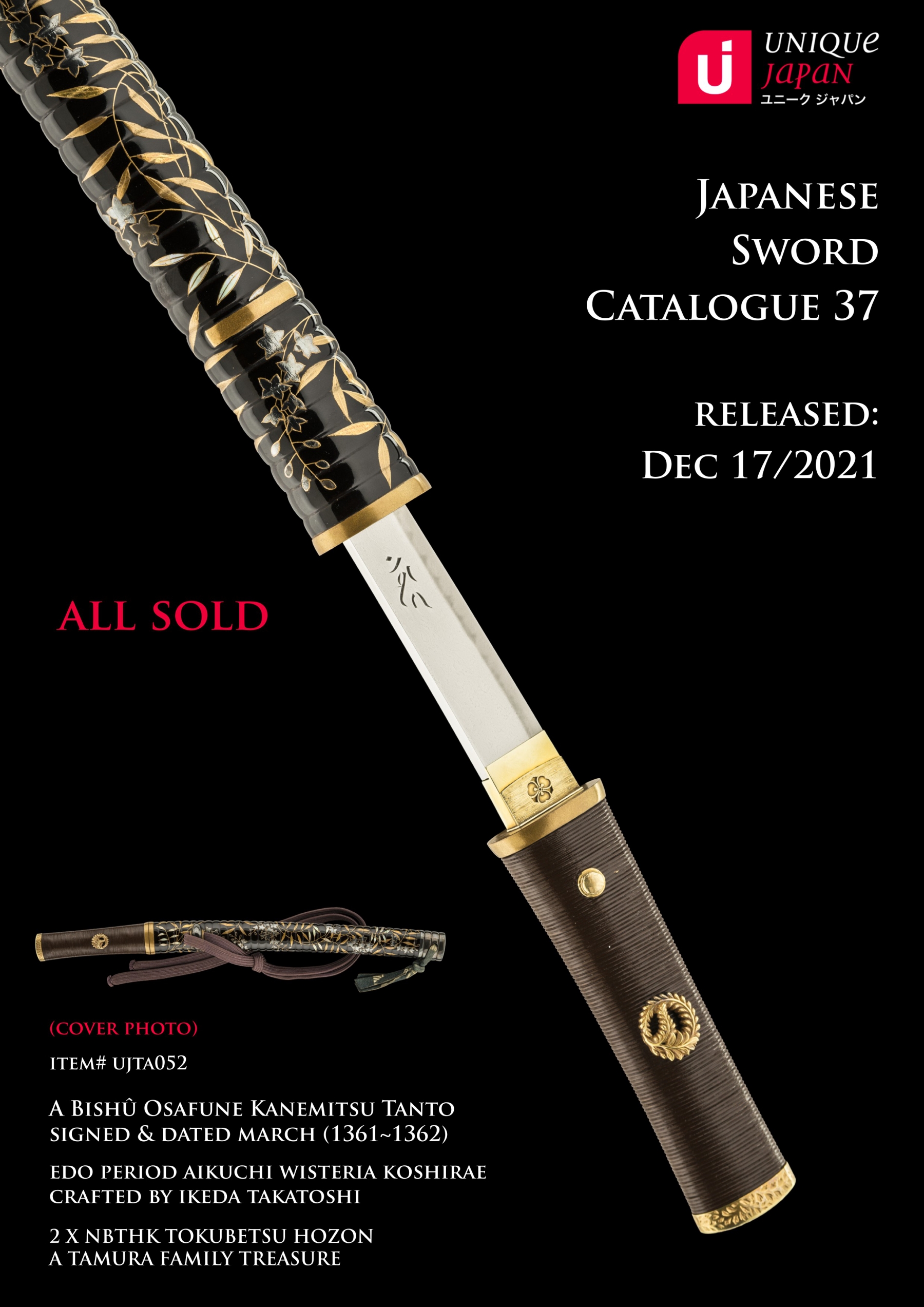
We next transport ourselves to the Kôan era (1361–1362) for a remarkable tantô by shodai Kanemitsu — one of Japan’s sword-making giants. Featuring his iconic kataochi-gunome hamon with kurikara and bonji horimono, this is a sword imbued with history. The incredible wisteria aikuchi koshirae crafted by Ikeda Takatoshi is a faithful replica of a koshirae once the property of late Muromachi period shôgun Ashikaga Yoshiaki and a former Tamura family treasure.
Next is a spectacular 700-year-old ubu-nakago tachi from the late Kamakura period, attributed to the Niô school. Standing tall at a full 81.2cm nagasa with glorious curvature and a huge kirikomi battle scar, this vintage 21st NBTHK Jûyô Tôken sword showcases splendid chikei and a beaming hosô-suguha hamon. Complementing it is a striking set of vermillion-lacquered tachi koshirae with matching Tosa-kashiwa-mon from the late Edo period. The following katana jumps to the Shintô period with notable smith Hizen Yukihiro — so much to admire, with his trademark abu-nomefu (horsefly eye) hamon. A magnificent custom koshirae was built for this sword over an 18-month period using Tokubetsu Hozon certified fittings, with Shôki the demon-slayer taking pride of place on the fuchi-kashira.
The following three swords are all collectible wakizashi. The first is an elegant sword by Yoshitake from Yamashiro province that achieved Yûshû-saku (Masterwork) status, with a custom koshirae telling the story of tugboat teamwork, the beauty of Mount Fuji, and a centuries-old method of catching fish. For those seeking a sharp sword with a multiple-body cutting test, look to the next piece by Yamato no Kami Yasusada. In gold inlay the nakago states that the blade severed two bodies on January 14, 1662 by Yamano Nagahisa. The final wakizashi is a one-handed fighting piece from the Sengoku Jidai (Warring States period) by Bishû Sukesada, dated to August 1514, with a handsome set of fittings equipped with a unique kôgai and kozuka.
The final three reference swords are a katana by early Shintô-period Mino Kanetaka, an elegant Nambokuchô period katana by the Ko-Mihara school with a ferocious dragon-guarding koshirae, and a wonderful signed tachi by Iesuke from the Ôei era that has seen many battles over the centuries. Rest up well, Iesuke.
Thank you as always for your genuine support and passion for life. Happy holidays from my family to yours. We look forward to serving you.
Warm regards,
Pablo Kuntz
December 2021