
ITEM# UJKA283 – Catalogue 37 – Sold
A Hirotaka Katana (伯耆守藤原汎隆)
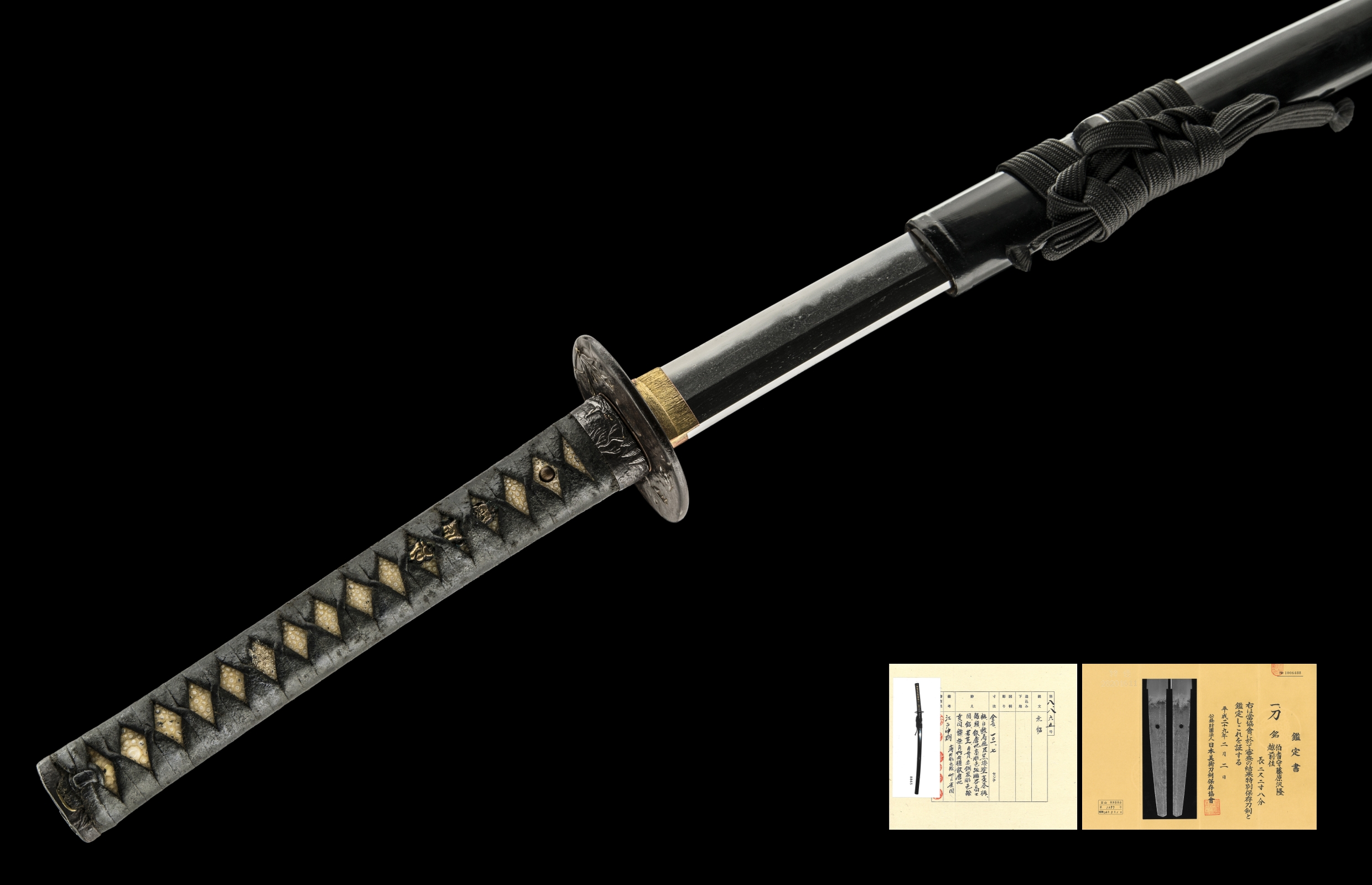
One of the most accomplished students of first-generation Kanetane, swordsmith Hirotaka was active in the Meireki era (1655-1658) out of Echizen province, earning the honorary title of Hoki no Kami – the title under which this blade is signed. He is regarded as an Echizen-Seki smith, though he occasionally signed with the supplement Shimosaka. Fujishiro ranks him Chûjô-saku, and his reputation as a wazamono smith – a maker of sharp swords – is well earned. The nakago here confirms he was residing in the castle town of Echizen at the time of forging, the full signature reading Hoki no Kami Fujiwara Hirotaka, Echizen Ju.
The blade is built for speed and dependability. A shallow sori of 0.9cm means it can be drawn from the scabbard in an instant – exactly what it was designed to do. The jihada is ko-itame with chikei, overlaid with a bright gunome midare hamon with long ashi and sunagashi – vigorous and alive under light. The darkish jigane is characteristic of blades forged along the Sea of Japan coast, a result of the local iron sand. Interestingly, sections of the hamon show a hako-midare pattern more typical of the neighbouring Kanewaka school of Kaga province, hinting at the cross-pollination of traditions in this region. A gold-wrapped habakiwith straight file marks completes the blade furniture.
The accompanying uchigatana-koshirae dates to the mid-Edo period (circa 1688-1780) – essentially a near-contemporary companion to the sword itself. A kuro roiro-nuri black-glossy lacquer saya sets a serious, austere tone. The tsuba is a rounded angular polished iron plate with two hitsu-ana, decorated in low relief with coloured accents depicting sparrows in bamboo. The fuchi-kashira are from the Jakushi school – founded in the early Edo period by Jakushi Kawamura, who studied painting in the Northern Sung style under the Buddhist priest Itsuzen – depicting a virtuous man in a deep ravine. The tsuka is wrapped in black lacquered gampi paper, a rare and distinctive finish that has survived the centuries in remarkably good condition.
| Item Number | UJKA283 |
| Sword Type | Katana |
| Swordsmith | Hoki no Kami Hirotaka (shodai, first generation) |
| Swordsmith (JP) | 伯耆守藤原汎隆 |
| Signature | Hoki no Kami Fujiwara Hirotaka, Echizen Ju |
| School | Echizen-Seki |
| Province | Echizen |
| Period | Shintô – Early Edo period (Meireki era: 1655-1658) |
| Nagasa | 69.0cm |
| Sori | 0.9cm |
| Moto-haba | 3.31cm |
| Weight | 765g |
| Nakago | Ubu, sujikai-yasurime, kengyô-jiri, 1 mekugi-ana. Length: 19.8cm |
| Jihada | Ko-itame with chikei |
| Hamon | Gunome midare with long ashi and sunagashi |
| Certificates | NBTHK Tokubetsu Hozon / NTHK-NPO Kanteisho (koshirae) |
| Fujishiro Rank | Chûjô-saku |
| Sharpness Rating | Wazamono |
| Koshirae | Uchigatana-koshirae, kuro roiro-nuri saya, circa Mid-Edo period (1688-1780) |
| Tsuba | Rounded angular polished iron, two hitsu-ana, low relief sparrows in bamboo design with gold and silver accents |
| Fuchi-kashira | Jakushi school, polished iron, depicting a virtuous man in a deep ravine with gold accents; fuchi signed Jakushi |
| Tsuka | Black lacquered gampi paper wrap, ivory-coloured same (rayskin) panels |
| Habaki | Gold-wrapped with straight file marks |
| Catalogue | Catalogue 37 |
| Status | Sold |
| Includes | Edo-period koshirae, shirasaya, bags, stand, kit, booklet, printed description |