
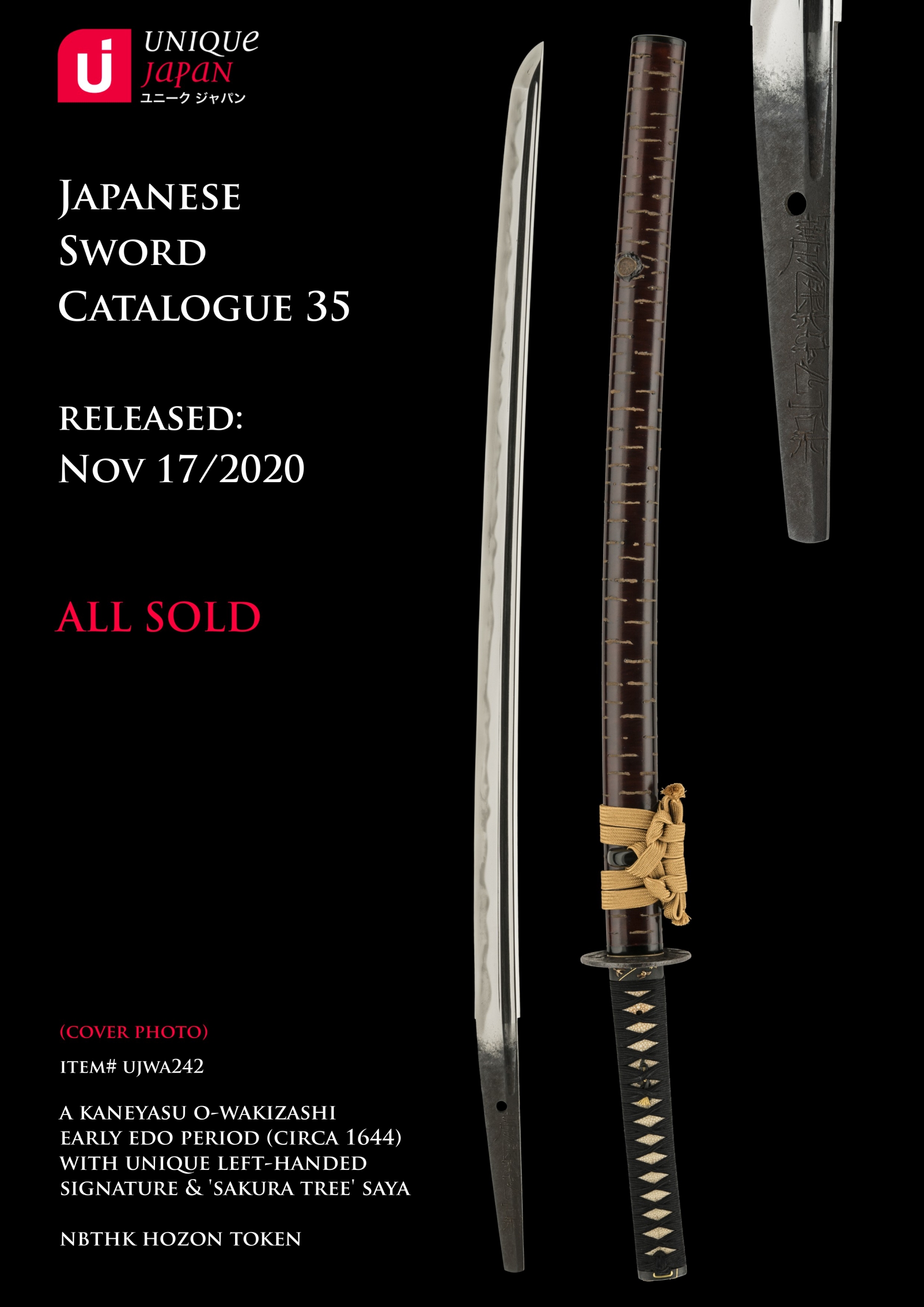
⇩ Download Catalogue 35 (141MB)
Free to download. 238 pages. All swords in this catalogue are sold.
Index of Swords
Opening Remarks
Hello everyone,
Well, the 2020 year is soon coming to a close. It has certainly been one to remember, and for reasons we all know why. For me personally, it has highlighted the vital importance of having meaning in one’s life. Without a definitive direction, without a guiding purpose, getting blown off course in times of confusion will inevitably ensue. Most of us have dug deep these past few months and have unearthed many discoveries — some dark, some filled with treasure. It is critical to keep digging to build the foundations necessary to battle the forceful winds of change that always come. It’s acceptable to struggle; that shows we’re marching forward, however hard. To suffer is not. When that occurs, we must be honest with the source of pain and make the required adaptations to bring order to our lives and to the lives we are responsible for. Let’s press forth with open eyes in 2021.
Ten swords make up this, our 35th sword catalogue. I’ve thoroughly enjoyed exploring the artistic dimensions that make up each piece — in truth, more than I ever have. Great art, in all forms, never ceases to amaze me. The profundity in message behind each creative expression opens up the world in ways we may not have seen before. These moments of awakening fuel me to share what I feel the art is trying to communicate and how we can use the message to inspire and learn from. These talented swordsmiths, metalsmiths, carpenters, and artists of all types were — and are — operating at tremendous depths of skill and imagination. These works of art serve as a guiding force, allowing us to build meaningful lives filled with creative purpose.
We commence the catalogue with a long ô-wakizashi by Mutsu no Kami Kaneyasu. He is known as Hidari-Mutsu, or ‘Lefty’ Kaneyasu, as he was left-handed and chiselled his signature in a uniquely mirrored fashion. The set of koshirae is absolutely brilliant — the saya looks like a sakura tree, its harmonious nature message uplifting. Next up is a katana by Ômiya Morikage from the violent mid-Nambokuchô period, circa the Enbun era 1356–1361. This is a wide, impressive katana with an ô-kissaki built for battle. A dragon-themed koshirae with matching Kyô-Kinkô fittings challenges us to confront our personal demons and retrieve the ‘gold’ that awaits when we prevail.
The third sword is a terrific katana from the early Edo period by Bizen superstar Ishido Yasuhiro. The gunome-chôji-midare hamon is pure delight. As this sword is in shirasaya only, we can assist the new owner in building a custom koshirae should they desire. Following is a shorter katana produced in Kaga province in the mid-1600s by swordsmith Kiyomitsu. There is an old-world charm to this bright suguha blade that few Shintô-period blades possess, and the ume (plum) and sakura-themed koshirae give it an attractive balance. Jumping to February 1746, we come to a supremely healthy katana by Kawachi Sukesada. This beefy blade carries a dramatic curve of over 3cm, evidently inspired by the one-handed katate-uchi masterpieces from his Sukesada family predecessors of the mid-1500s. The armoured crab-themed koshirae plays on the kanitsune (crab claws) visible in the hamon — a creative synchronicity that is both admirable and enjoyable.
A glinting katana by shodai (first generation) Nagamichi is the sixth sword. Ranked saijô-ôwazamono for the indelibly sharp blades he produced, this collectible Shintô-period katana has been freshly polished and fitted with a newly crafted habakiand shirasaya. The Edo period koshirae celebrating matsu (pine) and ikebana flowers carries a prosperous message into the new year. Travelling back to the middle Muromachi period, we have a beautiful signed and dated katana to February 1470 by Niô school swordsmith Sanekiyô. The velvety jihada of this Yamato-den sword shines in true kotô-period glory, while the koshirae — with its gorgeous ripple-design saya, playful fuchi-kashira, and fortune-telling Hakke tsuba — conveys inspirational wisdom.
Shodai Tadakuni follows with a katana that encapsulates everything a samurai sword should be: exceptional steel, a crisp signature, and an Edo period koshirae of the highest quality. It comes with a rare origami certificate from 1839 by Hon’ami Kôkan valuing it at ten gold pieces. The penultimate katana is a long, ruthless blade by Kunisada that underwent a two-body cutting test at Mt Nijuhachi. The serene set of Edo period koshirae captures the mood in which justice was served. The final sword is a museum-grade tachi by Ko-Ichimonji swordsmith Suke[yasu] — a reference piece included here as a time-travel experience through one of the most remarkable blades I have had the privilege of handling.
Thank you as always for your genuine support and passion for life. We look forward to serving you.
Warm regards,
Pablo Kuntz
November 2020