
ITEM# UJKA375 – Catalogue 35 – Sold
A Kunisada Tameshigiri Katana (国貞)
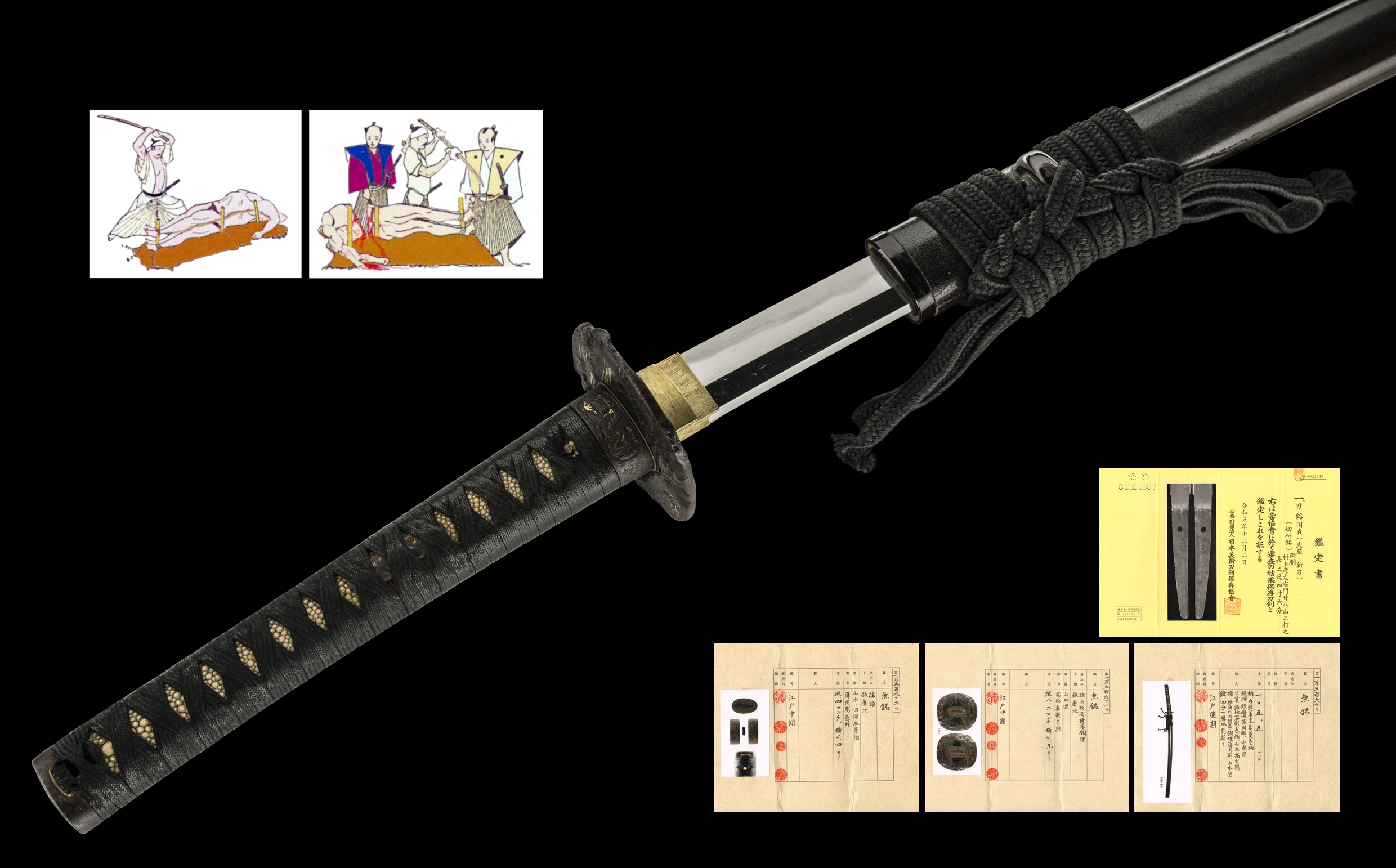
Swordsmith Kunisada was active during the mid-Edo period circa the Hôei era (1704~1711), working in Musashi province – the nation’s political and cultural capital. He is said to have hailed originally from Nakamura city in Ôshû province, and his signatures appear either as the full Ôshû Uda-gun Nakamura jû Kunisada or simply as Kunisada. Few swords by this smith survive, making any signed example a notable find.
This long, powerful katana carries a tameshigiri (cutting test) inscription chiselled into the ura (reverse) of the nakago. The test was performed by Murakami Hikozaemon at Nijûhachiyama – translated literally as ‘Mount Twenty-eight’ – recording the successful severance of two stacked bodies in a single sweeping stroke. It is a rare and sobering record of a blade tested to its full purpose.
Inspired by the location of the cutting test, a thoughtful antique Edo period koshirae accompanies the sword, its fittings united by a serene mountainous landscape theme. The iron tsuba from the Nara school depicts a rocky hillside scene with birds, temples, pine trees and clouds with traces of gold inlay; the fuchi-kashira, attributed to the Jakushi school of Nagasaki in Hizen province, continue the same contemplative landscape in carved iron. The ensemble holds a rare thematic coherence – sword, test site and fittings bound together by the image of a mountain. NBTHK Hozon papers certify both blade and fittings as Especially Worthy of Preservation, and NTHK-NPO Kanteishô certificates of authenticity have been awarded to the koshirae, tsuba and fuchi-kashira separately.
| Item Number | UJKA375 |
| Sword Type | Katana |
| Swordsmith | Kunisada |
| Swordsmith (JP) | 国貞 |
| Signature | Kunisada |
| Province | Musashi |
| Period | Shintô – Middle Edo period (Hôei era: 1704-1711) |
| Nagasa | 74.5cm |
| Sori | 1.0cm |
| Moto-haba | 2.72cm |
| Weight | 740g |
| Nakago | Ubu, sujikai-yasurime (diagonal file marks), ha agari kurijiri, 1 mekugi-ana |
| Jihada | Mixed itame-hada and mokume-hada with chikei |
| Hamon | Thick notare-ba in nie-deki with kinsuji, sunagashi and thick clawing ashi |
| Boshi | Nie-deki with dense nie crystals forming fingerprint-like patterns |
| Tameshigiri (JP) | (切付銘)両胴 村上彦左右門廿八山ニ打之 |
| Certificates | NBTHK Hozon (sword and fuchi-kashira); NTHK-NPO Kanteishô (koshirae, tsuba and fuchi-kashira) |
| Koshirae | Kuro-ishime-ji-nuri uchigatana-koshirae, Late Edo period (1780~1867); black lacquered saya with stone-surface texture; reinforced kojiri with faded gold inlay kumo-raimon (thunder and cloud) design |
| Tsuba | Polished iron, Nara school, Mid-Edo period (circa 1700~1780); rocky landscape with birds, priest on bridge, temples, pine trees, mountains and clouds in gold inlay; hitsu-ana filled with shakudô; NTHK-NPO Kanteishô certified |
| Fuchi-kashira | Iron, Jakushi school, Nagasaki, Hizen province, Mid-Edo period (1700~1780); carved mountainous landscape scene; NTHK-NPO Kanteishô certified |
| Menuki | Iron, landscape scene |
| Habaki | Gold-wrapped, single, with straight file marks |
| Catalogue | Catalogue 35 |
| Status | Sold |
| Includes | Shirasaya, Edo koshirae, stand, kit, DVD, booklet, printed description |