
Free to download. All swords in this catalogue are sold.
Index of Swords
Opening Remarks
Hello everyone!
I trust you all had a great summer. We spent some time in Rosemere, Quebec, Canada, which was brilliant seeing many old friends and family. We sure miss the big, tall trees already. It’s such a beautiful time of year with the changing leaves parading their full autumn spectrum.
I am proud to introduce ten wonderful swords in this, our 32nd Japanese sword catalogue. The first piece is a katana crafted by Ise no Kami Kuniteru, one of the finest smiths in Settsu province. This sword exudes Edo period formal wear in every way — a beautiful, well-forged blade with Yoshioka school kiri themed fittings that resemble a tuxedo. This koshirae is exactly what a samurai would typically carry if invited to a daimyo castle.
The next sword is a terrific wakizashi by Hiromichi of the respected Mishina school. This sword is full of energy. The blade is made in the Sôshû tradition with ample hataraki to enjoy. The wakizashi is secured in a unique Edo-period set of koshirae that celebrates our natural world. For the eco warrior!
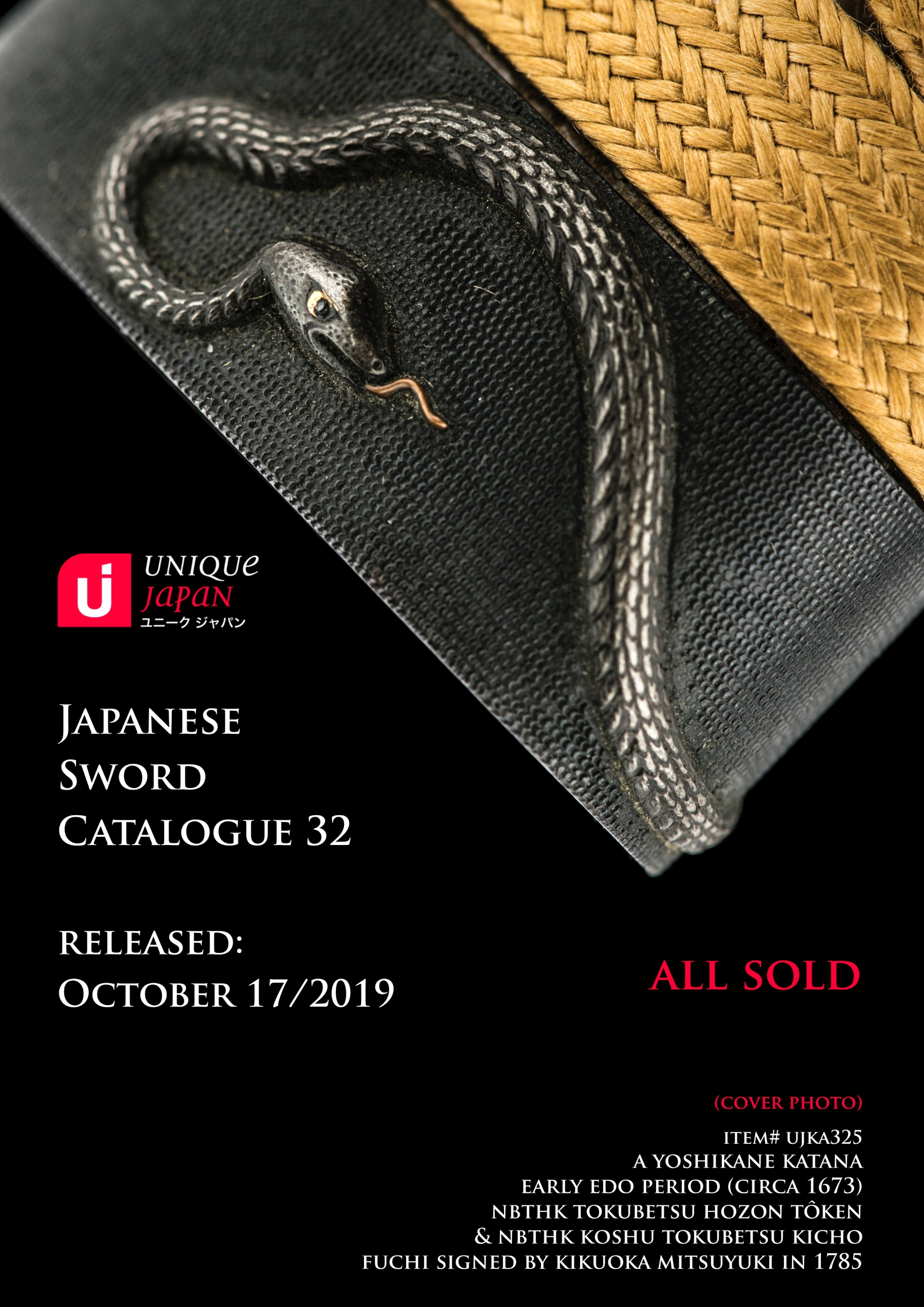
The slithering snake crafted by Jûyô level metalsmith Kikuoka Mitsuyuki gracing the cover of this catalogue is found on our next katana by Yoshikane of the Chikushu Nobukuni school. There is so much to admire in this piece. A solid, powerful sword with a jihada that jumps out to the eye. A bright, crisp suguha hamon and a marvellous set of Edo period fittings in a rare snake and dragon theme making it one of my personal highlights.
Jumping back 700 years to the late Kamakura period is a very special katana by Rai Kunizane — son of national treasure swordsmith Rai Kunitoshi. Its wide, magnificent shape makes it abundantly clear why this sword has been awarded prestigious NBTHK Jûyô tôken. The densely forged ko-itame-hada has plenty of ji-nie and dark swirls of chikei. A set of Hosokawa kuyô-mon (9 planets) menuki under the lacquered, leather-wrapped hilt with a pure gold kiri habaki and a signed Tadatoki Akasaka tsuba gives this sword stunning aura on display.
Next up is a powerhouse katana crafted by Kasusa no Suke Kaneshige that successfully severed three stacked human bodies — a rare tameshigiri cutting test performed in 1664 by Okada Jurôbei.
We then head to the violent Nanbokuchô period in the mid-1300s to a remarkable sword by Shigezane that was once a fierce naginata. Known as a naginata-naoshi, this katana bleeds dominance. The kissaki (tip) is an intimidating 9.5cm. A massive cut in defence from another sword in battle known as kirikomi rests on the base of the blade. This treasured samurai sword was the family heirloom of the Naitô family as recorded on the sayagaki by Kanzan sensei. Awarded 63rd NBTHK Jûyô tôken certification in 2017. A big-time sword.
A long, splendid katana by 2nd generation jôjô-saku swordsmith Tadatsuna is the next offering in the catalogue. Crafted in the late 1600s in a calm suguha hamon with a smooth, steady stream of nie and nioi, this is a sword where form and function meet in full glory. A fine opportunity to build a striking custom koshirae.
Shodai Masahiro of the Edo Hôjôji school is the following katana. This excellent sword echoes the majime (serious) character of samurai living in Edo at the time. The sayagaki by late Living National Treasure Hon’ami Nissû states that the yakiba is gorgeous, which is clear to see why. Its handsome koshirae features a Mino-Gotô cloud dragon tsuba and a shiokumi farming scene on the fuchi-kashira signed by Mogarashi Nyûdo Sôten.
For those wanting a cutting test, this impressive gold-inlaid wakizashi by ryô-wazamono Yasusada is one to consider collecting. This light, quick sword successfully severed through two stacked human bodies in one stroke by the renowned sword tester Yamano Ka’emon Nagahisa. Another potential custom koshirae project.
Our final listing in the catalogue is a delightful, freshly polished gendaitô katana from circa 1926 by Yoshishige of Gifu prefecture that has the power of nata-mame (sword beans) on its side!
Thank you as always for your genuine support and passion for life. We look forward to serving you.
Warm regards,
Pablo Kuntz
October 2019