
ITEM# UJKA347 – Catalogue 32 – Sold
A Kaneshige Tameshigiri Katana (上総介藤原兼重)
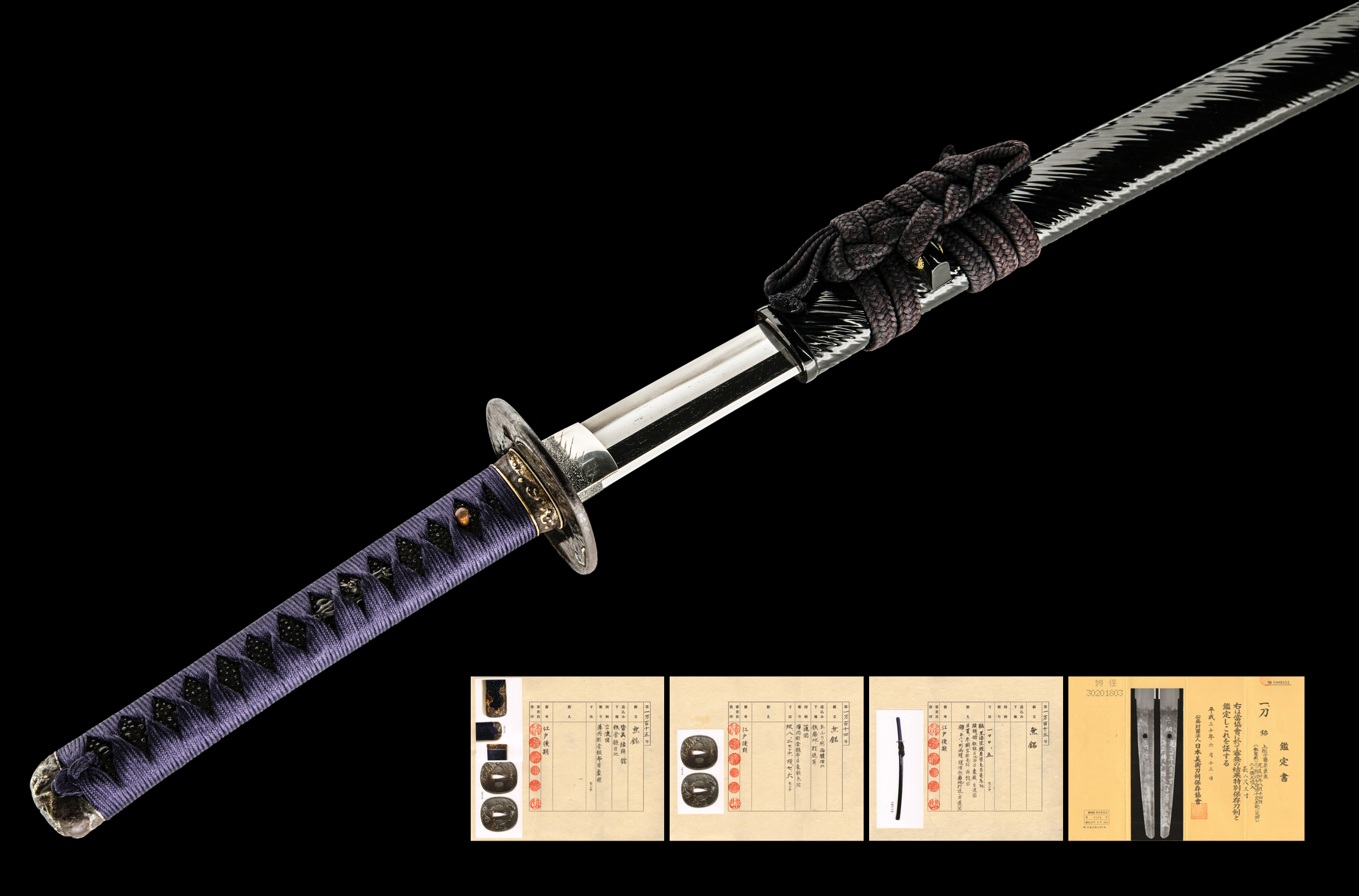
Few swords carry proof of their performance etched into the steel itself. This Kanbun-era katana by the second-generation Kazusa no Suke Fujiwara Kaneshige bears a gold-inlaid tameshigiri inscription documenting one of the most demanding feats in sword testing: on the 14th day of the 8th month of Kanbun 4 (August 14, 1664), sword tester Okada Jurôbei severed through three stacked human bodies and into the earthen mound below in a single stroke. The cut was delivered between the second and third sections of the torso – the ni-no-dô and san-no-dô – a notoriously resistant area that separates the merely sharp from the exceptional. Kaneshige’s Ryo-Wazamono rating was not theoretical; this blade earned it.
The steel rewards close study. A tight ko-itame jihada with ji-nie and chikei forms the canvas for a thick suguha nioguchi that recalls the great Kotetsu at his finest – vibrant, full of presence, threaded through with kinsuji and sunagashi. The $1 mixed into the suguha gives the hamon a restless energy, while the hakikake boshi sweeps cleanly through the tip. This is an Early Edo blade wearing Koto-period gravitas, very much in the spirit of the Sôshû tradition.
The sword comes with an outstanding late-Edo period uchigatana-koshirae lacquered in glossy black (kuro-roiro-nuri) with slanting notches. The tsuba, fuchi-kashira and kojiri form a complete matched set – soroi kanagu – by the Tanaka Toryusai School, certified authentic by the NTHK-NPO. Dragon menuki animate the purple-laced handle. The tsunagi is inscribed with the smith’s name and carries on its reverse the Kobayashi family heirloom notation, confirming this katana passed through eleven generations of the Kobayashi samurai family before it came to market.
| Item Number | UJKA347 |
| Sword Type | Katana |
| Swordsmith | Kaneshige (second generation) |
| Swordsmith (JP) | 上総介藤原兼重 |
| Signature | Kazusa no Suke Fujiwara Kaneshige |
| School | Musashi (resident of Tokyo) |
| Province | Musashi |
| Period | Shintô – Early Edo period (Kanbun era: 1661-1664) |
| Nagasa | 69.7cm (ubu) |
| Sori | 1.0cm |
| Moto-haba | 3.01cm |
| Weight | 695g |
| Nakago | Ubu-nakago, sujikai-yasurime (diagonal file marks), 21.7cm |
| Jihada | Tight ko-itame with ji-nie and chikei |
| Hamon | Thick suguha mixed with gunome-midare with ashi, kinsuji and sunagashi |
| Boshi | Hakikake |
| Tameshigiri (JP) | 寛文四年八月十四日 三ッ胴切手岡田十良兵衛 (花押) 二三拂土壇入 |
| Certificates | NBTHK Tokubetsu Hozon; NTHK-NPO Kanteisho (tsuba, soroi kanagu and koshirae designated Authentic) |
| Fujishiro Rank | Jo-saku |
| Sharpness Rating | Ryo-Wazamono |
| Koshirae | Edo uchigatana-koshirae (kuro-roiro-nuri naname-kizami saya), Late Edo period (1780-1867) |
| Tsuba | Iron, Tanaka Toryusai School (NTHK-NPO certified) |
| Fuchi-kashira | Iron with gold inlay, part of soroi kanagu set (NTHK-NPO certified) |
| Menuki | Dragon motif |
| Tsuka | Purple braid (murasaki ito) |
| Habaki | Silver habaki with diagonal file marks |
| Catalogue | Catalogue 32 |
| Status | Sold |
| Includes | Shirasaya, Edo koshirae, bags, stand, kit, DVD, printed description |