
ITEM# UJKA402 – Catalogue 37 – Sold
A Nidai Ippô Katana (江州住人佐々木入道源一峯)
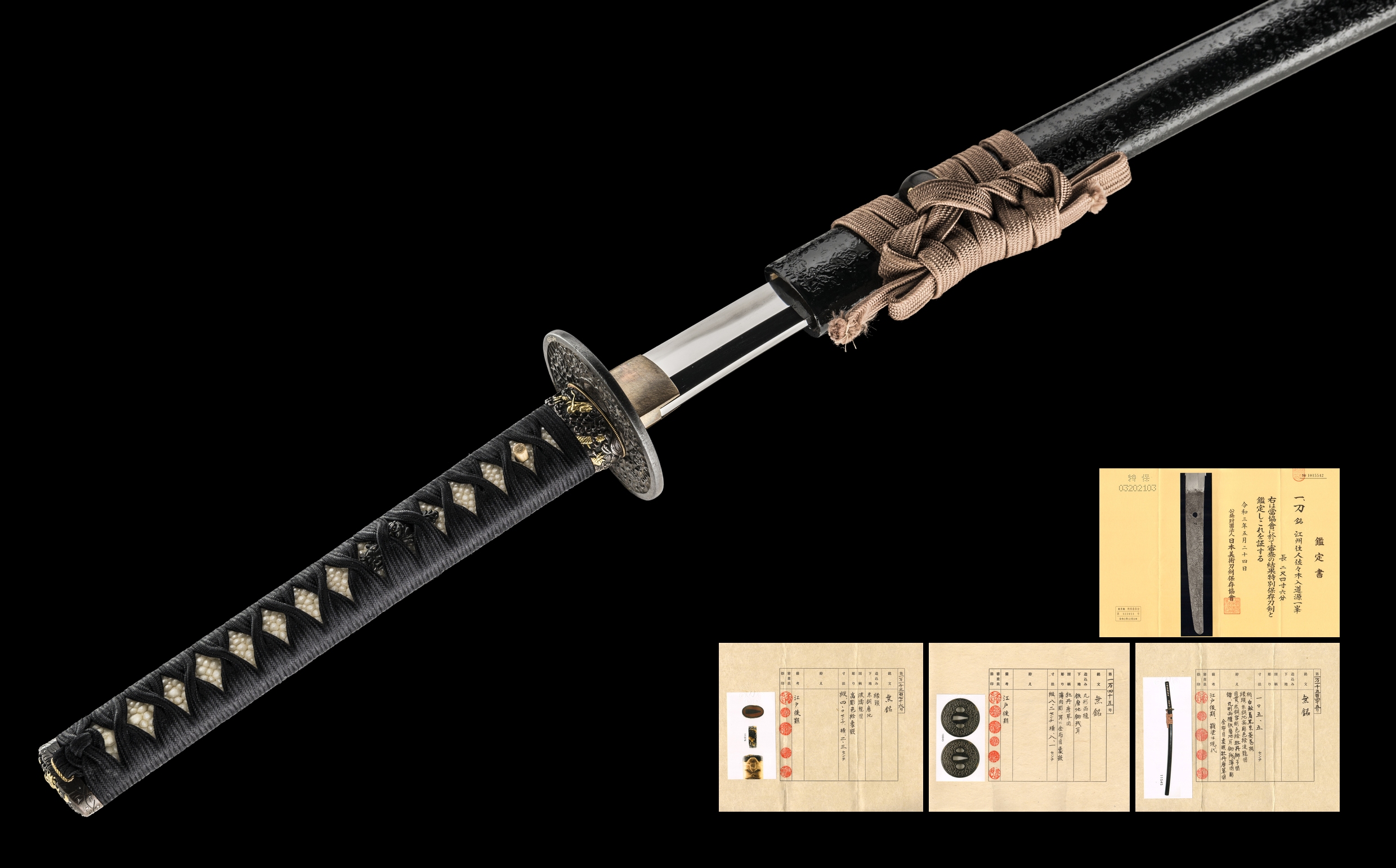
Nidai Ippô, also known as Sasaki Zenjirô, was the son of the first generation Ippô and a smith of considerable standing in early Edo Japan. Born into the Ômi-Ishido school – a lineage with roots reaching back to the Bizen Ichimonji tradition – he spent much of his life in Ômi province before eventually moving to Edo to work alongside shodai Korekazu of the famed Edo Ishido school. The school spread from Ômi to Osaka and Tokyo, and Zenjirô’s work sits comfortably among the finest of that tradition. Fujishiro ranks him jô-saku, a designation reserved for superior smiths, and he achieved the prestigious Jûyô Tôken in recognition of his craft. Notably, the nakago of this sword is signed with the characters Nyûdô – the name taken when a smith enters monastic life and devotes himself to Buddhism.
At 74.5cm in nagasa, this is a long and commanding blade, recently polished to an exceptional standard. The jihada is a well-forged combination of itame and masame, flowing with the energy characteristic of the Ishido school. The hamon is the sword’s centrepiece: a bursting gunome-chôji-midare of brilliant nie, with long impressive ashi driving down the blade and generous sweeps of sunagashi breaking across the steel. The yakidashi at the base takes on an Osaka style, with the hardened area widening before turning into the hamon – a subtle refinement that collectors will immediately recognise.
The sword is complemented by a superb set of Late Edo period koshirae. The fuchi-kashira, attributed to the Tamagawa School of Mito province, carries a dragon-in-waves motif in gold relief – a bold, auspicious design of exceptional quality. The tsuba is a polished iron piece with raised rims and nunome-zôgan, attributed to the Itô school in Edo, featuring an arabesque and peony design symbolising longevity and good fortune. Shakudô menuki in the form of shisa lions and peonies complete the ensemble with satisfying thematic unity. Five certificates in total accompany this impressive katana.
| Item Number | UJKA402 |
| Sword Type | Katana |
| Swordsmith | Ippô (second generation) |
| Swordsmith (JP) | 一峯 (二代) |
| Signature | Gôshû jûnin Sasaki Nyûdô Minamoto Ippô |
| School | Ômi-Ishido |
| Province | Ômi |
| Period | Shintô – Early Edo period (Tenna era: 1681-1684) |
| Nagasa | 74.5cm |
| Sori | 1.5cm |
| Moto-haba | 3.0cm |
| Weight | 850g |
| Nakago | Ubu, o-sujikai-yasurime, 1 mekugi-ana, 23.6cm |
| Jihada | Well-forged itame-hada and masame-hada |
| Hamon | Bursting gunome-chôji-midare with long ashi and plentiful sunagashi |
| Boshi | Ko-maru |
| Certificates | NBTHK Tokubetsu Hozon; NTHK-NPO Kanteisho (sword, koshirae, tsuba, and fuchi-kashira) |
| Fujishiro Rank | Jô-saku |
| Sharpness Rating | Wazamono |
| Koshirae | Kuro-ro-utakata-nuri saya uchigatana-koshirae (黒呂泡沫塗鞘打刀拵え) – Late Edo period (1780-1867) |
| Tsuba | Polished iron, raised rims, nunome-zôgan, arabesque and peony design – attributed to Itô school, Edo, Late Edo period; NTHK-NPO Kanteisho |
| Fuchi-kashira | Dragon in waves, gold on shakudô – attributed to Tamagawa School, Mito province, Late Edo period (1780-1867); NTHK-NPO Kanteisho |
| Menuki | Shisa lion and peony theme, shakudô – Late Edo period |
| Habaki | Copper, diagonal file marks |
| Catalogue | Catalogue 37 |
| Status | Sold |
| Includes | Shirasaya, koshirae, bag, stand, kit, booklet, printed description |