
⇩ Download Catalogue 43 (152MB)
Free to download. All swords in this catalogue are sold.
Index of Swords
Opening Remarks
Hi everyone, 2025 is off to the races, and I trust you are in great spirits. Big moments all over the world — it’s so easy to get distracted with it all, and emotions can run real hot. I’ll be honest, I don’t wish to pour oil on any fire. The only oil I am interested in is the Fujishiro oil that helps preserve Japanese swords. Sit back, grab a drink, and cosy up to Catalogue 43, as this is a special one!
We kick off the catalogue with a challenge — a brilliant Shintô period katana by Higo no Kami Kuniyasu that is in shirasaya only. I completely understand that most clients prefer a sword with koshirae, but I absolutely urge you to consider this blade, as it stands entirely on its own. A traditional sashikomi polish was given to it, bringing out its gorgeous gunome-chôji-midare with kobushigata chôji hamon magnificently well. The blade was also sharpened to a razor edge, affirming Kuniyasu’s well-deserved ô-wazamono ranking. Two certificates accompany this katana — NBTHK Tokubetsu Hozon and NTHK-NPO Yûshûsaku (Masterwork), the highest honour at the NTHK-NPO, awarded at the December 2024 shinsa. The sword has sayagaki potential with Tanobe sensei and would make for a superb custom koshirae project.
Next we travel back to the mid-1300s for a commanding katana by jô-saku and ryô-wazamono swordsmith Ômiya Morikage, embodying the warrior spirit of the Nambokuchô period. The blade’s impressive width and ô-kissaki reveal its origins as a formidable ô-dachi, originally approaching 90cm in length. Its striking gunome-midare hamon surges dramatically along the steel, accompanied by a brilliant midare-utsuri reflecting classic Bizen tradition. The elegant custom koshirae features an intimidating demon tsuba by Mogarachi Sôten, exquisite fuchi-kashira signed by Gotô Mitsutomo, and lovely bonsai tree menuki, all wrapped in pristine white silk with high-class jabaramaki braiding. Also certified NTHK-NPO Yûshûsaku (Masterwork).
We zip forward to the 1600s for a handsome katana by Yukimitsu of the Shintô Takada school. What makes this sword so collectible is the variety of traditions it encompasses in a single blade. The wide shinogi-ji and nagare-hada demonstrate a robust Yamato influence, while the hamon displays Mino characteristics featuring togari-gunome and yahazu-ba blended with Bizen and Osaka-Shintô elements — even the yô in the yaki-ba reflects Yamashiro aesthetics. A kirikomi battle scar on the mune suggests this sword has seen combat. The late Edo period koshirae has a real samurai feel with classic iron fittings and matching swirling gold arabesque motifs. The tsuka features a unique linen-wrapped hanabishi pattern that speaks to Japan’s nobility class — an ideal katana for the new nihôntô collector.
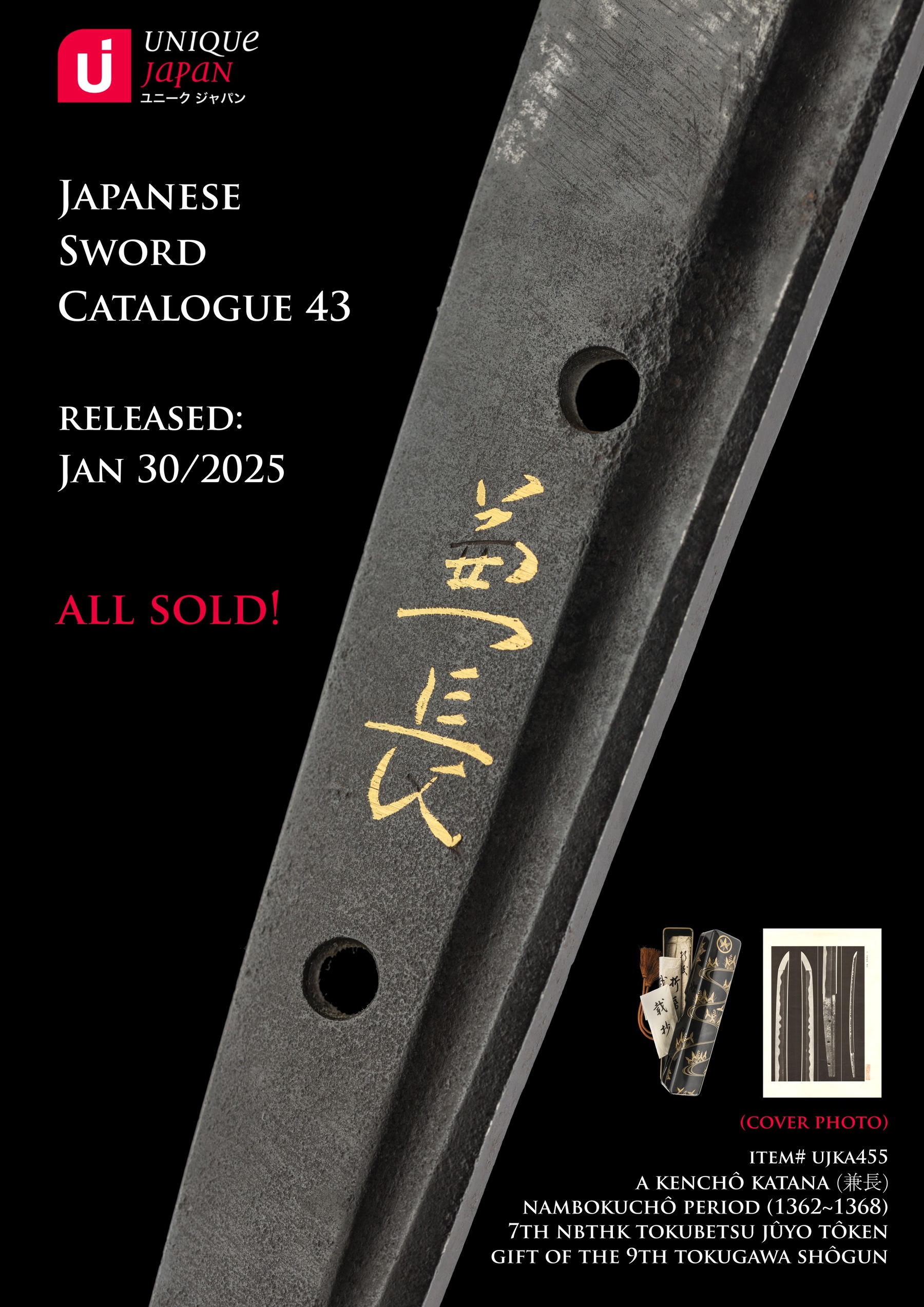
Once in a while, a sword so special comes to Unique Japan that it is hard to express in words the aura and cultural importance it represents. The following sword is an exceptional Tokubetsu Jûyô Tôken katana from the warring Nambokuchô period, attributed to Kenchô (also known as Kanenaga), the celebrated pupil of Chôgi. The blade represents a masterful blend of Bizen and Sôshû traditions, exemplifying the rare and coveted Sôden Bizen style of workmanship. The cover of this catalogue shows a close-up of the nakago gold-inlaid with kinzôgan-mei, and the sword comes with an origami from Hon’ami Kôyû dated to 1753, assessing its value at 15 gold coins. That same year, the ninth shôgun Tokugawa Ieshige presented this very katana as a gift to Lord Asano Munetsune upon his succession as head of the Asano clan. This is a precious sword worthy of a place among the most prestigious nihôntô collections, and it comes with my highest recommendation.
Although Kenchô may be a hard act to follow, the next addition is a remarkable daishô pairing a katana by fourth generation Tadayoshi with a wakizashi by second generation Tadahiro, both masters of the renowned Tadayoshi school of Hizen province. The blades display graceful curvature adorned with a vivid gunome-chôji-midare hamon which, on the wakizashi, extends brilliantly towards the shinogi. Outstanding horimono evokes deep spiritual power. An exquisite daishô koshirae with a split-lacquer design, an incredible pair of dragonfly tsubas, rain dragon motifs, and cloisonné enamel is a samurai tour de force. All three pieces — both swords and the daishô koshirae — carry NBTHK Tokubetsu Hozon certification. We even have a copy of a handwritten note in which the samurai owner documented both swords and all the beautiful fittings he acquired, along with the prices he paid. So cool.
Swordsmith Kanegishi (also read Kanekishi) is our next katana. He worked in Seki city, Mino province, around five hundred years ago during the Kyôroku era of the turbulent Muromachi period, circa 1528–1532. If you are seeking a long sword (74.5cm) that has almost certainly seen battle, consider claiming this blade. This very sharp and sturdy Sue-Seki katana carries an eye-catching kenbô-midare hamon paying tribute to first generation Kanefusa about a century earlier. Its handsome koshirae features an iron tsuba adorned with a suhama motif, thoughtfully chosen to complement the blade’s swirling hamon, which evokes the natural curves of a sandbar. The unique diamond-shaped renbishi fuchi-kashira from the famed Yoshioka school gives the sword an armoured presence. Very few signed examples of Kanegishi katana are known, making this a fine discovery indeed.
For those wanting a very special cutting-test sword, the next katana must be placed on your radar. This magnificent blade by shodai Ietada of Kaga province bears a gold-inlaid tameshigiri inscription stating that the blade severed through two bodies in a single stroke before embedding in the earthen testing ground. Through extensive research by Operations Manager Ayumu Ogusu, we discovered that the tester, Miyai Rokubei, was a samurai of the Kaga domain, listed as an archer on a document from 1670. The blade is also documented in Kashû Shintô Shû, a notable reference on Kaga’s top Shintô period smiths. The hamon is a brilliant gunome-chôji midare featuring distinctive ‘tadpole’ formations called kawazu no ko-chôji, made famous by Bizen Moriie during the golden Kamakura age. The sword is mounted in an elegant Edo period handachi-koshirae — a katana of pure samurai class.
Our final sword is a delightful tantô by Enju Nobukatsu, sharing qualities of the classic Enju school that dates back to the Kamakura period in the Kikuchi area of Higo province, Kyûshû. It features a wavy ayasugi-hada and a bright suguha hamon that splits into nijû-ba in a very Yamato-den manner, with several river-like veins of kinsuji flowing through the hamon most impressively. Its wonderful koshirae is certified to the late Edo period, with menuki depicting Hotei — the Japanese god of contentment and happiness, guardian of children, widely recognised as the Laughing Buddha. For a small blade, this tantô packs a punch and carries positive energy. Nobukatsu is ranked chûjô-saku (above average smith), and there is a good chance this sword can be upgraded to NBTHK Tokubetsu Hozon — Unique Japan will assist.
Thank you for all your passion, trust, and confidence in our ability to serve you in this wonderful world of Japanese samurai swords. It means a great deal to me and the team. I wish you and your family a healthy and prosperous year ahead!
Warm regards,
Pablo Kuntz
January 2025