
ITEM# UJKA426 – Catalogue 43 – Sold
A Kuniyasu Katana (肥後守国康)
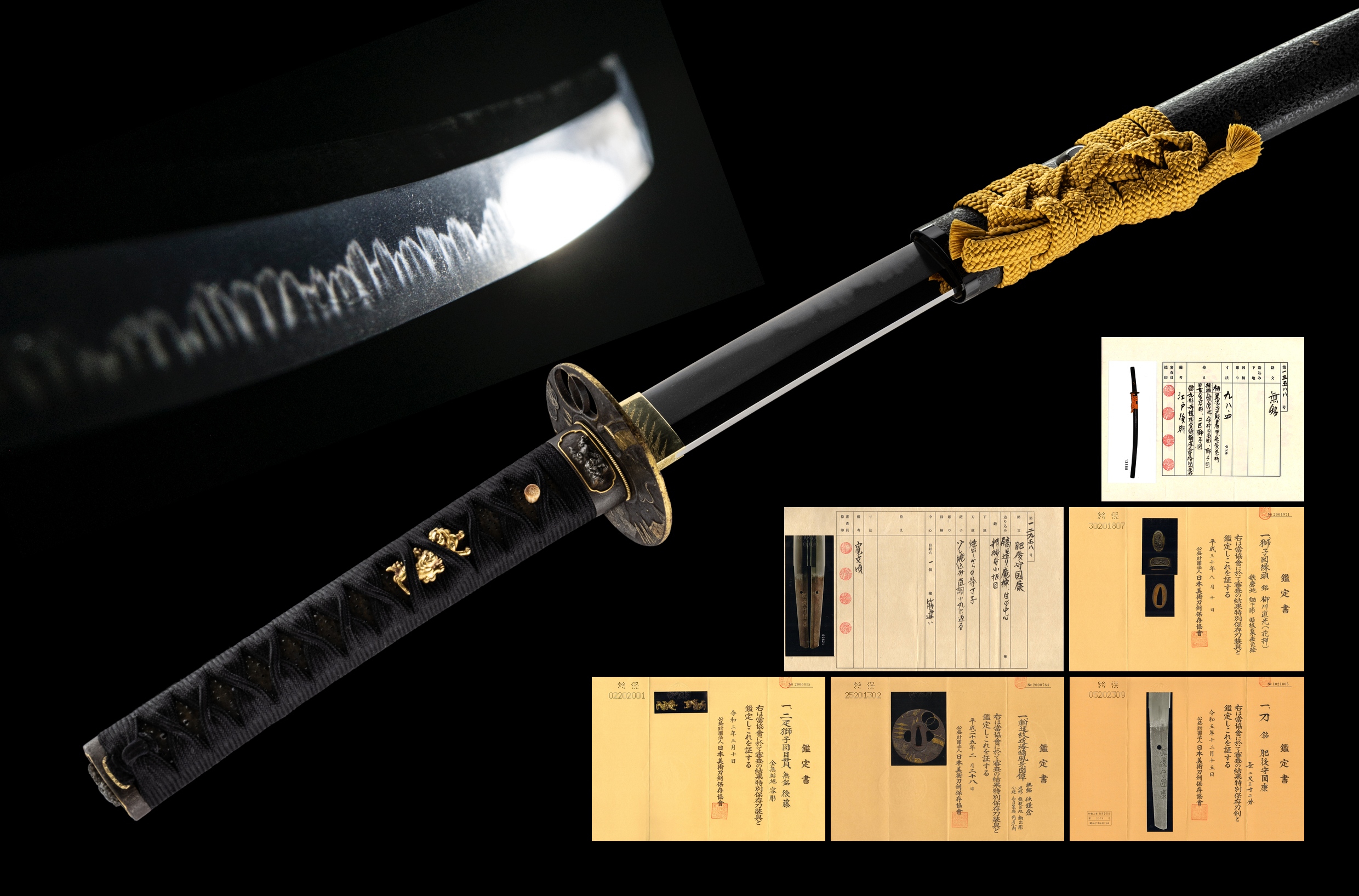
This is a highly collectible shintô period katana by first generation Higo no Kami Kuniyasu from Settsu province, modern day Ôsaka. Born Kobayashi Genzaemon, Kuniyasu is the third son of shodai Kunisuke, founder of the Kunisuke school, who first studied under the great Horikawa Kunihiro in Kyôto. Kuniyasu’s workmanship closely follows that of his older brother, second generation Kunisuke, centred on a spectacular gunome-chôji-midare and the distinctive fist-shaped clusters of clove blossom buds known as kobushigata chôji. Long ashi stretch magnificently toward the cutting edge, and brilliant kinsuji thread through the hamon – the mark of a supremely accomplished smith.
A traditional sashikomi polish was applied to this fine blade to deliver a more classical finish, avoiding the use of hadori that can exaggerate the contrast between the hamon and body of the blade. The chôji-midare hamon responds beautifully to sashikomi when executed to this standard. The blade was also sharpened to an exceptionally keen edge, fully affirming Kuniyasu’s well-deserved ô-wazamono ranking – his swords require careful handling due to their remarkable cutting ability. The ubu nakago is in excellent condition with crisp sujikai-yasurime file marks intact.
This sword carries two prestigious certificates: NBTHK Tokubetsu Hozon, issued in the 5th year of Reiwa (2023), and the NTHK-NPO Yûshûsaku (Masterwork) designation – the highest honour at the NTHK-NPO – achieved with a tremendous score of 83/100 at the December 2024 shinsa in Tokyo. The original torokusho (registration card) bears serial number 2379, registered in the 27th year of Shôwa (1952), the very first year swords were formally registered in Japan, strongly suggesting this blade once resided in a prominent daimyo collection.
Since the sword first appeared on the Unique Japan archive, two further chapters have been added. The blade was sent to Tanobe-sensei, who inscribed his sayagaki in March 2025 – praising the refined ko-itame forging, the vibrant kobushigata chôji-midare in the manner of brother Naka-Kawachi (2nd generation Kunisuke), the rich ashi and bright nioiguchi concluding in a sugu komaru bôshi, and declaring the overall deki outstanding. Unique Japan has also completed a custom koshirae of exceptional quality. The centrepiece is a Kamakura-school iron tsuba – a pagoda and bridge scene in gold crosshatched inlay, enriched by a wachigai-mon in openwork that carries a deep esoteric Buddhist resonance – holding its own NBTHK Tokubetsu Hozon certificate. The fuchi-kashira is the work of Yanagawa Naomitsu (1733-1808), second-generation master of the Yanagawa tradition and direct artistic heir to the great Yokoya Sômin, carved with a shishi lion in a dramatically raised posture that scholars have likened to a Hokusai composition – NBTHK Tokubetsu Hozon. The menuki are solid-gold shishi by the Gotô school, the shogunate’s preeminent oiebori workshop, executed with the fine and intricate carving that defines that school at its peak – also NBTHK Tokubetsu Hozon. The tsuka is black-lacquered samekawa under black silk in hishimaki style, and the saya carries a kuro-ro-ishime-urushi lacquer with gold maki-e accents, sombre and refined in equal measure. Every element of this ensemble was chosen to honour the blade.
| Item Number | UJKA426 |
| Sword Type | Katana |
| Swordsmith | Higo no Kami Kuniyasu (1st gen.) |
| Swordsmith (JP) | 肥後守国康 |
| Signature | Higo no Kami Kuniyasu |
| School | Kunisuke school (Settsu) |
| Province | Settsu |
| Period | Shintô – Kanbun era (1661-1673) |
| Nagasa | 70.3cm |
| Sori | 1.5cm |
| Moto-haba | 3.14cm |
| Weight | 820g |
| Nakago | Ubu, sujikai-yasurime, ha-agari kurijiri, one mekugi-ana |
| Jihada | Well-forged ko-itame with ji-nie and chikei |
| Hamon | Gunome-chôji-midare with kobushigata chôji, kinsuji and Ôsaka yakidashi |
| Boshi | Sugu komaru |
| Certificates | NBTHK Tokubetsu Hozon (sword, tsuba, fuchi-kashira & menuki); NTHK-NPO Yûshûsaku (Masterwork); NTHK-NPO Kanteishô (koshirae) |
| Fujishiro Rank | Jô-saku |
| Sharpness Rating | Ô-wazamono |
| Sayagaki | Tanobe Michihiro (Tanzan) – Sesshu Higo no Kami Kuniyasu, outstanding deki in the manner of Naka-Kawachi, dated March 2025 |
| Koshirae | Kuro-ro-ishime-urushi ni kin-maki-e uchigatana-koshirae (black stone-surface lacquer with gold maki-e), Modern era |
| Tsuba | Kamakura school attribution, iron ground, pagoda and bridge motif in gold inlay with wachigai-mon openwork – NBTHK Tokubetsu Hozon |
| Fuchi-kashira | Yanagawa Naomitsu (柳川直光, 1733-1808), shishi lion motif with gold inlay frame – NBTHK Tokubetsu Hozon |
| Menuki | Gotô school, solid gold shishi – NBTHK Tokubetsu Hozon |
| Tsuka | Black-lacquered samekawa, black silk hishimaki wrapping |
| Habaki | Gold with copper ground |
| Catalogue | Catalogue 43 |
| Status | Sold |
| Includes | Shirasaya, custom koshirae, fabric bag, stand, kit, printed description, original torokusho (1952) |