
⇩ Download Catalogue 40 (150MB)
Free to download. 219 pages. All swords in this catalogue are sold.
Index of Swords
Opening Remarks
Hi everyone! All good? Well, it’s a landmark edition here with Catalogue 40. It feels amazing to have made it this far — and of course I have you all to thank for your incredible support and encouragement over the years. These catalogues have turned into a pure love affair with Japanese swords, digging deep into each piece to present them properly, in the light they deserve. It is definitely a team production, and I wish to thank my assistants Ayumu Ogusu and Yuki Ando, plus our photographer extraordinaire and longtime friend Eric Bossick, for their work and dedication.
We kick off the catalogue with a delightful Sue-Hôshô katana. As many of you know, I am a fan of masame-hada — I love the purity of the straight grain — and this katana has just that. Conservatively the sword is from the early 1400s, though its old Tokubetsu Kichô certificate and Kanzan sayagaki date it a century earlier. The kizami-zaya koshirae is completely first class, a fine display piece for any home or office. We next flash forward to 1915 for a remarkable katana by the great Gassan Sadakazu. This Sôshû Masamune utsushi masterpiece is simply incredible — a sword like this rarely comes available. The following katana is by Nidai Tadakuni, notable for its gentle wavy notare hamon. You do not see notare very often on Hizen swords, making this rather collectible. It has a meaningful koshirae too. Fellow Hizen swordsmith Nidai Tadahiro is the next featured katana, carrying a vintage sayagaki by Hon’ami Kôhaki and housed in a brilliant Higo koshirae.
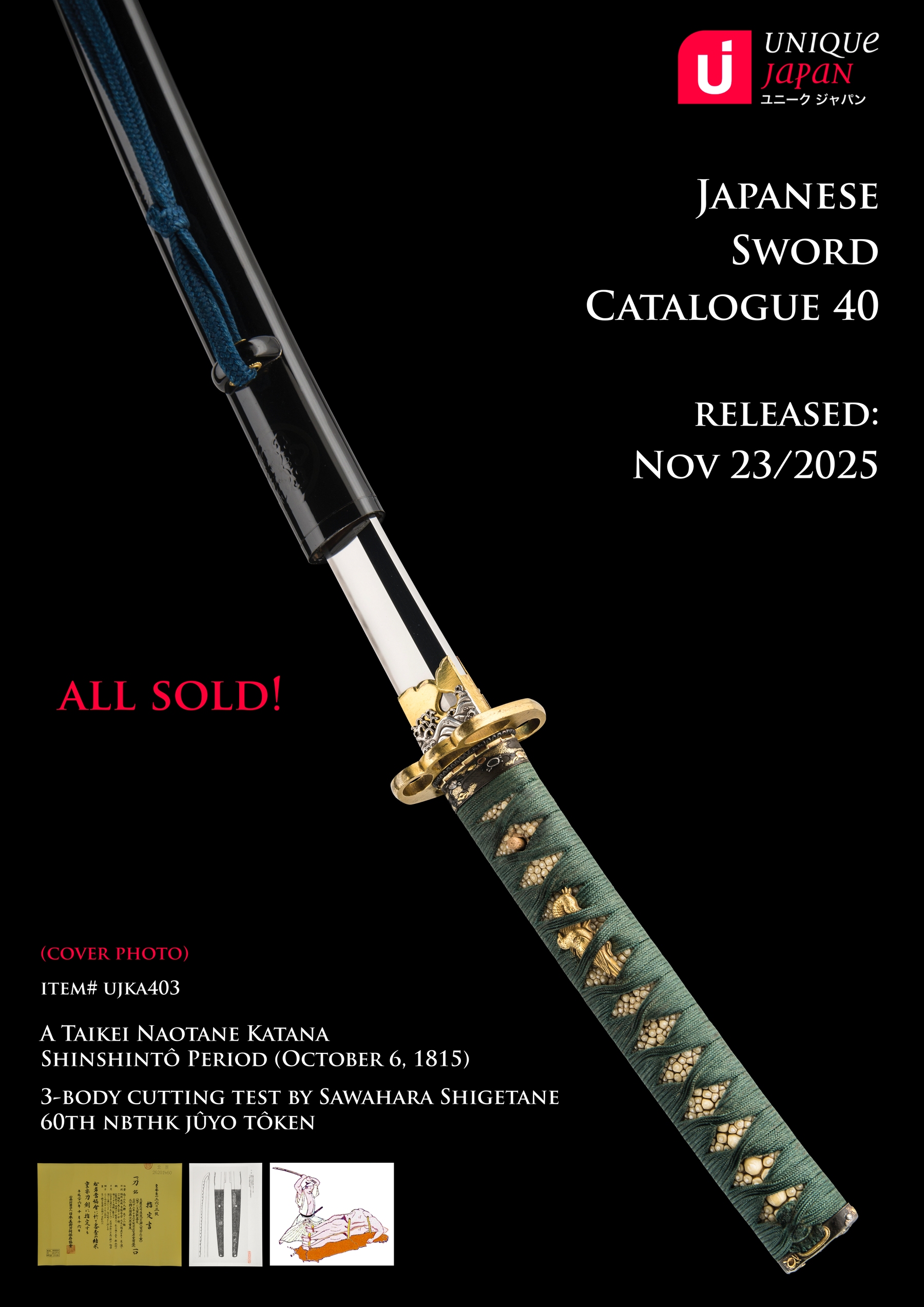
The prestigious Yoshioka-Ichimonji school is the maker of our fifth katana. In this weighty sword you will enjoy a narrow suguha-chôji at the base which then blossoms beautifully about halfway up into a wide ô-chôji-midare — rather like having two swords in one. Visible mokume-hada in all sizes can be appreciated alongside midare-utsuri and mune-yaki, where the top spine of the blade looks to be on fire. Good potential custom koshirae project. The centrepiece of Catalogue 40 is a katana by Shinshintô grandmaster Taikei Naotane. This museum-worthy Jûyô Tôken blade has performed an ultra-rare three-body cutting test whereby a swordsmith — in this case Naotane’s master student Shigetane — carried out the tameshigiri. This appears to be the only Jûyô Tôken cutting-test piece in existence that can make this claim. Everything about this samurai-commissioned sword is collectible.
Next is a wonderful katana attributed to Naminohira Yasuyuki by the late Hon’ami Kôson, an immense figure in Japan’s sword world. Its distinctive ayasugi-hada and bright suguha / ko-gunome hamon is a joy to study under the light. For those seeking a sword from the Yamashiro Rai school, this Rai Kunizane katana warrants consideration. Kunizane flourished around the Shôwa era (1312–1317) and into the Nambokuchô period. The blade features a torii-zori shape with full-length bô-hi and a substantial kissaki, giving it a rather statuesque appearance.
The next exquisite collectible is a splendid sunnobi-tantô by shodai Ôwari Masatsune, exactly one shaku in length — a prime example of his early career work, before his son Nidai Masatsune died unexpectedly in 1609. The sword is accompanied by a rare and beautiful Edo period toppei koshirae paying homage to the ruling Tokugawa shôgunate. Nidai Kanemichi of the notable Mishina family is our tenth sword, and its hamon is quite rightly a ‘ten’ in eye-catchiness — a marvellous snow-capped $1 that uniquely bunches into groups of two and three. Awesome cloud dragons guard the koshirae on both the fuchi-kashira and menuki, and the saya displays gorgeous Tsugaru-nuri lacquerwork originating from wintry Aomori. Our third Hizen blade is an absolutely splendid katana by Shodai Masahiro, featuring a magnificent gunome-chôji-midare hamon over a tightly forged konuka-hada. Its shirasaya carries a sayagaki by Kunzan sensei, and a striking koshirae with black maki-e depictions of dragonflies within a garden theme. Another shodai smith follows in the form of Darani Katsukuni, whose magnificently sharp katana displays a brilliant sambonsugi hamon cascading the length of the blade like a pulsing heartbeat. Its elegant Edo period koshirae features imperial chrysanthemums, surging waves, and adorable monkeys.
Right around the corner are two more swords you must know about. First is a tremendous katana by Tsuda Sukenao, student and son-in-law of grandmaster Sukehiro. This toran-ba blade is dated to August 1690, when Sukenao was 53 years old — significant as he passed away at 55, making this one of the last swords he ever made. We wrap up the catalogue with a Tokubetsu Jûyô Tôken naginata-naoshi katana by Osafune Yoshikage. Its certificate describes a gallant naginata-naoshi shape with kinsuji, sunagashi, and other hataraki, and calls it an outstanding masterwork among all blades known by the smith. Extraordinary.
Thank you as always for your passion for life. We look forward to serving you.
Warm regards,
Pablo Kuntz
November 2023