
ITEM# UJKA174 – Catalogue 40 – Sold
A Sue-Hôshô Katana (保昌・貞家)
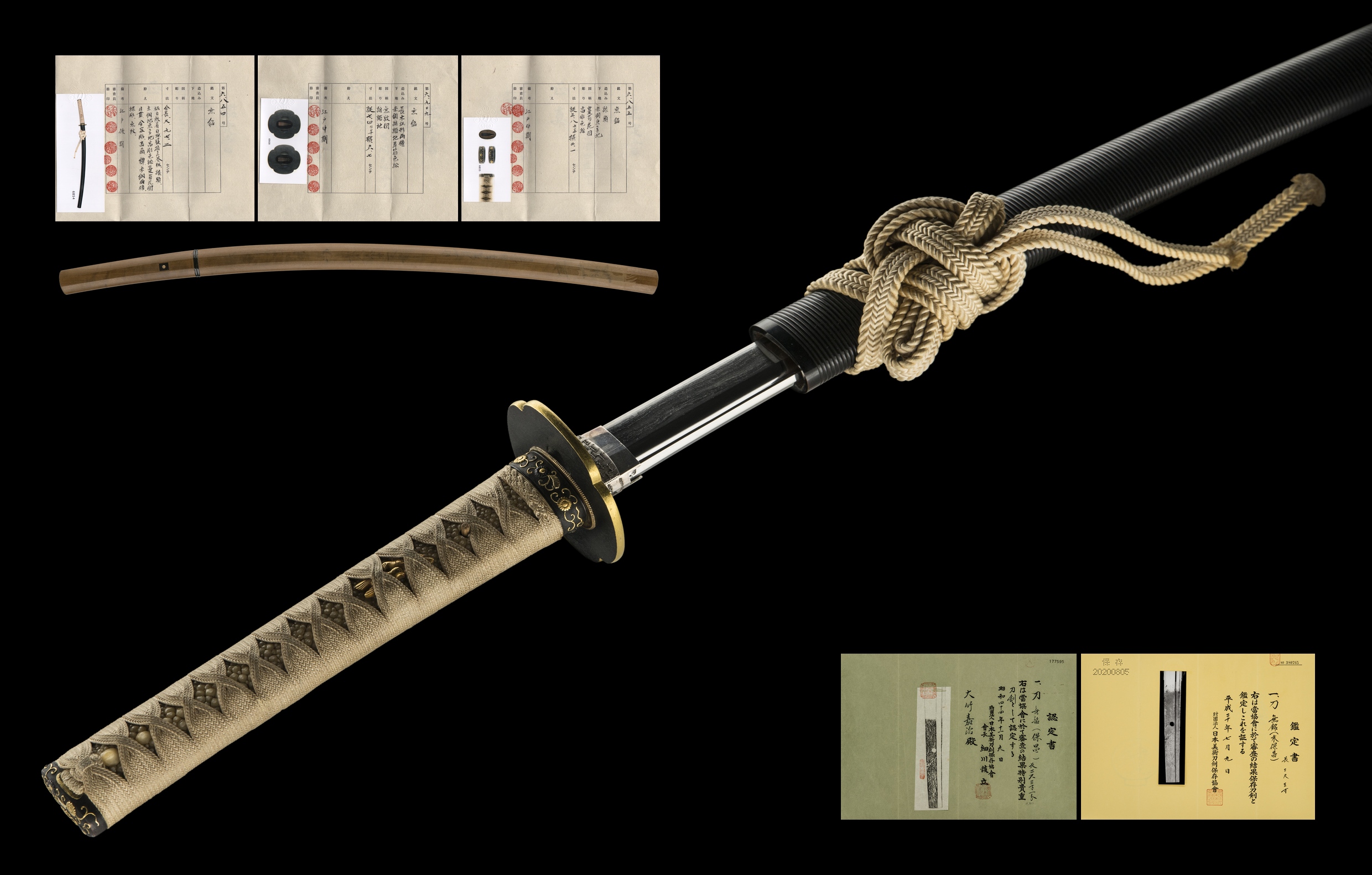
The Hôshô school holds a singular place amongst the five major schools of the Yamato tradition. Alone amongst them, the smiths of Hôshô forged exclusively in the pure straight-grain pattern known as masame-hada – a discipline that demanded extraordinary control and produced steel of unmistakeable character. The school began in the middle to late Kamakura period and counts Sadamune, Sadayoshi, and Sadatsugu amongst its finest names. Blades attributed to the Sue-Hôshô school are those made in the early Muromachi period, circa the 1400s.
This sword carries an NBTHK Hozon certificate attributing it to the Sue-Hôshô school, yet its provenance reaches considerably further back. A former green Tokubetsu Kichô certificate – one of the most respected verdicts of the old system – placed it at least a century earlier, to Hôshô proper. Confirming this elevated attribution, the sword carries a sayagaki by Dr. Satô Kanzan, the eminent scholar and author, who authenticated it to Hôshô Sadaie, a smith working during the Bunpô era (1317-1319) of the late Kamakura period. The jihada of undulating masame-hada with fine channels of chikei gleaming like comets through the steel fully supports this reading.
The koshirae that accompanies this blade is itself a remarkable object. Crafted in the late Edo period, the kizami-saya – its every ring hand-carved – is lacquered in glossy black and clearly takes its inspiration from the straight grain of the blade’s own masame-hada. The fittings, attributed to the celebrated Yoshioka Inaba no Suke school, feature chrysanthemums and karakusa vines in gold and shakudô over a fine nanako ground – a celebratory suite of the highest craft. The tsuka is wrapped in beautifully preserved white silk, with a matching pair of gold loving birds as menuki. Altogether, an inspiring piece of Japanese sword history.
| Item Number | UJKA174 |
| Sword Type | Katana |
| Attribution | Sue-Hôshô school (mumei); formerly attributed to Hôshô Sadaie by Tokubetsu Kichô and sayagaki |
| School | Sue-Hôshô (Hôshô school, Yamato tradition) |
| Province | Yamato |
| Period | Kôtô – Early Muromachi period (Kanshô era: 1460~1466) |
| Nagasa | 69.6cm (o-suriage) |
| Sori | 1.70cm |
| Moto-haba | 2.8cm |
| Weight | 550g |
| Nakago | O-suriage, kiri-nakago-jiri (straight cut), deep rich brown patina, one mekugi-ana |
| Jihada | Undulating masame-hada (straight grain) with fine channels of chikei |
| Hamon | Bright beaming hoso-suguha |
| Certificates | NBTHK Hozon; NBTHK Tokubetsu Kichô (attributed to Hôshô school); NTHK-NPO Kanteisho (tsuba, fuchi-kashira, koshirae) |
| Sayagaki | Dr. Satô Kanzan — attributed to Hôshô Sadaie, dated Shôwa kanoe-inudoshi shoshun kichijitsu (early spring, Year of the Dog, 1970) |
| Koshirae | Edo kizami-saya kuro-roiro-nuri uchigatana-koshirae — late Edo period (1780~1867); NTHK-NPO certified |
| Tsuba | Formal shakudô tsuba with chirimen-hada and gold accents on the rim; attributed to Yoshioka Inaba no Suke (Edo period); NTHK-NPO certified |
| Fuchi-kashira | Fine nanako ground with chrysanthemums and karakusa vines in gold and shakudô; attributed to Inaba no Suke Yoshioka (mid-Edo period, 1700s); NTHK-NPO certified |
| Menuki | Pair of loving birds, gold |
| Tsuka | White silk wrap over same |
| Habaki | Silver habaki with weave-like file marks |
| Catalogue | Catalogue 40 |
| Status | Sold |
| Includes | Shirasaya with sayagaki, Edo kizami koshirae, fabric bags, stand, kit, description |