
ITEM# UJKA423 – Catalogue 40 – Sold
A Naminohira Yasuyuki Katana (波平安行)
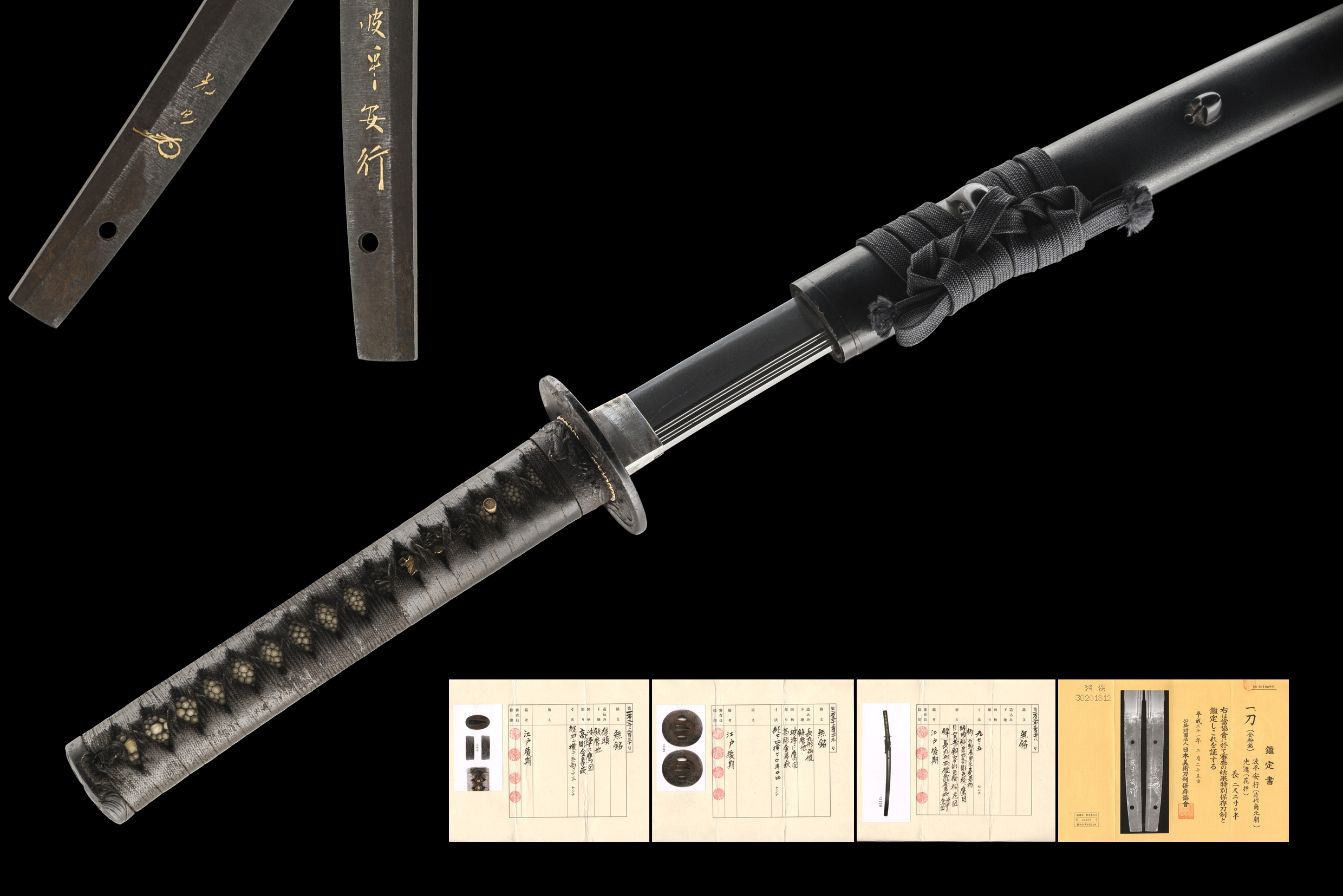
The Naminohira school, rooted in Satsuma province on the southern tip of Kyûshû, can trace its origins all the way back to the late Heian period (900-1184). Smiths of the school worked exclusively in service of the Satsuma clan and observed a strict rule of transmission known as Isshi-sôden – secrets of the craft passed only to one’s son or a single chosen student. This katana has been attributed to Naminohira Yasuyuki, second generation, who worked during the turbulent Nambokuchô period circa 1338-1362. His given name was Shôhei, and he was said to be the son or nephew of the first generation Yasuyuki.
The attribution was painted in gold lacquer (kinpunmei) on the nakago sometime in the early 1900s by the late great Hon’ami Kôson (1879-1955), together with his monogram (kaô). Kôson was a towering figure in the Japanese sword world – a distinguished scholar, author of foundational texts on sword appraisal, and the man who coined the famous system of the gokaden, the five great traditions of the kotô period. His kinpunmei on a blade carries genuine weight.
The blade itself rewards careful study. The distinctive ayasugi-hada – that compressed, undulating grain named after the resonance-enhancing carving found on koto and shamisen instruments – runs throughout, with masame, nagare and deep swirling chikei. The suguha and ko-gunome hamon in rich nie-deki flows with ko-ashi, uchinoke and the characteristic nezumi-ashi – a strong signature of the Naminohira school. Impressively carved gomabashi grooves add a further spiritual dimension. The sword comes with a fine set of antique Satsuma-koshirae from the Late Edo period, lacquered black with stone-surface texture, the tsuba attributed to Ishiguro Koretsune with a matching hawk-and-wave theme throughout the fittings.
| Item Number | UJKA423 |
| Sword Type | Katana |
| Attribution | Attributed to Naminohira Yasuyuki, second generation (kinpunmei by Hon’ami Kôson & kaô) |
| School | Naminohira |
| Province | Satsuma |
| Period | Kotô – Nambokuchô period (1346-1368) |
| Nagasa | 66.8cm (o-suriage) |
| Sori | 1.2cm |
| Moto-haba | 2.91cm |
| Weight | 770g |
| Nakago | O-suriage (greatly shortened), kiri-yasurime (straight file marks), 2 mekugi-ana |
| Jihada | Masame-hada mixed with ayasugi-hada and nagare with deep swirling chikei |
| Hamon | Chû-suguha and ko-gunome in nie-deki, ko-ashi, uchinoke and nezumi-ashi |
| Boshi | Ko-maru |
| Certificates | NBTHK Tokubetsu Hozon (issued Heisei 31 / 2019, February 25th); NTHK-NPO Kanteishô (tsuba, fuchi-kashira and koshirae) |
| Koshirae | Edo Satsuma-gatana-koshirae (kuro-ishime-ji nuri saya), Late Edo period (1780-1867) |
| Tsuba | Polished iron, attributed to Ishiguro Koretsune (Edo Ishiguro school), hawk and wave design, NTHK-NPO Kanteishô certified |
| Fuchi-kashira | Matching hawk and wave theme, NTHK-NPO Kanteishô certified |
| Menuki | Shakudô, paulownia flower design |
| Tsuka | Silk braid wrap over same (ray skin), aged with waxy texture |
| Habaki | Silver habaki with diamond design file marks |
| Catalogue | Catalogue 40 |
| Status | Sold |
| Includes | Shirasaya, Edo Satsuma koshirae, fabric bags, stand, maintenance kit, description |