
ITEM# UJKA424 – Catalogue 40 – Sold
A Katsukuni Katana (伊豫大掾橘勝国作)
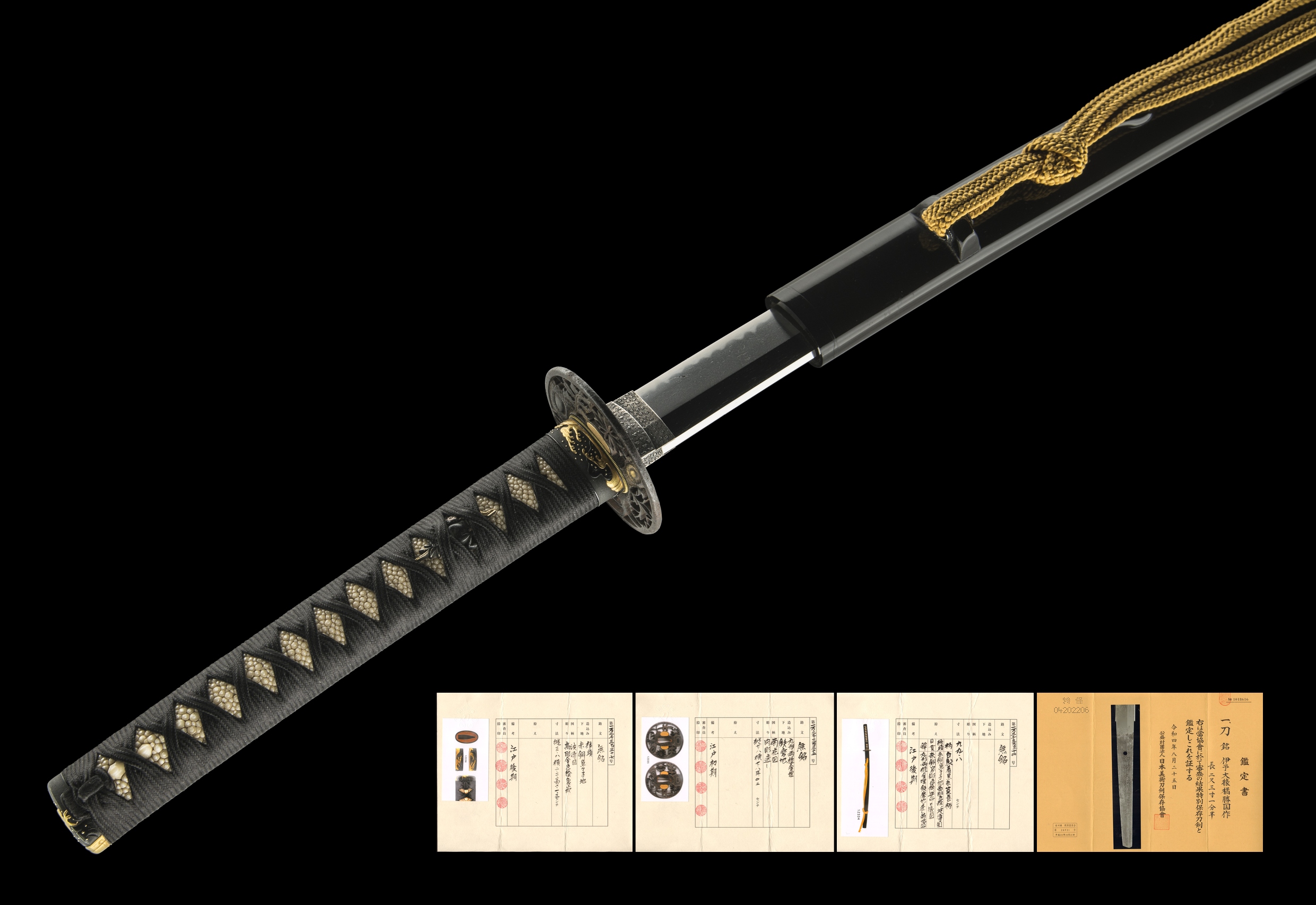
The name Katsukuni – literally ‘victorious province’ – was no accident. It was bestowed upon the smith by the powerful Maeda daimyô family of Kaga, along with the honorary court title Iyo Daijô and the prestigious clan name Tachibana. First generation Katsukuni, founder of the shintô-era Darani school, traced his lineage through the ancient Rai tradition and counted himself the 17th generation from the legendary Rai Kuniyoshi. His school had roots stretching back through the kotô period, through the Echizen Chiyozuru line and into the forges of Kaga province, before the line continued for seven generations into the Meiji era.
Katsukuni’s signature achievement was his sambonsugi-hamon, modelled on the celebrated Seki-Kanemoto school but with a Kaga refinement: nie applied in the valleys of the three-cedar pattern, giving the temper line a depth and texture that marks out the finest examples. This katana delivers exactly that – a prominent, rhythmic sambonsugi hamon cascading the full length of the blade with sunagashi and kinsuji threading through. The jihada is a characterful mix of itame and straight-grain masame-hada with swirling chikei. The kissaki at nearly 4cm is a bold chû-kissaki that gives the blade an authoritative, commanding presence. Katsukuni is ranked jô-saku as a superior swordsmith, and this blade fully represents that standing – solid, sharp, and classically Kaga in character.
The Edo period koshirae is a collector’s piece in its own right. The iron tsuba, certified Ko-Hagi school from Nagato province, is pierced in a magnificent kikka-no-zu (chrysanthemum) design with gold-filled hitsu-ana – a luxury only a samurai of considerable means could afford. The fuchi-kashira, attributed to the skilled metalsmith Ozaki Naomasa (circa 1763-1782), are finished in shakudô with nanako ground and depict surging waves in gold relief. The menuki are delightful: small monkeys carrying bamboo upon their shoulders, with an amusing upward gaze captured in the carving. Together the fittings make this one of the more distinguished koshirae to come through the Unique Japan archive.
| Item Number | UJKA424 |
| Sword Type | Katana |
| Swordsmith | Iyo Daijô Katsukuni (1st gen.) |
| Swordsmith (JP) | 伊豫大掾勝国 (初代) |
| Signature | Iyo Daijô Tachibana Katsukuni saku |
| School | Darani |
| Province | Kaga |
| Period | Shintô – Early Edo period (Kanbun era: 1661-1673) |
| Nagasa | 70.2cm |
| Sori | 1.0cm |
| Moto-haba | 2.96cm |
| Weight | 755g |
| Nakago | Ubu (original, unaltered); kata-sujikai-yasurime (diagonal file marks); 1 mekugi-ana |
| Jihada | Itame with masame-hada and swirling chikei |
| Hamon | Kanemoto-like sambonsugi with sunagashi and kinsuji |
| Certificates | NBTHK Tokubetsu Hozon; NTHK-NPO Kanteisho (tsuba, fuchi-kashira, koshirae) |
| Fujishiro Rank | Jô-saku (superior swordsmith) |
| Sharpness Rating | Ô-wazamono (maker of extremely sharp swords) |
| Koshirae | Kuro-roiro-nuri saya uchigatana-koshirae; Late Edo period (1780-1867) |
| Tsuba | Polished iron, sukashi kikka-no-zu (chrysanthemum design); Ko-Hagi school, Nagato province; gold-filled hitsu-ana; NTHK-NPO certified Early Edo period |
| Fuchi-kashira | Shakudô with nanako ground, surging waves in gold relief; attributed to Ozaki Naomasa (circa 1763-1782) |
| Menuki | Monkeys carrying bamboo; shakudô |
| Tsuka | Black braid (kurogumi) over same |
| Habaki | Silver, cluster design |
| Catalogue | Catalogue 40 |
| Status | Sold |
| Includes | Shirasaya, Edo koshirae, fabric bags, stand, kit, description |