
ITEM# UJKA478 – Catalogue 45 – Sold
A Shodai Tadakuni Tameshigiri Katana (肥前住播磨大掾藤原忠国)
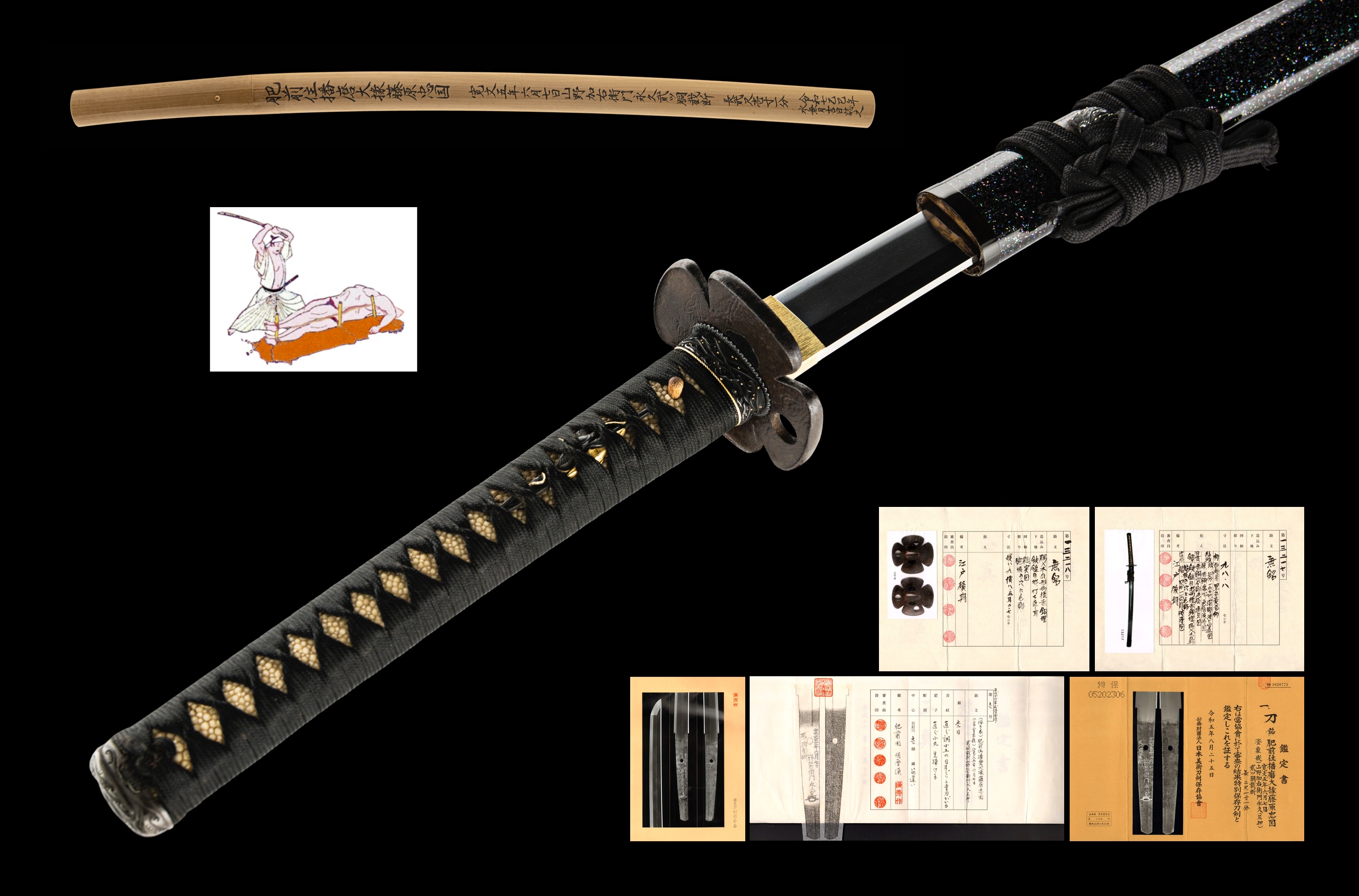
Shodai Harima Daijô Tadakuni was one of the most distinguished swordsmiths of Hizen Province during the mid-1600s. A nephew and direct student of grandmaster Tadayoshi, he was part of the Hashimoto family lineage and contributed significantly to the development of the Hizen-tô tradition. In 1634 he was granted the honorary title “Harima Daijô” – Lord of Harima Province – marking the formal beginning of his career under the name Tadakuni. Working under the patronage of the Nabeshima clan for the Ôgi domain, he earned a reputation for technical excellence and elegant craftsmanship that placed him firmly among the finest Shintô-period smiths. His blades are admired for their graceful proportions, shallow curvature, and well-balanced chû-kissaki – and above all for the incomparable konuka-hada, the “rice-bran grain” steel texture that is the hallmark of Hizen quality.
While many of Tadakuni’s works feature a flamboyant gunome-chôji-midare hamon, this katana represents his classical, restrained side – forged in a deep chû-suguha with a bright, even nioguchi, nijû-ba, sunagashi, and kinsuji. The jihada is splendid konuka-hada with wonderful ji-nie and plenty of chikei. The bôshi is ko-maru with a clean turnback. The nakago is ubu with sujikai-yasurime file marks and one mekugi-ana, and bears the full long signature “Hizen-jû Harima Daijô Fujiwara Tadakuni” chiselled in a confident, flowing hand. On the reverse of the nakago, a gold-inlaid inscription records that on the seventh day of the sixth month of Kanbun 5 (June 7th, 1665), sword-tester Yamano Ka’emon Nagahisa conducted a tameshigiri cutting test on this blade, severing through two human bodies in a single stroke – futatsu-dô setsudan. This is an exceptional and rare distinction, documented in gold for eternity.
The accompanying late-Edo koshirae is lacquered in aogai-mijin-nuri – fine particles of mother-of-pearl suspended in black lacquer, producing a shimmering, jewel-like surface that catches light with extraordinary subtlety. The fuchi is forged in rich dark-chocolate shakudô with gold highlights depicting crashing waves; the kashira and kojiri echo the same wave motif in softer-toned shibuichi. The menuki depict ukai – cormorant fishing – rendered in gold and shakudô, a poetic subject symbolising loyalty and the master-retainer bond. The tsuba, by an armourer (katchû-shi) of the late Edo period, is iron with tsuchime-ji hammered surface and an elongated lobed form with udenuki-ana arm cord holes – martial, austere, and entirely appropriate for a sword of this character. A gold habaki on copper ground with exquisite file marks and a chrysanthemum-patterned koshirae bag complete a mounting of outstanding presence. The original torokusho registration card, issued January 25th, 1951 in Nagasaki – serial number 1198, one of the very first swords registered in Japan – accompanies the sword and strongly suggests this blade remained in Hizen province from the day it was forged until modern times.
| Item number | ujka478 |
| Sword type | Katana |
| Swordsmith | Hizen-jû Harima Daijô Fujiwara Tadakuni (Shodai – first generation) |
| Swordsmith (JP) | 肥前住播磨大掾藤原忠国 |
| School | Hizen-tô (Hashimoto / Tadayoshi lineage) |
| Province | Hizen |
| Period | Shintô, early Edo – Meireki era (1655–1658) |
| Nagasa | 63.9cm (ubu) |
| Sori | 0.76cm |
| Moto-haba | 3.16cm |
| Saki-haba | 2.30cm |
| Kissaki | 3.63cm |
| Moto-kasane | 6.7mm |
| Saki-kasane | 4.9mm |
| Nakago | 19.1cm, ubu, sujikai-yasurime, mekugi-ana 1, iriyama-gata nakago-jiri |
| Weight | 745g |
| Jihada | Splendid konuka-hada with wonderful ji-nie and plenty of chikei |
| Hamon | Deep chû-suguha, bright nioguchi, nijû-ba, sunagashi, kinsuji, yakidashi |
| Bôshi | Ko-maru turnback |
| Tameshigiri | Futatsu-dô setsudan (two bodies in one stroke) – Yamano Ka’emon Nagahisa, June 7th 1665, Kanbun 5. Gold inlaid on nakago (ura). |
| Tameshigiri (JP) | (金象嵌)寛文五年六月七日山野加右衛門永久(花押)貮ツ胴截断 |
| Certificate 1 | NBTHK Tokubetsu Hozon (#1020773, Reiwa 5, August 2023) |
| Certificate 2 | NTHK-NPO Yûshûsaku – Masterwork designation (Heisei 16, December 2004) |
| Certificates 3–4 | NTHK-NPO Kanteishô (koshirae and tsuba certified as Authentic) |
| Torokusho | Original registration card – Nagasaki Prefecture, No. 1198, Showa 26 (January 25th, 1951) |
| Fujishiro rank | Jô-saku |
| Sharpness rating | Wazamonô |
| Koshirae | Aogai-mijin-nuri saya, uchigatana-koshirae, late Edo (1780–1868) |
| Tsuba | Katchû-shi (armourer) – iron, tsuchime-ji, elongated lobed form, udenuki-ana, late Edo (NTHK-NPO certified Authentic) |
| Fuchi-kashira | Shakudô fuchi (wave motif, gold highlights) / shibuichi kashira (wave motif) |
| Kojiri | Shibuichi, wave motif |
| Menuki | Ukai (cormorant fishing) – gold and shakudô |
| Tsuka | White samekawa, hishimaki, black ito |
| Habaki | Gold on copper ground, exquisite file marks |
| Catalogue | Catalogue 45 |
| Status | Sold |
| Included | Shirasaya, fabric bag (chrysanthemum design), stand, kit, printed description, original torokusho, NTHK-NPO framable photograph |