
⇩ Download Catalogue 45 (261MB)
Free to download. Most swords in this catalogue are sold; two remain available.
Index of Swords
Opening Remarks
Hi everyone, I hope all is well and that you had a wonderful summer. In August, Hannah and I travelled to see family and friends in Montreal, Canada, and we drove about eight hours for Hannah’s first trip to New York City. Hannah went completely bananas when we crossed the Hudson River with the top down and Taylor Swift blasting from the speakers — ‘Welcome to New York!’ We stayed for three nights with my close client and friend Michael, where I was able to reunite myself with his top jûyô and tokubetsu jûyô swords acquired through Unique Japan over many years. I loved the fact he had vinyl playing in the background — it has inspired me to purchase my own turntable for the first time since the 1980s!
Let’s get rocking with the swords in Catalogue 45! There is a family theme within these twelve lots that you’ll definitely appreciate. We kick things off with an Edo period daishô pairing a wakizashi and katana by the Shintô period’s fifth and sixth generation Sukesada of Bizen province. The blades beam with gunome-chôji-midare and a brilliantly composed suguha hamon. The daishô koshirae features formal black lacquer with gold-accented fittings, all mounted in matching formal attire, radiating dignity and commanding presence. A perfect family keepsake from father to son.
Next up is a top-class samurai sword by Shodai Harima Daijô Tadakuni — a distinguished swordsmith of Hizen province during the mid-1600s. On June 7th, 1665, sword-tester Yamano Ka’emon Nagahisa used this muscular blade to sever through two human bodies in one stroke. The test result is documented in gold inlay on the nakago, solidifying Tadakuni’s wazamonô ranking. A gorgeous Edo period koshirae with an eye-catching aoi-gai (mother-of-pearl) lacquered scabbard and beautiful fittings showcasing a striking wave motif will look incredible on display in any home or office.
We then travel back to the mid-Kamakura period for a wakizashi by one of my personal favourite smiths, Hatakeda Sanemori. A jôjô-saku smith active during the golden era of Japanese sword-making, Sanemori is believed to be the son or student of Moriie, founder of the Hatakeda school, who may have descended from the Ichimonji line. This elegant and substantial wakizashi displays a vivid chôji-midare incorporating the school’s iconic kawazu-ko-chôji hamon. Lovely utsuri is also seen with a heartbeat of ashi, yô, sunagashi, and long lines of kinsuji. Unique Japan can arrange to take this sword to Tanobe sensei for sayagaki services as a well-deserved extra touch.
Sharpness continues with a riveting katana attributed to Kanenori, a skilled smith of the San’ami group in Mino province during the Eishô period, circa 1504–1521. The hamon is a brilliant $1 with thick nie, interspersed with chôji, pointed togari, tobiyaki, and frequent sightings of sunagashi and kinsuji. This highly collectible sword severed through the chunky shoulder area of a human torso in November 1642, tested by Ôkawa Hachiemon who was retained by lords of the Maeda family. This katana also comes with a sayagaki by Hon’ami Chôshiki dating back to 1884 — remarkable — accompanied by a fabulous koshirae with exquisitely crafted matching-themed fittings depicting the famous late Heian period Ujigawa Battle during the tumultuous Genpei War.
The catalogue moves to a terrific ‘Last Samurai’ katana crafted by Gassan Sadayoshi in November 1864. Celebrated for reviving the Gassan school during the Shinshintô period, Sadayoshi trained in Edo under Suishinshi Masahide, and together with his adopted son, the great Gassan Sadakazu, established a thriving workshop in Ôsaka, working closely with the Japanese imperial family. This powerful katana was crafted just years before the fall of the Tokugawa shôgunate and features an exquisitely forged nagare-hada with excellent clarity and consistency. There is a stoic confidence in this sword and koshirae that is deeply spiritual.
For those seeking a jûyô tôken katana, be sure to claim the next piece — a katana attributed to the Miike school (pronounced Mee-kay) from the late Kamakura period, carrying a prestigious early 11th session NBTHK jûyô-tôken certification from 1963 and sayagaki by Kanzan sensei attesting that the sword was an heirloom of the powerful Shimazu family from Satsuma province. One could consider building a custom koshirae with the Shimazu kamon (crest) to pay honourable tribute to the sword and the family who treasured it for centuries.
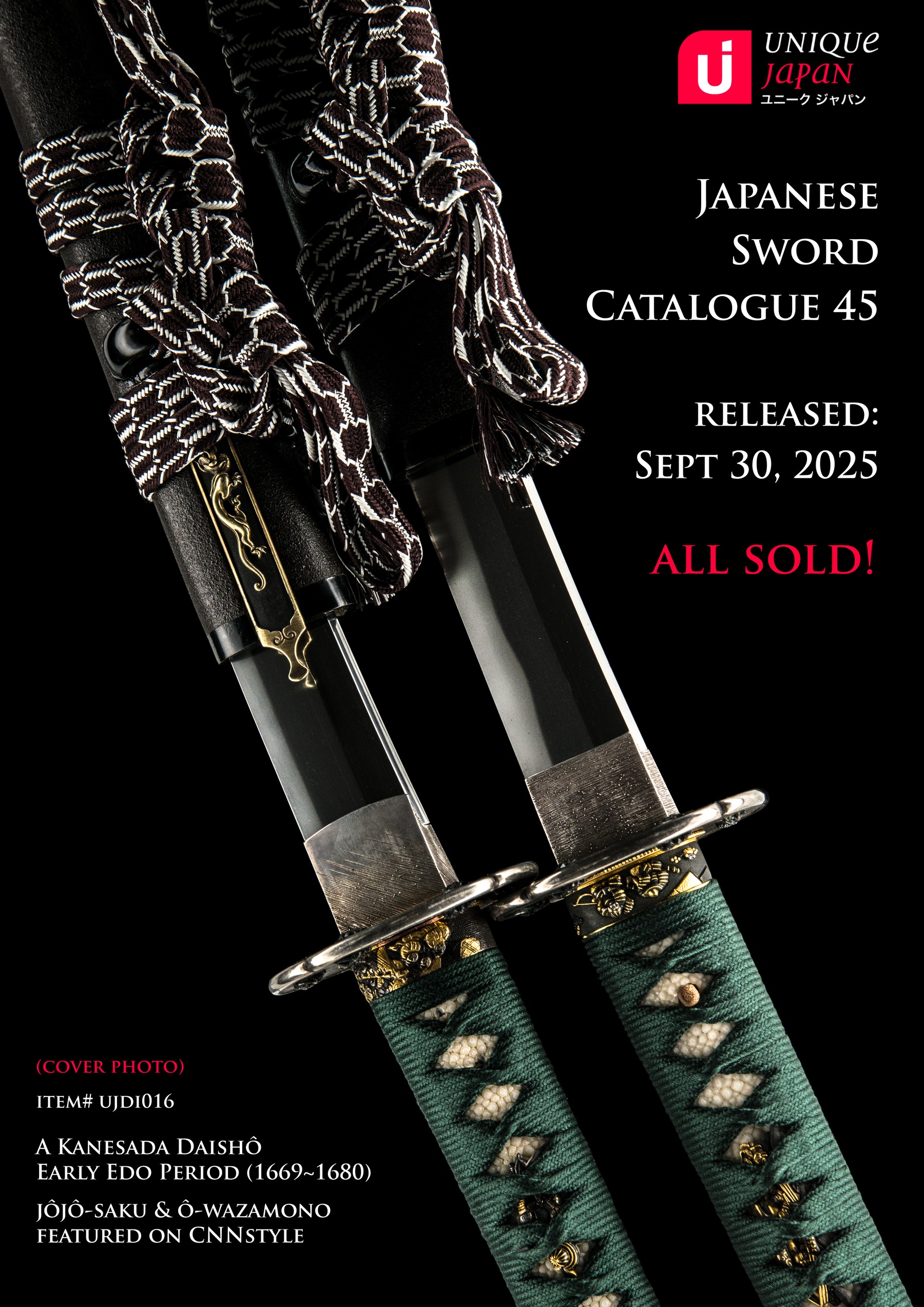
We now crank up the volume to eleven with a daishô by nidai Echigo no Kami Kanesada — a phenomenal talent within the Ôsaka-Shintô tradition. Out of respect for his sensei, he relinquished the name Kanesada in 1680 and worked under the title Sakakura Gon-no-Shin Terukane when his sensei’s son came of age. Forty-nine of Kanesada’s swords have achieved NBTHK jûyô tôken and two have reached the prestigious rank of NBTHK Tokubetsu Jûyô. This remarkable daishô with its glorious notare hamon and powerful $1 was featured by CNN Style on the topic of antique Japanese swords in an article for which I was interviewed back in 2015. Read on for my personal backstory on this special samurai daishô.
Next is a wonderful katana by a smith I have great respect for — Shodai Ippô, founder of the Ômi branch of the Ishidô school. Swords crafted by Ippô are rare — more commonly seen are blades by his son Sasaki Ippô — making this piece highly collectible and a great pleasure to study. This powerful katana has graceful curvature, thick ji-nie, vivid chikei, and a hamon that combines artistic brush strokes of notare and $1 with a tôranba-like peak at the monouchi. A handsome late Edo period koshirae lacquered in vermillion with a black base is pure samurai aesthetic. The tsuba captures the magnificence of Mount Fuji with a waving tribute to Hokusai’s Kanagawa masterpiece.
The glory of the Kamakura period resumes with a long and elegant 700-year-old tachi sugata-shaped katana by the Senjuin school. The Senjuin school represents the earliest and most refined among the five major schools of the Yamato tradition, its origins tracing back to the late Heian period when smiths connected with Tôdaiji temple forged blades at a sub-temple in the Senju valley. With its koshi-zori and small kissaki, the hamon is a refined hosô-suguha bright with nie, gently varied by small gunome. A marvellous uchigatana koshirae dating to the mid-Edo period (1700s) accompanies the sword, with tsuba and menuki recounting the powerful stories of the Go-Hôjô clan, the Honda family warriors, and the brutal siege of Odawara castle during the Sengoku-jidai. A samurai sword with integrity and class.
We fast forward to an outstanding katana by third generation Yasutsugu, bearing the iconic Tokugawa family aoi-mon, crafted with Nanban-tetsu in Edo and dated February 1666, when the smith was 37 years old. Measuring an impressive 72.9cm with futatsu-bi (two parallel grooves), the blade features finely forged ko-mokume-hada with ji-nie and plentiful chikei. A graceful suguha hamon with ko-gunome and delicate ashi displays brilliant activity, and a secondary mekugi-ana suggests a previous tameshigiri cutting test. The beautiful Edo period koshirae features a lovely tsuba attributed to Sano Naoyoshi with a taro leaf design and a fuchi-kashira depicting chrysanthemums, certified to Kaga Kuwamura Katsuhisa, who trained in the prestigious Gotô school.
We complete the catalogue with a katana and wakizashi attributed to first and second generation Hôki no Kami Nobutaka — prominent swordsmiths who served the Owari Tokugawa family. I acquired these swords in the UK during the spring of 2023, when both were in rather terrible shape. I could see the potential, however, and over a period of two years the swords were restored by top craftsmen in Japan and then submitted to the NBTHK. I couldn’t believe that the swords turned out to be related — another father and son! I was proud of the team effort that made it all happen. Preference will go to the client who takes both swords, and a ‘family discount’ will be offered. Building a formal daishô would be a meaningful undertaking, although it’s entirely optional.
Thank you all for your continued support — we look forward to serving you.
Warm regards,
Pablo Kuntz
September 2025