
ITEM# UJKA472 – Catalogue 46 – Sold
An Uda Tomotsugu Katana (宇多友次)
Uda Tomotsugu was a prominent early smith of the Uda school, which relocated from Yamato province to Etchû in the late Kamakura to Nanbokuchô period. The school’s founder, Ko-Nyûdô Kunimitsu (古入道国光), is said to have established his lineage in Etchû during the Bunpô era (1317-1319), blending the disciplined craftsmanship of the Yamato tradition with Sôshû influences absorbed through exposure to Norishige and his circle. Tomotsugu, a direct disciple or close successor of Kunimitsu, was active from the late 14th century, with blades attributed between the Eitoku and early Ôei eras (1381-1428) especially prized.
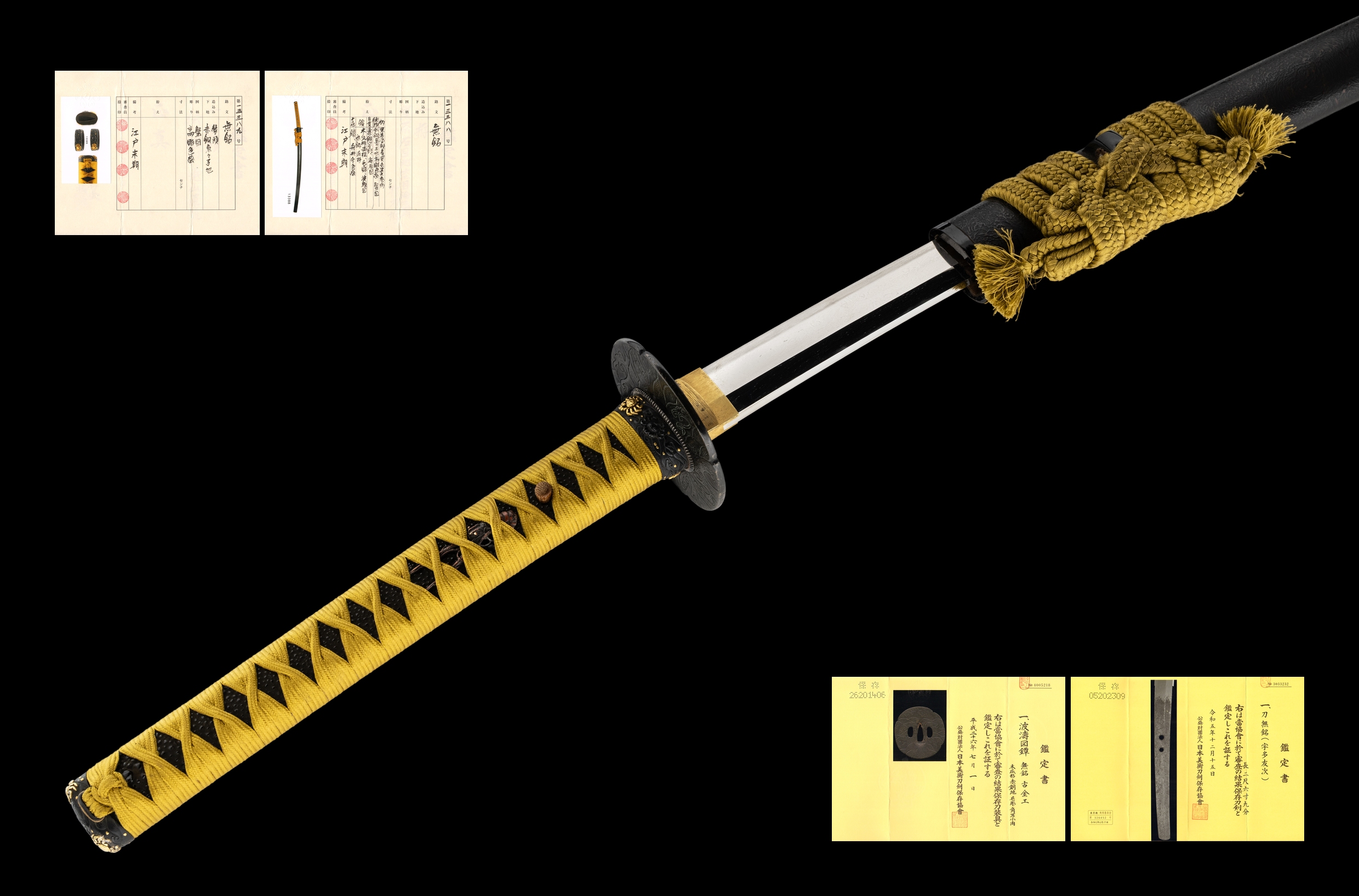
At over 81cm this is an extraordinary blade – tachi-length, yet with a curvature that reflects the transitional moment of the early Muromachi period, when swords were shifting from mounted combat to the standing draw of the true katana. An NBTHK judge confirmed both the Ôei-era dating and the essentially ubu condition of the nakago, with at most a slight machi-okuri. The vast majority of swords from this era or earlier are ô-suriage; to find one in original shape with a full 23.6cm nakago is a rare thing. The jigane is a beautifully forged mix of itame and mokume-hada threaded with flowing masame – the Yamato influence made visible – and punctuated by a long, impressive line of dark chikei. The hamon is a bright suguha with subtle undulations and scattered hotsure, animated by kinsuji, crescent-moon uchinoke, sunagashi, and kuichigaiba – a full complement of refined hataraki.
The accompanying Late Edo-period koshirae is unified by a water theme of uncommon quality. The saya is finished in a dark brown stone-surface lacquer with a wood-grain pattern (kuro-cha ishime-ji mokume-nuri). The tsuba is a superb Ko-Kinkô piece in shakudô, its lobed form carved in fine ke-bori hairline engraving with raging waves – it holds its own NBTHK Hozon certificate. The fuchi-kashira is attributed to Tôyama Naoyuki (浜野直随) of the Hamano school, crafted in shakudô with gold-accented crabs riding the waves, and carries its own NTHK-NPO Kanteishô certification. Completing the maritime ensemble are a pair of wonderfully sculpted lobster menuki – ise-ebi being among the most auspicious subjects in Japanese iconography. Two habakiare included: a gold habaki over copper ground, and a shakudô ganseki-habaki in a striking rock texture.
| Item Number | UJKA472 |
| Sword Type | Katana |
| Swordsmith | Attributed to Uda Tomotsugu (mumei) |
| School | Uda |
| Province | Etchû |
| Period | Kotô – Early Muromachi period (Ôei era: 1394-1428) |
| Nagasa | 81.6cm |
| Sori | 1.7cm |
| Moto-haba | 2.88cm |
| Saki-haba | 1.73cm |
| Kissaki | 2.75cm |
| Moto-kasane | 6.6mm |
| Saki-kasane | 4.2mm |
| Nakago | 23.6cm, ubu (possible slight machi-okuri), katte-sagari-yasurime, ha-agari kuri-jiri, 2 mekugi-ana |
| Weight | 740g |
| Jihada | Itame and mokume-hada mixed with flowing masame and dark chikei |
| Hamon | Suguha with kinsuji, uchinoke, sunagashi, kuichigaiba and hotsure |
| Certificates | NBTHK Hozon (sword and tsuba); NTHK-NPO Kanteishô (koshirae and fuchi-kashira) |
| Koshirae | Late Edo period (1780-1868) uchigatana-koshirae; kuro-cha ishime-ji mokume-nuri saya (dark brown stone-surface lacquer in wood-grain pattern) |
| Tsuba | Ko-Kinkô (古金工), mumei; mokkô-gata shakudô, raging waves in ke-bori hairline engraving; NBTHK Hozon |
| Fuchi-kashira | Attributed to Tôyama Naoyuki (遠山直随 / 浜野直随), Hamano school; shakudô with gold accents, crab and wave motif; NTHK-NPO Kanteishô |
| Menuki | Lobster (ise-ebi) pair |
| Tsuka | Hishi-maki style; deep-yellow silk over black-lacquered samekawa |
| Habaki | Two habaki: gold habaki with copper ground; shakudô ganseki-habaki (rock texture) |
| Catalogue | Catalogue 46 |
| Status | Sold |
| Includes | Shirasaya, Edo koshirae, fabric bags, stand, kit, printed description |