
ITEM# UJKA406 – Catalogue 39 – Sold
A Katsukuni Katana (伊豫大掾橘勝国作)
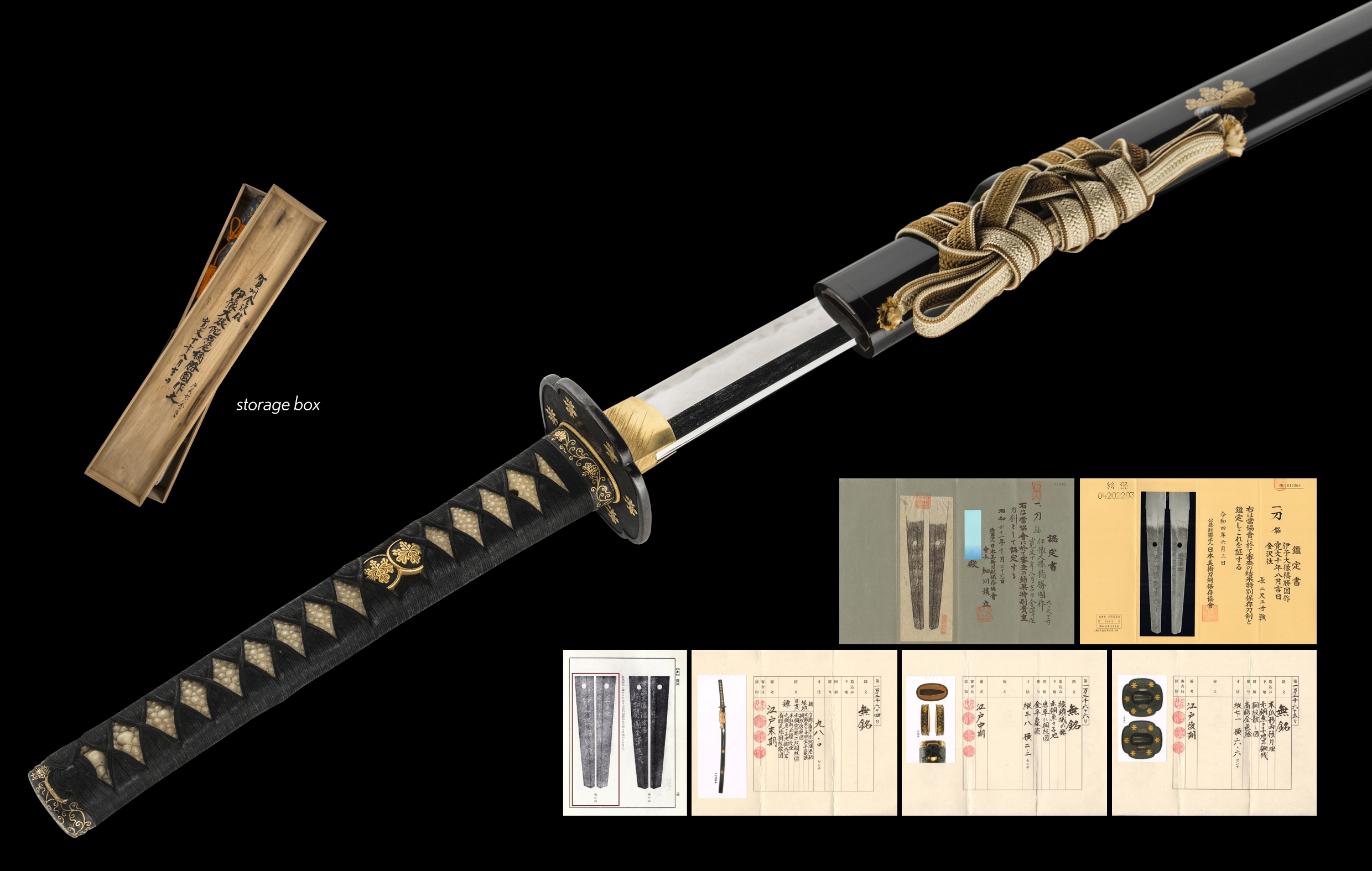
The name Katsukuni – meaning ‘victorious country’ – was bestowed upon this smith by the powerful Maeda daimyô family of Kaga province, whose seat was the castle town of Kanazawa. The first generation’s father, Ieshige, had already established the shintô Darani school as a serious force in Kaga smithing, but it was Katsukuni who elevated the lineage to national prominence. Through the patronage of chancellor Yotsuji Yoshiie and the recommendation of the Maeda family, he received the honorary court title Iyo no Daijô and adopted the clan name Tachibana, tracing his lineage – on whatever basis – to the 17th generation Rai Kuniyoshi. The Katsukuni line ran for seven generations until the Meiji era.
This katana was forged in August 1670, the tenth year of the Kanbun era, and bears the full late-career signature of the first generation – a bannen mei recorded in the prestigious Fujishiro Nihon Shintô Jiten reference book, where this blade is listed on page 34. The jihada is a characteristic mix of itame and straight-grain masame-hada running close to the shinogi, animated by swirling dark lines of chikei. The hamon is the school’s signature sanbonsugi – modelled on the Seki-Kanemoto tradition but distinguished by clusters of nie crystals pooled in the valleys between the cedar-tree peaks, a hallmark of the Darani school. The boshi takes the elegant saki-Jizô form, combining a midare komi transition with a rounded tip. The blade is rated ô-wazamono for cutting ability – among the highest rankings possible – and carries the Fujishiro rank of jô-saku.
The sword comes complete with a striking Edo period uchigatana-koshirae in glossy black lacquer adorned with gold kiri-mon crests in fine maki-e – one of the most refined family crests in Japanese heraldry. The shakudô tsuba with its nanako ground and raised gold kiri-mon carries an NTHK-NPO certificate, as does the fuchi-kashira attributed to Inaba no Suke Yoshioka of the mid-Edo period. The entire set has been cared for across generations and arrives in a vintage storage box with hakogaki and sayagaki by Kanzan Satô, appraised in 1972.
| Item Number | UJKA406 |
| Sword Type | Katana |
| Swordsmith | Iyo Daijô Katsukuni (1st gen.) |
| Swordsmith (JP) | 伊豫大掾勝国 (初代) |
| Signature | Iyo Daijô Tachibana Katsukuni saku / Kanazawa jû Kanbun jûnen hachigatsu kichijitsu |
| Date | Kanbun 10, 8th month, auspicious day (August 1670) |
| School | Darani (Shintô) |
| Province | Kaga (Kanazawa, Ishikawa) |
| Period | Shintô – Early Edo period (Kanbun era: 1661-1673) |
| Nagasa | 69.7cm (ubu) |
| Sori | 1.3cm |
| Moto-haba | 2.93cm |
| Weight | 630g |
| Nakago | Ubu (original, unaltered tang), sujikai-yasurime (diagonal file marks), iriyama-gata / Kashû nakago-jiri, 1 mekugi-ana. Length: 18.7cm |
| Jihada | Itame with masame hada with swirling chikei |
| Hamon | Sanbonsugi (Kanemoto-style) with nie in the valleys, sunagashi and kinsuji |
| Boshi | Midare komi with saki-Jizô |
| Certificates | NBTHK Tokubetsu Hozon (Reiwa 4 / 2022) & NBTHK Tokubetsu Kichô (Showa 41 / 1966); NTHK-NPO Kanteisho (tsuba, fuchi-kashira and koshirae) |
| Fujishiro Rank | Jô-saku (superior swordsmith) |
| Sharpness Rating | Ô-wazamono (maker of extremely sharp swords) |
| Sayagaki | Kanzan Satô — Shodai Katsukuni, Darani school, Kanbun 10 (August 1670), Shôwa 47 (1972) |
| Koshirae | Edo period uchigatana-koshirae — kuro-ro-nuri kirimon maki-e saya (Late Edo, 1780~1867) |
| Tsuba | Shakudô, multi-lobed, nanako ground with gold kiri-mon (paulownia crests); NTHK-NPO Kanteisho certified |
| Fuchi-kashira | Attributed to Inaba no Suke Yoshioka (mid-Edo, 1700s) — shakudô nanako with gold kiri-mon and ivy motif; NTHK-NPO Kanteisho certified |
| Menuki | Gold kiri-mon (paulownia crests) |
| Tsuka | Jabara-maki silk braid over same (stingray skin) |
| Habaki | Gold niju habaki (double habaki) with crisp file marks |
| Catalogue | Catalogue 39 |
| Status | Sold |
| Includes | Shirasaya with sayagaki by Kanzan Satô, Edo koshirae, vintage storage box with hakogaki, fabric bags, stand, maintenance kit, description |