
⇩ Download Catalogue 39 (115MB)
Free to download. 219 pages. All swords in this catalogue are sold.
Index of Swords
Opening Remarks
Hello! For as long as I can remember, I have loved wordplay — especially puns. My teenage friends would thwack my shoulder every time I came up with another groan-worthy one, and despite the constant beatings, I would annoy them any time I could. This penchant for puns did not stop when I lived in Japan. I met a few people, especially older men, who loved to horse around with words and phrases too. One such play on words was the number 39. ‘Three’ in Japanese is san and ‘nine’ is kyû. Put them together and you have san-kyû — which sounds like “thank you.” I can assure you, this was gold when I first clocked into it. And so, my friends and clients, Catalogue 39 is dedicated to you. Thank you for your trust. Thank you for your confidence. We have worked together on hundreds of quality antique Japanese swords over the years, and it has been an absolute privilege serving you all. San-kyû for all your support.
We kick off with a superb katana by Mizuta Kunishige with a gritty, soulful Sôshû-den influence and striking horimono work. This sword beams with confidence. I am very proud of the magnificent custom koshirae built for it in Japan, with a guiding theme revolving around Japan’s most beloved symbol — the sun. Next is a 700-year-old daishô by the Shikkake school. These swords represent a fine opportunity for the new caretaker to build a personal custom daishô koshirae or enjoy them as they are in shirasaya. Yamato-den swords embody a calm mystique that grows on you — the wavy nagare-hada and kinsuji exude a timeless beauty.
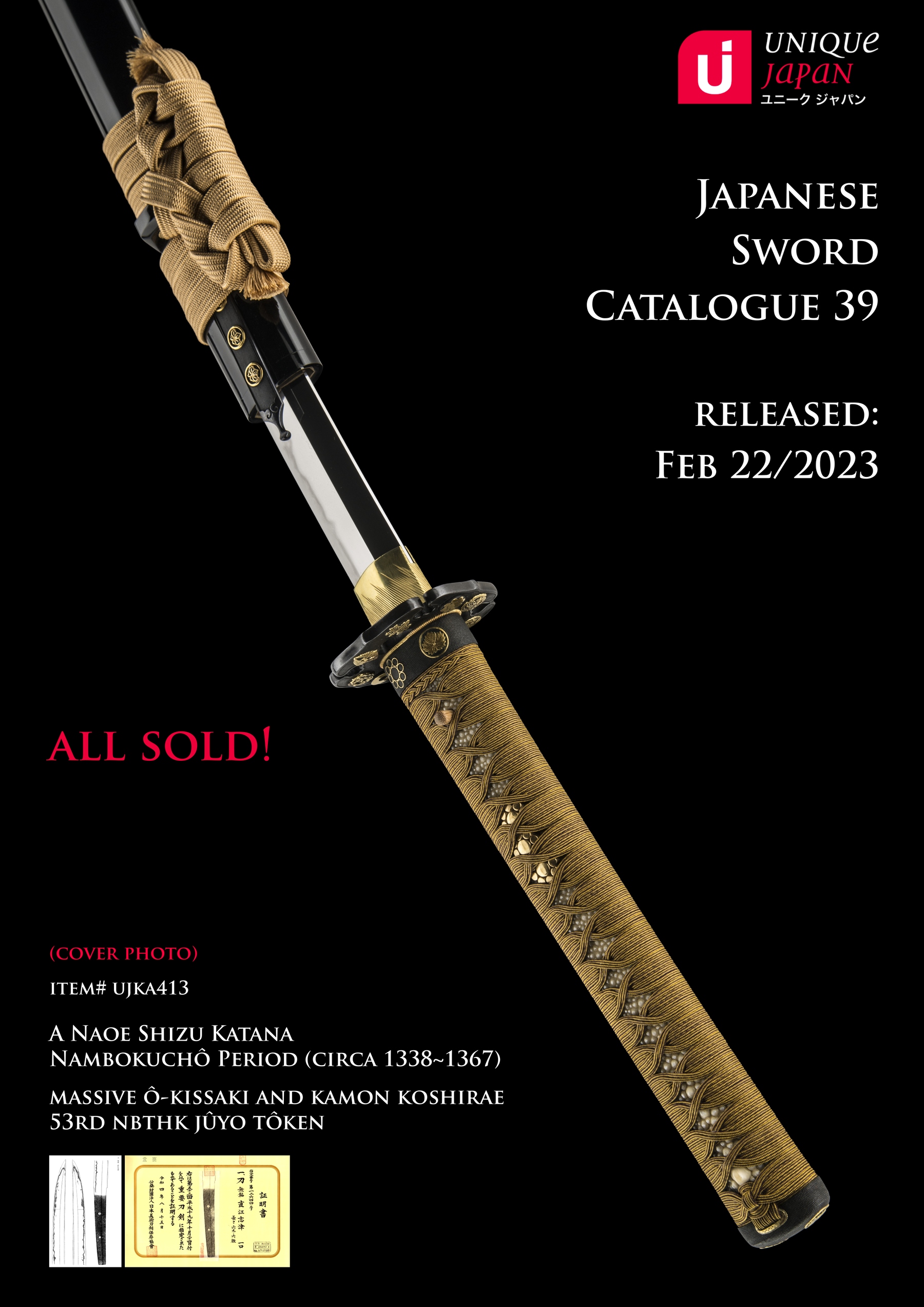
For those seeking a katana with a long ô-kissaki, look no further than the fabulous Naoe-Shizu katana. This NBTHK Jûyô piece is stunning in every way. The jihada is a fantastic mixture of itame, mokume, and nagare-hada with copious chikei and ji-nie. The hamon pumps along like a heartbeat, churning out Mino-tradition togari with tobiyaki, yô, sunagashi, and kinsuji. A terrific set of koshirae with countless family kamon decorates the piece with eye-catching class. Not all Naoe-Shizu swords are created equal — this one is a keeper. The following katana is by shodai Katsukuni, a name meaning ‘victorious country’ bestowed by the powerful Maeda daimyô family of the Edo period. The sword is listed in the prestigious shintô-jiten by Fujishiro and comes with its own striking Edo period koshirae, a vintage storage box with hakogaki, and a sayagaki by Kanzan sensei.
Our next sword is the most historically significant piece of the catalogue — a tantô by one of Japan’s greatest ever swordsmiths, Rai Kunitoshi. Ranked saijô-saku (grandmaster), four swords protected as kokuhô (National Treasures) were crafted by Rai Kunitoshi, two of which are tantôs. Certified as NBTHK Jûyô Tôken in 1982, the sword carries a sayagaki by former NBTHK chairman Honma Junji (Kunzan sensei) from the same year. It bears Kunitoshi’s iconic three-character signature on a beautifully curved furisode-nakago and was polished by renowned sword polisher Sasaki Takushi in 2016. Rai Kunitoshi’s son Ryôkai is the maker of the graceful wakizashi that follows. What ties this sword together so brilliantly is the fully matching dragon-themed koshirae crafted during the mid-Edo period — a terrific first sword for those beginning a collection, and equally appealing to seasoned nihôntô enthusiasts.
Shifting gears to the early Edo period, we have a magnificent katana by Echigo no Kami Kanesada — the adopted son of shodai Kanesada, later taking the name Sakakura Gennoshin Terukane. Kanesada II is one of the most important swordsmiths from Settsu province (Osaka), with some eighty swords having achieved Jûyô Tôken or Tokubetsu Jûyô certification. This perfectly healthy katana has a spectacular toran-ba (surging wave) hamon bursting with presence. The sayagaki by Dr. Satô Kanzan states that this katana is a masterwork among all works by Kanesada.
For collectors seeking a sword with a gorgeous grain pattern, the Shigezane katana of the Motoshige school deserves serious consideration. Hours can be spent gazing into the vivid textures of itame (plank grain), mokume (burl grain), and nagare-hada (running wavy grain). The tight razor-sawtooth hamon with falling yô is a delight that complements rather than overwhelms — Jûyô Tôken quality throughout. An outstanding set of matching iron-laden Edo period koshirae featuring Kumagai school rain and sand dragons gives the entire sword a dark and mysterious feel. The sayagaki by Tanobe sensei confirms this as a masterwork of Shigezane.
We complete the catalogue with a cutting-test wakizashi by Hizen Tadahiro. If you would like to own a cutting-test sword of your own, be sure to reach out directly, as these swords are often sold privately.
Thank you as always for your passion for life. Let’s have a great year ahead!
Warm regards,
Pablo Kuntz
February 2023