
ITEM# UJWA256 – Catalogue 39 – Sold
A Nidai Tadahiro Tameshigiri Wakizashi (近江大掾藤原忠廣)
Born Hashimoto Heishiro in Saga, Hizen province in 1614, the second generation (nidai) Tadahiro began working alongside his father, shodai Tadayoshi, from the age of ten. Guided by the school’s founding genius and great contemporaries including shodai Masahiro and Yoshinobu, he assumed leadership at nineteen following his father’s death in 1632 – and in July of 1641, just nine years after taking over, was granted the coveted honorific title of Ômi Daijô. He was only 28. He worked for an astonishing sixty years until his death in 1693 at the age of 81, and is ranked jôjô-saku – a highly superior smith – among the legendary smiths of Hizen.
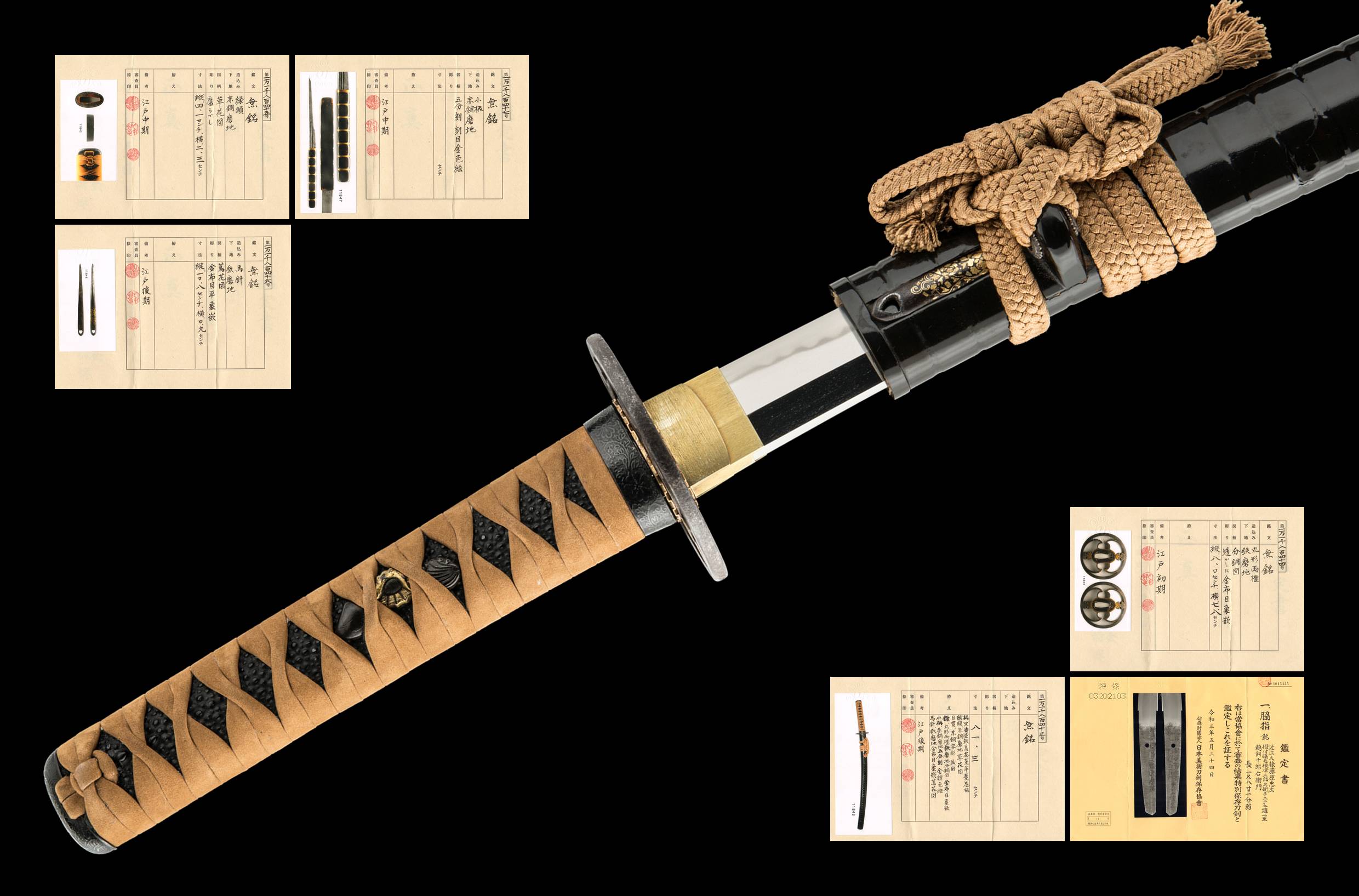
This long wakizashi carries one of the rarest features a blade can bear: a tameshigiri cutting test inscribed directly onto the nakago. Two testers – Nezu Saburôbei and Ukai Jûrôemon – together tested this blade, severing through the clavicle and chest of a convicted criminal into the mound below, and recorded it in classical Japanese on the ura. The cut itself, through the wakige (underarm/clavicle) and into the dodan (chest), represents one of the more demanding tests on the traditional body-cutting chart. The inscription also notes that the chôji-midare hamon was found magnificent, a rare editorial note from a tester. Sayagaki authentication by Dr. Satô Kanzan (Kanzan) accompanies the blade, dated Shôwa 46 (1971).
The blade itself is a veritable treat. Where the majority of nidai Tadahiro’s output features a straight suguha hamon, this piece bursts with a brilliant gunome chôji-midare that lights up the full length of the blade. The jihada is the school’s signature fine konuka-hada with that characteristic wet, glassy surface. Housed in a magnificent late Edo Higo uchigatana-koshirae complete with a Shôami school gold-inlaid tsuba, Misumi school fuchi-kashira bearing the Hosokawa kuyô-mon crest, seashell menuki, bashin (horse needle), and kogai, this is a complete, coherent ensemble of exceptional quality. The original torokusho (registration card), bearing serial number 151, dates to Showa 26 (1951) – one of the very first swords formally registered in Japan.
| Item Number | UJWA256 |
| Sword Type | Wakizashi |
| Swordsmith | Ômi Daijô Tadahiro (2nd gen.) |
| Swordsmith (JP) | 近江大掾忠廣 (二代) |
| Signature | Ômi Daijô Fujiwara Tadahiro |
| School | Tadayoshi school |
| Province | Hizen |
| Period | Shintô – Early Edo (post-1641) |
| Nagasa | 54.8cm |
| Sori | 1.67cm |
| Moto-haba | 2.95cm |
| Weight | 500g |
| Nakago | Ubu, sujikai-yasurime, 15.8cm, 1 mekugi-ana |
| Jihada | Konuka-hada |
| Hamon | Gunome chôji-midare |
| Certificates | NBTHK Tokubetsu Hozon (No. 1015425, Reiwa 3 / 2021) & NTHK-NPO Kanteisho |
| Fujishiro Rank | Jôjô-saku |
| Sayagaki | Dr. Satô Kanzan (Kanzan) — Nidai Tadahiro, dated Shôwa kanoto-idoshi (1971) |
| Tameshigiri (JP) | 摺付脇毛根津三郎兵衛手ニテ土壇ニ至 鵜飼十郎右衛門 |
| Koshirae | Higo uchigatana-koshirae (gobu-kizami kuro-ro-nuri saya), Late Edo period (1780-1867) |
| Tsuba | Shôami school, polished iron with gold nunome-zogan traces, scale design, early Edo (1603-1700); NTHK-NPO Kanteisho |
| Fuchi-kashira | Misumi school, Higo province (1700s); kashira with kuyô-mon (Hosokawa family crest) |
| Menuki | Seashell theme, in homage to Hizen province’s island setting |
| Habaki | Gold-wrapped niju-habaki |
| Catalogue | Catalogue 39 |
| Status | Sold |
| Includes | Shirasaya with Kanzan sayagaki, Higo koshirae (with bashin and kogai), orange silk koshirae bag, NBTHK Tokubetsu Hozon certificate, NTHK-NPO Kanteisho certificate, original torokusho (registration card no. 151, Showa 26 / 1951) |