
ITEM# UJKA365 – Catalogue 39 – Sold
A Kunishige ‘Horimono’ Katana (備中国水田住国重作)
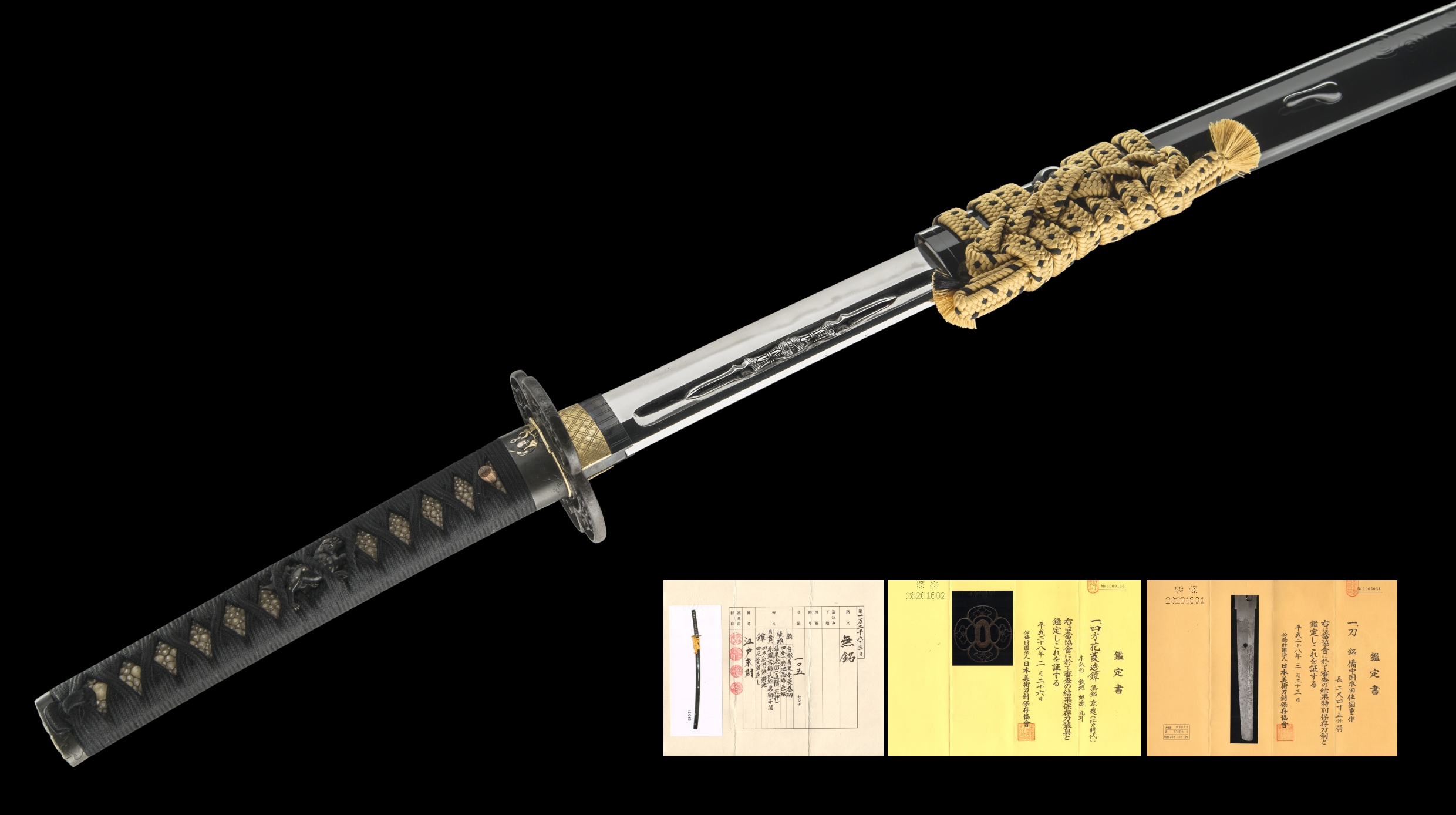
The Mizuta school traced its roots to a group of smiths living in Mizuta village, Bittchû province, said to be descendants of Ko-Aoe Tametsugu. In the Shintô period, the school’s character shifted dramatically – away from Sue-Bizen and Sue-Mihara traditions and towards a more electric Sôshû influence, with loads of visible nie crystals, a surging gunome-midare hamon, and plentiful hataraki that includes sunagashi and kinsuji. The most celebrated smith of the Shintô Mizuta school was Ôtsuki Yogoro Kunishige, also known as 5th generation Ôyogo Kunishige. He died young, leaving his son Katsubei – the 6th generation – in the care of his younger brother, swordsmith Ichizô.
This long, muscular katana is the work of Katsubei, the final working smith of the Ôtsuki branch, who flourished during the Kanbun era (1661-1673). He was ranked chû-jôsaku and wazamono for the cutting ability of his blades. The spiritual dimension of this sword is immediate and striking. On the omote (front), a boldly carved tokkosho (独鈷杵) – a single-prong vajra – symbolises the indestructibility of the diamond and the irresistible force of the thunderbolt. The reverse carries a rare hatahoko, a banner spear associated with Vaisravana, the God of War and one of the Four Heavenly Kings – scholar Markus Sesko notes that such engravings are uncommon and align perfectly with the Sue-Sôshû character of this blade. Together the two horimono make this katana an object of both lethal purpose and profound Buddhist symbolism.
The dazzling gunome-midare hamon surges with a deep, Sôshû-esque nioguchi, packed with sunagashi and kinsuji hataraki. The jihada is a gritty mokume with pronounced chikei, and the shinogi-ji displays a rare itame-hada more typical of Kamakura or Nambokuchô blades – a detail worth appreciating on a Shintô sword. A magnificent custom koshirae was built over two years around a theme of solar symbolism: maki-e suns on the lacquered black saya honouring Amaterasu, guardian shisa lion menuki leaping from aged samekawa, and a delightful fuchi-kashira depicting Zhang Guolao – the wine-loving Taoist immortal. This is a katana that unites lethal sharpness with layers of creative and spiritual tradition.
| Item Number | UJKA365 |
| Sword Type | Katana |
| Swordsmith | Kunishige (6th generation, Ôtsuki branch) |
| Swordsmith (JP) | 国重 (六代) |
| Signature | Bittchû no Kuni Mizuta jû Kunishige saku |
| School | Mizuta (Shintô) |
| Province | Bittchû |
| Period | Early Edo – Kanbun era (1661-1673) |
| Nagasa | 74.2cm |
| Sori | 1.40cm |
| Moto-haba | 3.14cm |
| Weight | 825g |
| Nakago | Ubu (original, unaltered); sujikai-yasurime (diagonal file marks); 19.4cm |
| Jihada | Gritty mokume-hada with pronounced chikei; itame-hada in the shinogi-ji |
| Hamon | Gunome-midare with deep Sôshû-esque nioguchi, sunagashi and plentiful kinsuji |
| Boshi | Midare-komi |
| Certificates | NBTHK Tokubetsu Hozon (blade); NBTHK Hozon & NTHK-NPO Kanteisho (tsuba and koshirae) |
| Fujishiro Rank | Chû-jôsaku |
| Sharpness Rating | Wazamono |
| Koshirae | Custom uchigatana-koshirae; kuro-ronuri kin sumi maki-e saya lacquered in glossy black with gold and black maki-e sun motifs; crafted from 2021 (Kanoto-Ushi year) |
| Tsuba | Kyô-sukashi tsuba; multi-lobed iron with hanabishi openwork; unsigned, Edo period; NBTHK Hozon |
| Fuchi-kashira | Depicts Zhang Guolao (Eight Immortals) with wine vessel and phoenix feather; shakudô with gold accents |
| Menuki | Shisa lions in shakudô; set over aged samekawa |
| Tsuka | Black silk braid over aged samekawa (ray skin) |
| Habaki | Shakudô and gold habaki with criss-cross file marks |
| Catalogue | Catalogue 39 |
| Status | Sold |
| Includes | Shirasaya, custom koshirae, fabric bags, stand, kit, booklet, description |