
ITEM# UJDI016 – Catalogue 45 – Sold
A Nidai Kanesada Daishô (越後守包貞)
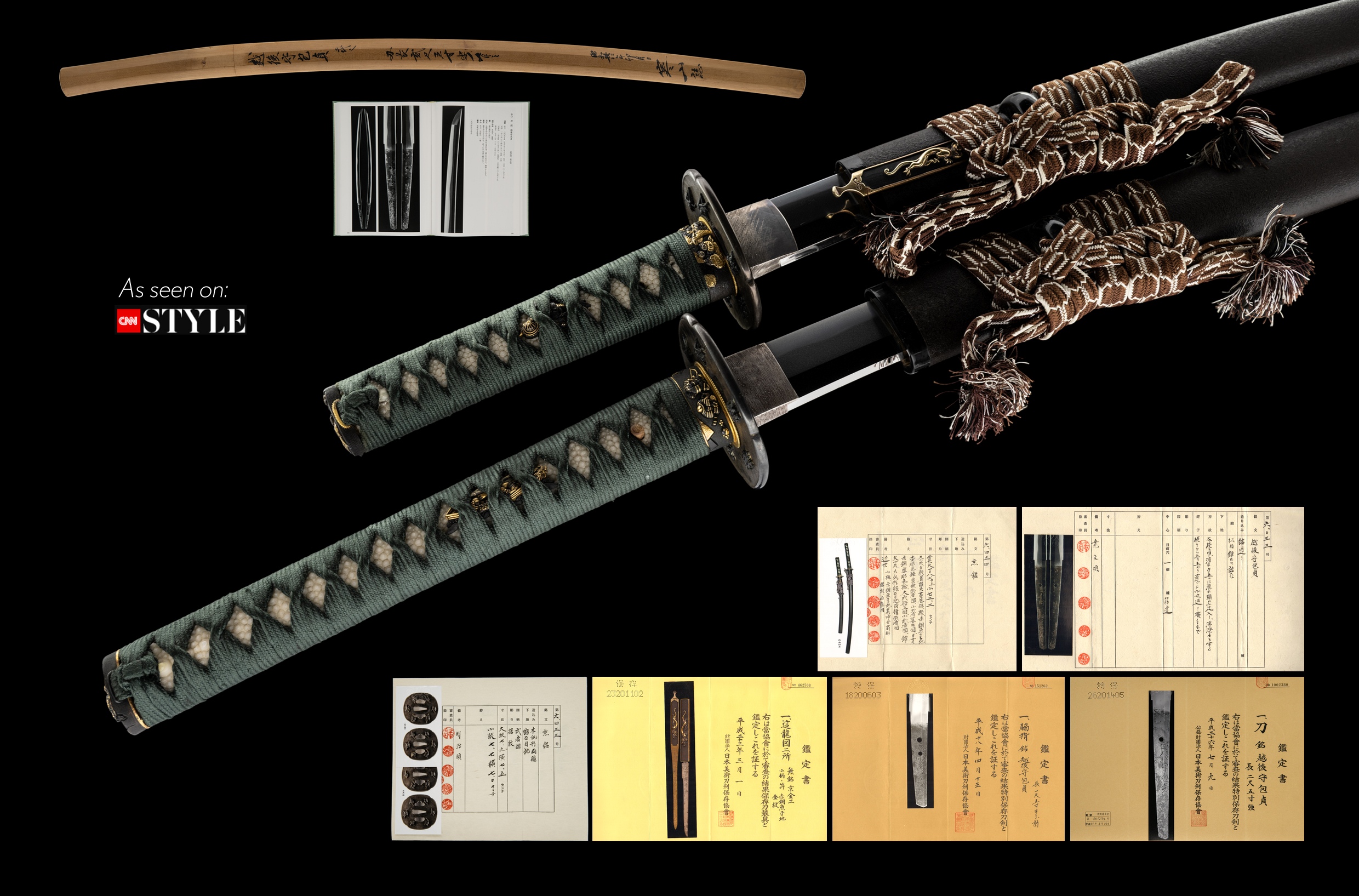
Nidai Echigo no Kami Kanesada (越後守包貞) stands as one of the luminaries of the Ôsaka-Shintô tradition. He first trained under Terukado (照門) of the Zenjô (善定) line from Mino before entering the studio of the shodai Kanesada, whose son-in-law and eventual successor he became. Upon his sensei‘s death in 1669 he inherited the name Kanesada, along with the full weight of that legacy. Yet when the shodai’s natural son came of age, he relinquished the name without hesitation, continuing thereafter as Sakakura Gon-no-Shin Terukane (坂倉言之進照包) – a gesture of selfless generosity that speaks directly to his character. Fujishiro ranks him Jôjô-saku, his cutting ability is classified Ô-wazamono, and forty-nine of his swords have achieved NBTHK Jûyô Tôken with two reaching Tokubetsu Jûyô – numbers that place him firmly at the apex of the Shintô canon. His blades are typically forged with a fine, dense ko-itame hada, bright with thick ji-nie and lively chikei, and he is celebrated above all for his tôran-ba – those billowing wave patterns inspired by fellow Ôsaka grandmaster Tsuda Sukehiro, rendered with a nioiguchi of extraordinary brilliance.
The katana is the rarer and more celebrated of the pair. Where Kanesada typically works in powerful $1, this blade breaks from convention: its hamon is a long, deeply undulating notare of exceptional consistency, described as one of the finest examples of notare ever seen on a Nidai Kanesada sword – rare precisely because it diverges so markedly from his signature style. Abundant chôji-ashi emerge from the brilliant, clear nioiguchi, and the overall atmosphere is one of serenity and extraordinary elegance. The jihada is a fine, dense ko-itame saturated with ji-nie and lively chikei; the bôshi resolves in a clean ko-maru kaeri. The wakizashi presents the more traditional face of Kanesada: its hamon a powerful gunome-hako-midare opening with a classic Ôsaka-yakidashi, widening with a gentle notare before erupting into dynamic, storm-like swells. Together these two swords offer a study in contrast – quietude and force, serenity and energy – an extraordinary juxtaposition forged by the same hand. The katana is published on pages 100-101 of the NTHK-NPO Yûshûsaku Masterwork swords catalogue (Heisei 27, June 2015), and both blades carry their own NBTHK Tokubetsu Hozon certificates.
The bespoke daishô-koshirae was commissioned over a decade ago by a Unique Japan client, assembled from top-quality antique Edo and Meiji fittings around a unified samurai warrior theme – one of the first custom daishô ever built by Unique Japan. The katana fuchi-kashira is the signed work of Gotô Mitsukuni (後藤光邦), second son of Gotô Teijô and ninth head of the Gotô main line, retained metalworker to the Maeda family of Kaga – the design depicts an armoured samurai poised for combat. The wakizashi fuchi-kashira counterpoints this with figures from the Chinese Three Kingdoms: Guan Yu and Liu Bei, their brotherhood embodying loyalty and valour. The matched daishô tsuba are the work of a Meiji-period craftsman, finished in a shimmering silver ishime ground and inlaid with twelve bushi family crests – a number with deep symbolic resonance. The kozuka and kogai are the work of the Kyô-Kinkô school, in shakudô with nanako ground and Amaryû (rain dragon) motifs in gold, certified NBTHK Hozon. This very daishô was featured in CNNstyle’s July 2015 article “Blade runners: The powerful mystique of the samurai sword,” in which Pablo was interviewed – a piece that remains online to this day.
| Item Number | UJDI016 |
| Sword Type | Daishô (katana & wakizashi) |
| Swordsmith | Nidai Echigo no Kami Kanesada (2nd generation, Ôsaka) |
| Swordsmith (JP) | 越後守包貞 |
| Signature | Echigo no Kami Kanesada (both blades) |
| School | Ôsaka-Shintô (Kanesada lineage) |
| Province | Settsu (Ôsaka) |
| Period | Shintô – Early Edo period (Kanbun-Enpô era: 1669-1680) |
| Nagasa (k) | 75.4cm (ubu) |
| Nagasa (w) | 46.3cm (ubu) |
| Sori (k) | 1.9cm |
| Sori (w) | 0.9cm |
| Moto-haba (k) | 3.09cm |
| Moto-haba (w) | 2.98cm |
| Weight (k) | 815g |
| Weight (w) | 500g |
| Nakago (k) | Ubu; katte-sagari-yasurime; ha-agari kurijiri; 1 mekugi-ana |
| Nakago (w) | Ubu; katte-sagari-yasurime; ha-agari kurijiri; 2 mekugi-ana |
| Jihada | Ko-itame with thick ji-nie and plentiful chikei (both blades) |
| Hamon (k) | Notare with chôji-ashi, sunagashi, and brilliant nioiguchi |
| Hamon (w) | Gunome-hako-midare with Ôsaka-yakidashi and notare |
| Boshi (k) | Ko-maru kaeri |
| Boshi (w) | Kaen-bôshi (thick nie forming sunagashi) |
| Certificates | NBTHK Tokubetsu Hozon (katana, Heisei 26 / July 2014); NBTHK Tokubetsu Hozon (wakizashi, Heisei 18 / April 2006); NBTHK Hozon (kozuka & kogai, Heisei 23 / March 2011); NTHK-NPO Yûshûsaku (katana, designated Masterwork); NTHK-NPO Kanteshô (koshirae); NTHK-NPO Kanteshô (daishô tsuba) |
| Fujishiro Rank | Jôjô-saku (highly superior smith) |
| Sharpness Rating | Ô-wazamonô (maker of supremely sharp swords) |
| Publication | NTHK-NPO Yûshûsaku Masterwork swords catalogue, pages 100-101 (Heisei 27, June 2015) |
| Sayagaki | Kanzan (寒山誌) – Echigo no Kami Kanesada, second generation; blade length 75.4cm; dated Shôwa 34 (April 1959) [katana saya] |
| Koshirae | Cha-ishime-ji-nuri daishô-uchigatana-koshirae (茶石目地塗大小打刀拵); brown lacquer with stone-like surface; modern era; NTHK-NPO Kanteshô |
| Tsuba | Matched daishô pair; Meiji period (1867-1912); silver ishime ground with 12 bushi family crests inlaid; NTHK-NPO Kanteshô |
| Fuchi-kashira (k) | Signed Gotô Mitsukuni (後藤光邦), 9th head of Gotô main line, Kaga school – armoured Kamakura samurai warrior motif; shakudô nanako |
| Fuchi-kashira (w) | Chinese Three Kingdoms motif: Guan Yu and Liu Bei; shakudô nanako with gold |
| Menuki (k) | Samurai warriors advancing by boat; shakudô with gold |
| Menuki (w) | Samurai warriors preparing for battle; shakudô with gold |
| Tsuka | Matched daishô pair; white same (ray skin); green hishimaki braid |
| Habaki (k) | Silver with rainfall file marks |
| Habaki (w) | Silver with horizontal file marks |
| Kozuka & Kogai | Kyô-Kinkô school; shakudô with nanako ground; Amaryû (rain dragon) motif in gold; Edo period; NBTHK Hozon |
| Catalogue | Catalogue 45 |
| Status | Sold |
| Includes | Shirasaya (pair, with Kanzan sayagaki on katana saya), daishô-koshirae, fabric bags, stand, kit, printed description |