
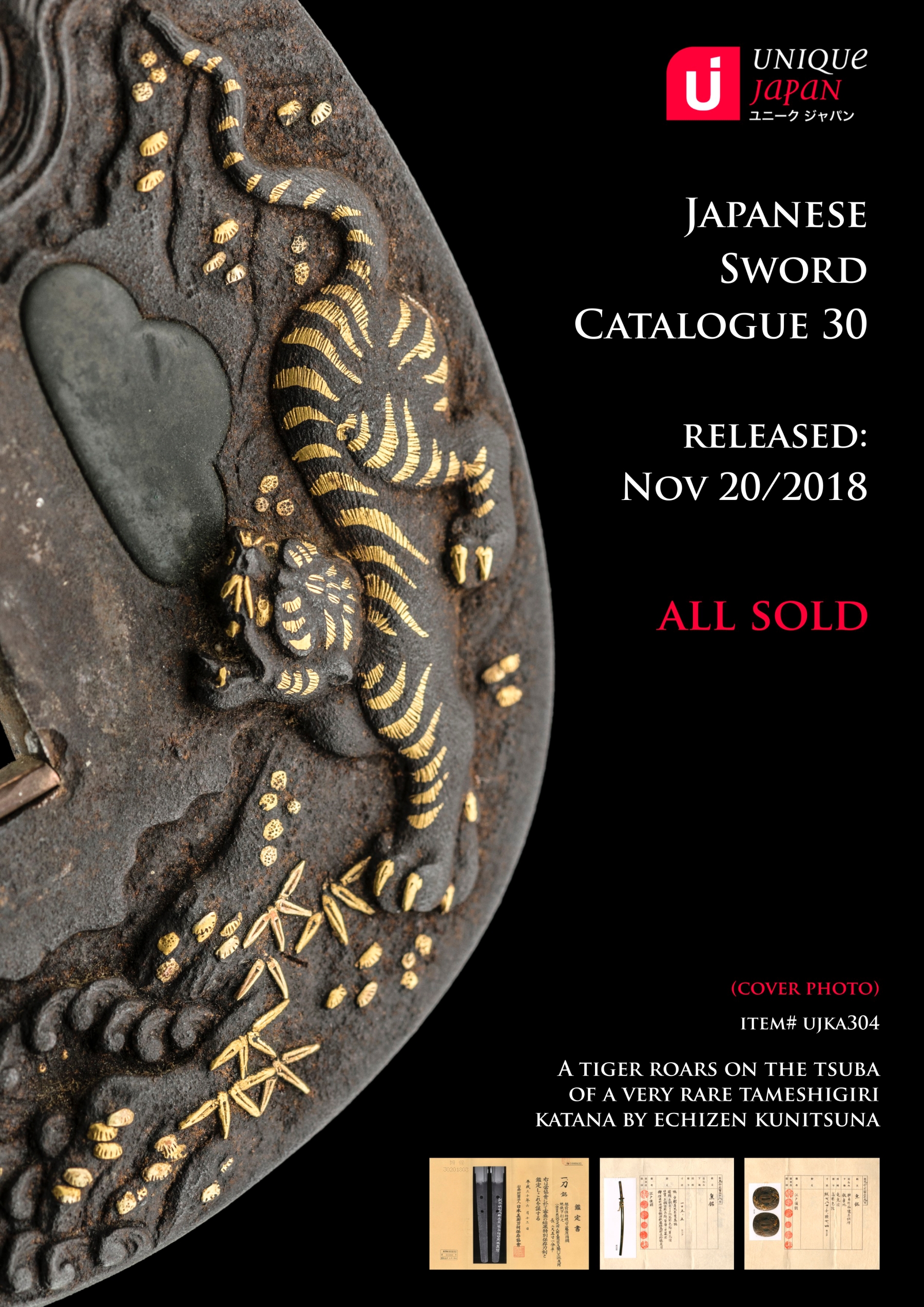
⇩ Download Catalogue 30 (100MB)
Free to download. 153 pages. All swords in this catalogue are sold.
Index of Swords
Opening Remarks
Hello everyone!
Shorter days and cooler nights — the holiday season is approaching and our home is growing in excitement and anticipation. Happy Thanksgiving to all those celebrating in the US.
Thank you for downloading Catalogue 30. This is a proud landmark for UJ, and I want to thank everyone who has been a part of this journey. It’s a great pleasure to serve you. There are five katana (one on hold) and four wakizashi on offer in this catalogue. Each with a great story to tell.
We begin with a beautiful katana by the Fujishima school from the early to mid-Muromachi period, circa 1400s. The hadamono jihada on this sword is vibrant and eye-catching. This unique style of forging was specifically engineered for the frigid temperatures of the provinces that border the Sea of Japan — stronger, better flex and sharper. This katana comes with a handsome warrior-themed koshirae.
The following sword is a super powerful katana by Hiroshige of the Shitahara school. This sword has left a big-time impression on me. Constructed in an unokubi-zukuri (neck of a cormorant) shape, the balance of this sword is incredible. This is a samurai sword for battle. A great katana to build a koshirae for.
An elegant Edo-period katana by Kuniyoshi is next. This sword is like a sharp tuxedo — full of class. It has lovely curvature, a bright ko-gunome hamon that bends the light beautifully. This katana is housed in a black-lacquered koshirae with a Chôshû tsuba and dragon fuchi-kashira signed by Seijo.
A very intense katana by Kunitsuna is our cover sword. This sword went through a rare tameshigiri tachi-kesa cutting test on a live convicted criminal, whereby tester Sen’a severed his body diagonally in one stroke. A second cutting test was further performed across his body on an earthen mound. The rarity of this sword cannot be overstated. A striking Edo-period koshirae with a fierce tiger and dragon Masachika tsuba and a uniquely tsugaru-lacquered scabbard finishes it off perfectly.
A spectacular 62nd Jûyô Tôken katana attributed to Nakajima-Rai is the final katana. The Nakajima-Rai branch of the Rai school earned its nickname after Rai Kuninaga, student of Kunitoshi, travelled from Kyoto to the Nakajima district in the Osaka area at the very end of the Kamakura period. This katana is a masterclass of the strength and sophistication the Nambokucho period represents.
The catalogue switches gears from katana to wakizashi, starting with a sharp shôbu-zukuri attributed to Kanenobu from the end of the late Muromachi period. Deep valleys of an ô-gunome hamon shine so bright. A matching koshirae with a unique saya that looks like tree-bark looks awesome on display.
A wonderful sunnobi tantô signed by Nobuyoshi is the following sword — charming in every way. Look for the bright, wavy hamon on nagare-hada that flows like a stream. The fittings form a tribute to the beauty of nature and feature a tsuba designed after the majestic Kami-iso shrine.
We complete the catalogue with a rare and collectible wakizashi jointly crafted by shinshintô maestro Koyama Munetsugu and Kosugi Sukenaga — a top-ranking samurai official and trusted advisor to the Doi family of the Koga fief. Making this meaty wakizashi even more impressive is that it was used in a tameshigiri cutting test with Gotô Gosaburô, in which it severed the body of a convicted criminal in one stroke. The nakago of this sword was published in a book by Mitsuo Shibata.
Thank you as always for your genuine support and passion for life. My team and I look forward to serving you. Happy holidays and my warmest regards.
Pablo Kuntz
November 2018