
⇩ Download Catalogue 25 (34MB)
Free to download. All swords in this catalogue are sold.
Index of Swords
Opening Remarks
Konnichiwa everyone!
I am very proud to report that we launched uniquejapan.com ten years ago this month onto the World Wide Web. Time flies. I am in Tokyo now enjoying this milestone with the team as I write this message. Thank you for downloading Japanese Sword Catalogue 25.
We have seven wonderful katana in this catalogue that we are proud to offer.
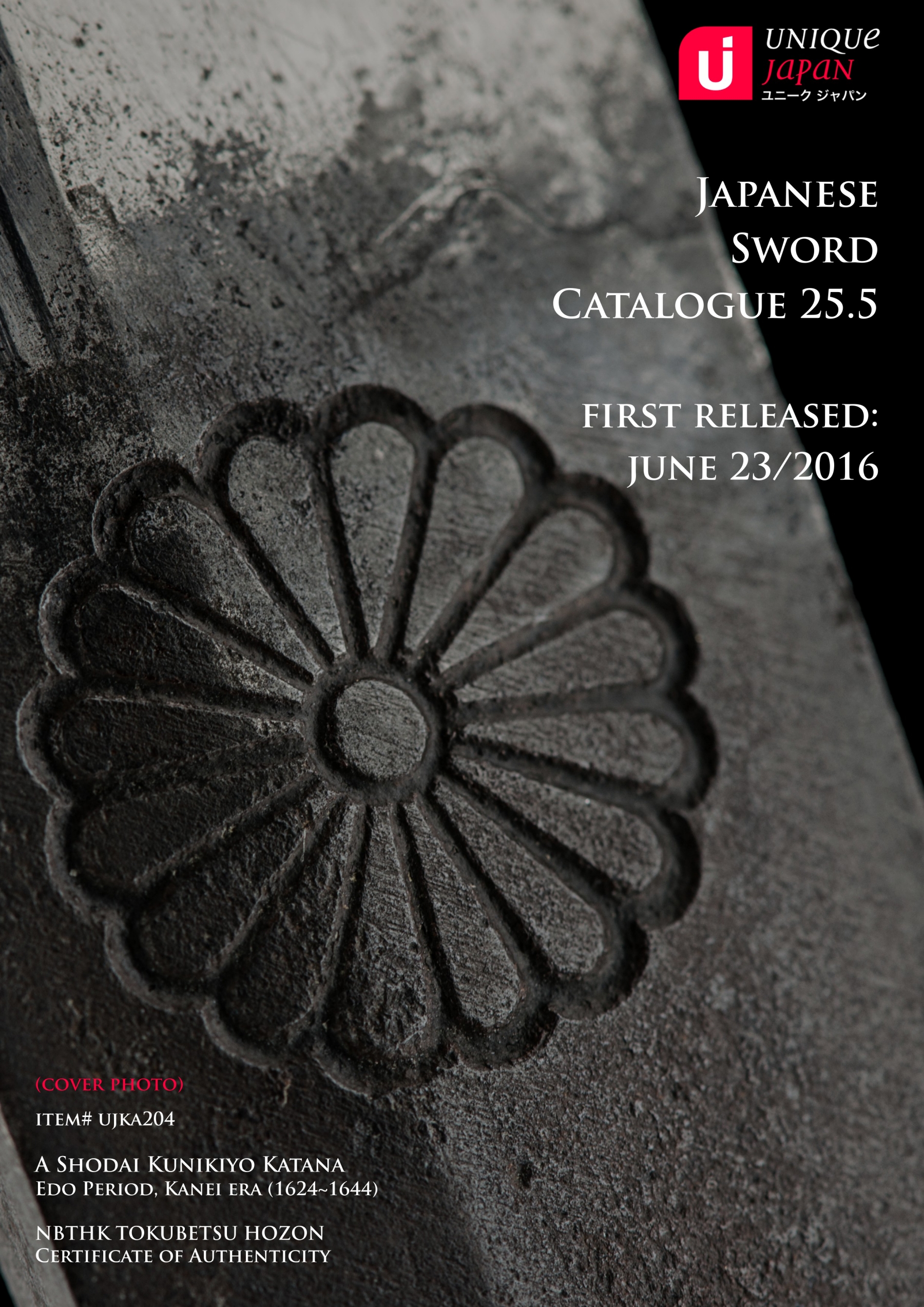
The kiku-mon (mark of the chrysanthemum) featured on the cover page is from the nakago (tang) of a brilliant katana by Yamashiro no Kuni Kunikiyo — the most famous smith in the Edo period who had permission from the imperial family to engrave this prestigious 16-petal kamon (crest). Kunikiyo worked in Echizen province as he was retained by the powerful Daomyô Matsudaira Tadamasu. This highly collectible sword radiates 400 years of history in your hands.
Another notable kamon is the aoi-mon (hollyhock) of the ruling Tokugawa family, bestowed to swords of the Yasutsugu school. A fabulous katana attributed to Nidai Yasutsugu (second generation), signed by his younger brother, is available for ownership. Both the sword and its glorious Edo-period fittings are incredible.
Item UJKA209 is a fine steely creation by fourth-generation shinshintô smith Kanetomo of modern-day Fukushima prefecture. Six certificates of authenticity accompany this sword — be sure to look for the unique work in the blade near the tip area and the silver arrowheads!
A fellow fourth-generation smith by the name of Kanemoto, who worked in 1573 during the unifying Momoyama period, crafted a true warrior katana with an eye-catching sambonsugi hamon. The koshirae is terrific. The devilish oni (demon) on the menuki is very good fun.
For those who appreciate Yasukuni shrine swords, consider the katana by maestro Yakuwa Yasutake who once worked there. The katana is dated to August 1979, crafted when he was about to become mukanza-ranked smith. The sword is housed in lovely Edo-period Higo koshirae with a unique Jingo school tsuba depicting a lightning storm.
Rounding up the catalogue is a healthy and robust katana by Echizen Hirotaka from the Meireki period, circa 1655. The understated elegance of this sword is one to cherish.
Each katana holds a special story. May the sword become a source of spiritual inspiration for you to create your own special story.
Thank you to all who have joined our VIP email list and to the many who claimed swords in Tokyo via a private meeting. As always, I look forward to serving you.
Sayonara,
Pablo Kuntz
June 2016