
ITEM# UJKA325 – Catalogue 32 – Sold
A Nobukuni Yoshikane Katana (筑州住源信国吉包)
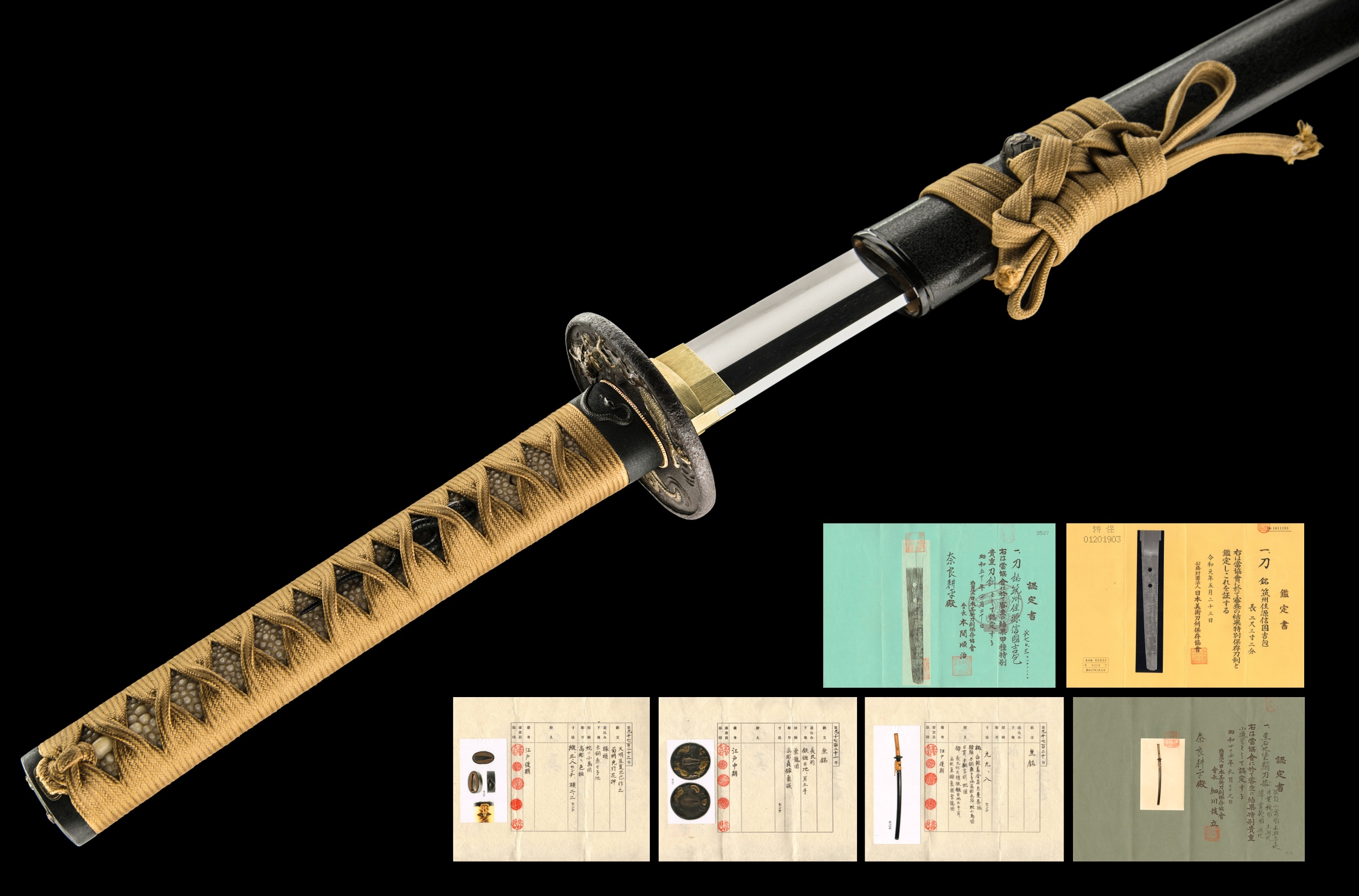
Born Nobukuni Sukezaemon, Yoshikane is the 14th generation of the Chikuzen Nobukuni school, succeeding the founder in the lineage of one of Kyushu’s most accomplished smithing traditions. Rated jo-saku by Fujishiro, this early Edo period blade is fully consistent with the master’s finest work: densely forged with a shallow curvature, powerful chu-kissaki, and a spectacular mokume-hada blended with o-hada that gives the steel a deep, wood-like finish. The swirling grain pattern carries right into the kissaki, while abundant chikei – dark lines of interwoven nie-crystals – animate the surface under light. Yoshikane died on August 22nd in the sixth year of Genroku, 1693.
The hamon is a precise, beaming chu-suguha enriched with kinsuji, brushed strokes of sunagashi, and the characteristic yô (clusters of nie-crystals falling like leaves toward the edge) for which Yoshikane is particularly celebrated. The consistency and brightness of the nioguchi throughout the blade is a mark of exceptional craftsmanship. This katana earned the prestigious NBTHK Koshu Tokubetsu Kicho Tôken designation in 1975 – the highest certificate below Jûyô Tôken, issued for only nine years between 1973 and 1982 – in addition to a more recent NBTHK Tokubetsu Hozon.
The accompanying Edo period koshirae is a masterpiece in its own right. The fuchi bears a coiling snake in high relief, signed and dated by master metalsmith Kikuoka Mitsuyuki to the summer of Tenmei 5 (1785) – crafted in the Year of the Snake of the tsuchinoto cycle. Founder of the Kikuoka school, Mitsuyuki came from a family of renowned haiku and waka poets, and hints of that lyrical sensibility inform his creations. A hammered iron tsuba attributed to Hirado Kunishige of Hizen province carries a fantastically detailed brass takabori relief of a three-clawed Japanese cloud dragon (unryu no zu), while matching menuki in the form of long serpents weave under the braided silk. The kashira depicts birds in flight on a shakudo nanako ground. Six certificates of authenticity accompany this exceptional ensemble.
| Item Number | UJKA325 |
| Sword Type | Katana |
| Swordsmith | Yoshikane |
| Swordsmith (JP) | 筑州住源信国吉包 |
| Signature | Chikushû jû Minamoto Nobukuni Yoshikane |
| School | Chikuzen Nobukuni |
| Province | Chikuzen (Kyushu) |
| Period | Shintô – Early Edo period (Enpô era: 1673-1681) |
| Nagasa | 70.3cm |
| Sori | 1.1cm |
| Moto-haba | 3.23cm |
| Weight | 800g |
| Nakago | Ubu, kiri-yasurime, kurijiri (2 mekugi-ana; upper hole original, lower added in Edo period) |
| Jihada | Itame and o-hada with swirling chikei and ji-nie; mokume-hada visible throughout including kissaki |
| Hamon | Bright chu-suguha with kinsuji, sunagashi, yo, and ko-ashi |
| Certificates | NBTHK Tokubetsu Hozon; NBTHK Koshu Tokubetsu Kicho; NBTHK Tokubetsu Kicho (koshirae); NTHK-NPO Kanteisho (koshirae, tsuba, fuchi-kashira) |
| Fujishiro Rank | Jo-saku |
| Koshirae | Edo period uchigatana-koshirae (kuro-ishime-ji-nuri saya, Late Edo period: 1780-1867); NBTHK Tokubetsu Kicho certified |
| Tsuba | Hammered iron; brass takabori cloud dragon (unryu no zu), attributed to Hirado Kunishige, Hizen province, Mid Edo (circa 1700-1780); NTHK-NPO Kanteisho certified |
| Fuchi-kashira | Shakudo nanako; fuchi with coiling snake by Kikuoka Mitsuyuki, signed and dated Tenmei 5 (1785); kashira with birds in flight; NTHK-NPO Kanteisho certified |
| Menuki | Snake-form menuki in shakudo |
| Habaki | Gold-wrapped niju habaki with diagonal file marks |
| Catalogue | Catalogue 32 |
| Status | Sold |
| Includes | Shirasaya, Edo koshirae, bags, stand, kit, DVD, booklet, printed description |