
ITEM# UJKA357 – Catalogue 35 – Sold
A Niô Sanekiyo Katana (二王実清作)
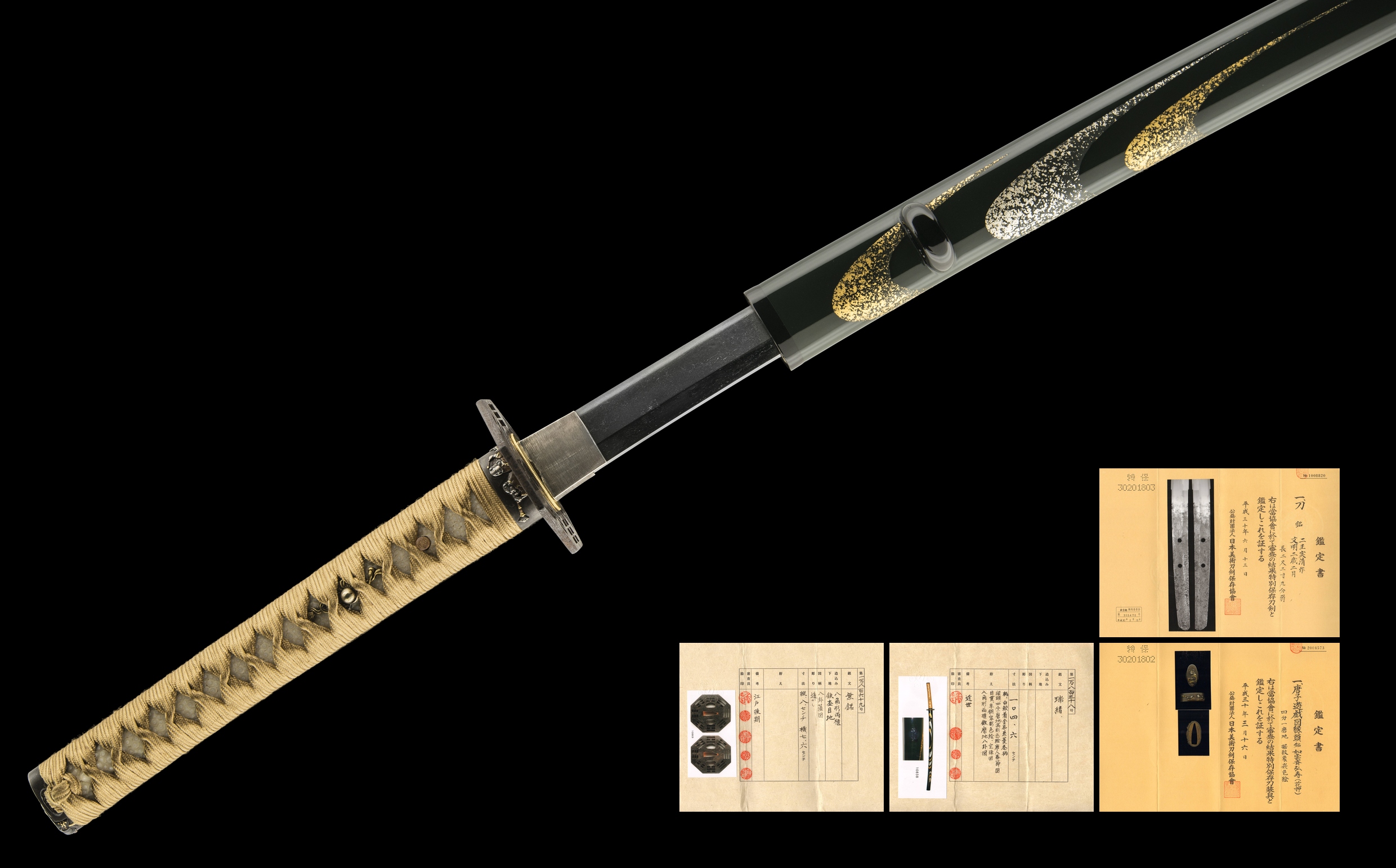
The Niô name is said to originate with the Niho manor of Suô province – a domain home to many properties owned by the Todaiji (Great Eastern Buddhist Temple) in Yamato (Nara), the former capital of Japan. As Niô School blades bear a strong resemblance to Yamato works, it is widely assumed that a meaningful technical exchange existed between the two regions. The school’s founder, Kiyotsuna, is represented by a tachi dated March 1265 preserved at the famous Itsukushima-jinja shrine.
This rare katana by Niô Sanekiyo has been signed and dated to the second month of Bunmei 2 – February 1470 – and carries a palpable sense of 555 years of history. The nakago has been shortened via machi-okuri, a process that moves the notches upward to reduce cutting length while preserving the signature and date in full. The complex jihada is a sublime mixture of itame-hada, mokume-hada, and nagare-hada, enriched with chikei and a gorgeous shirake-utsuri that reveals itself as the blade is gently rotated under the light. The bright suguha hamon carries ko-ashi and the rarely seen uchinoke – small crescent-moon formations along the temper line – before resolving into a rounded komaru-boshi at the tip.
The sword is complemented by an exquisite custom koshirae crafted and signed by Mizuo in the modern era. The deep green lacquered saya is adorned with a sweeping ripple design in gold and silver maki-e – a meditation on cause and effect, on the irreversible reach of wise and foolish actions alike. The Hakke-design iron tsuba, attributed to Shinano Tôshô and authenticated by NTHK-NPO Kanteisho, represents the eight trigrams of yin and yang, while the fuchi by Jounsai Hirotoshi captures two boys playing flute and drum. The menuki are hôju-no zu (precious orbs), and a young aristocratic boy gallops on a stick horse decorates the kashira. Silver habakiwith horizontal file marks completes the ensemble. This is a gem of a samurai sword.
| Item Number | UJKA357 |
| Sword Type | Katana |
| Swordsmith | Niô Sanekiyo |
| Swordsmith (JP) | 二王実清 |
| Signature | Niô Sanekiyo saku / Bunmei ni toshi nigatsu |
| Date | Bunmei 2 (February 1470) |
| School | Niô |
| Province | Suô (resident of Yamaguchi) |
| Period | Kotô – Middle Muromachi (Bunmei era: 1469-1487) |
| Nagasa | 69.4cm |
| Sori | 1.0cm |
| Moto-haba | 2.72cm |
| Weight | 745g |
| Nakago | Machi-okuri (shortened tang), 21.4cm, 2 mekugi-ana |
| Jihada | Itame-hada and nagare-hada with chikei and shirake-utsuri |
| Hamon | Suguha with ko-ashi and uchinoke |
| Boshi | Komaru-boshi |
| Certificates | NBTHK Tokubetsu Hozon (sword and fittings); NTHK-NPO Kanteisho (koshirae and tsuba) |
| Koshirae | Uchigatana-koshirae; deep green lacquered saya with gold and silver maki-e ripple design (midoriiro-urushinuri saya ni kin-gin hamon maki-e); crafted and signed by Mizuo, modern era |
| Tsuba | Polished iron, octagonal Hakke (eight trigrams) design; attributed to Shinano Tôshô, late-Edo period (circa 1780-1867); NTHK-NPO Kanteisho |
| Fuchi-kashira | Signed Jounsai Hirotoshi with kaô; fuchi depicts two boys playing flute and drum; kashira depicts a young boy with stick horse |
| Menuki | Hôju-no zu (precious orbs) in gold-braided silk |
| Tsuka | Gold-braided silk over same (ray skin) |
| Habaki | Silver with horizontal file marks |
| Catalogue | Catalogue 35 |
| Status | Sold |
| Includes | Shirasaya, custom koshirae, stand, kit, DVD, booklet, printed description |