
ITEM# UJKA394 – Catalogue 37 – Sold
A Niô Tachi (二王)
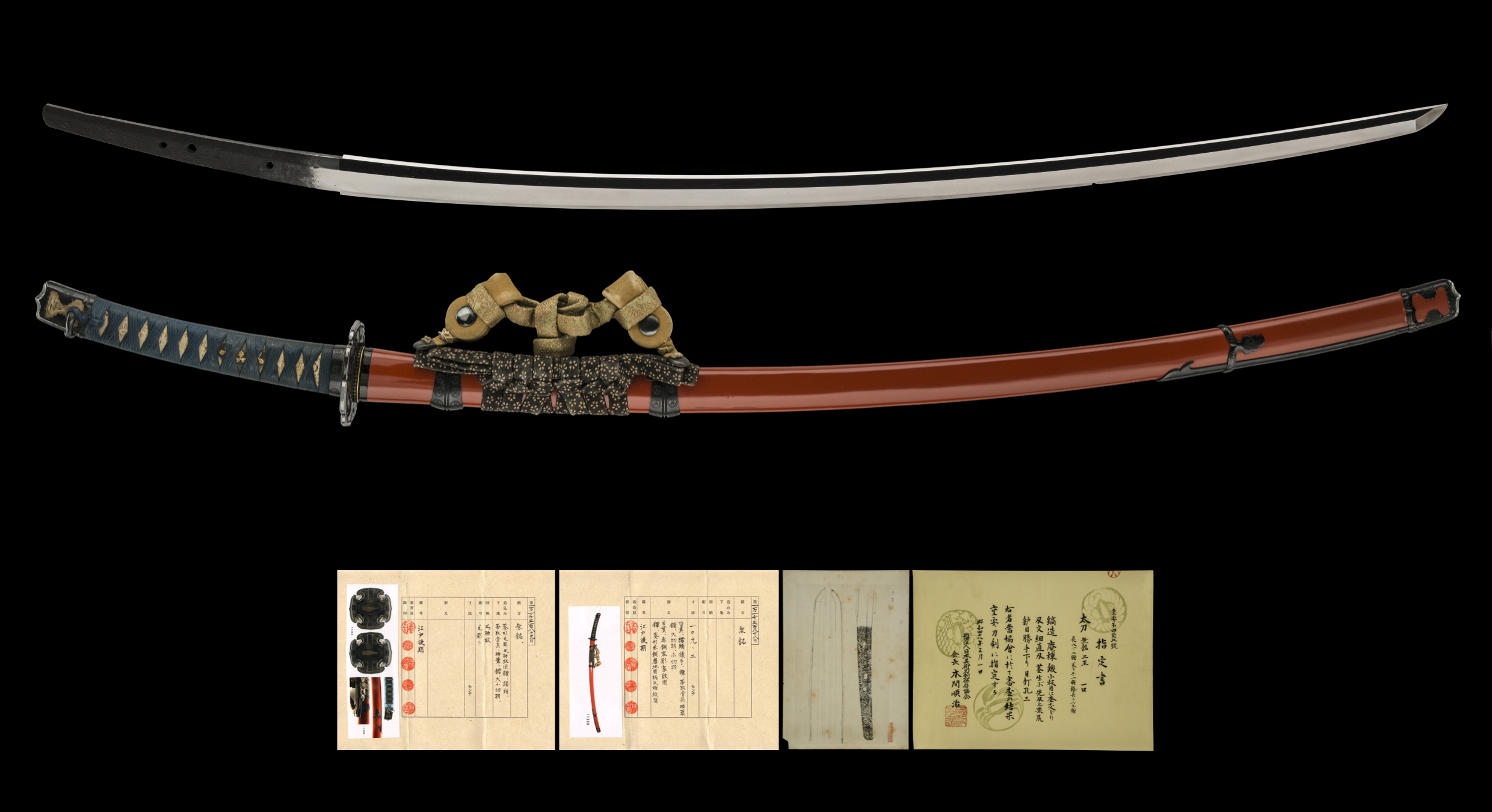
Few tachi from the late Kamakura period survive in ubu condition – that is, with the original, unshortened nakago intact. This one does. Attributed to the Niô school of Suô Province and dating to around the Gentoku era (1329-1331), it stands at 81.2cm in nagasa with a sweeping curvature of 2.58cm – the precise geometry of a cavalry sword. That it has endured seven centuries without having its tang cut down is, in itself, a remarkable act of custodianship across the generations. A deep kirikomi battle scar in the upper third of the blade is the only honest record of the fighting this sword witnessed, and it should never be removed. It is not a flaw. It is history.
The steel carries all the hallmarks of Niô craftsmanship. The kitae is a dense ko-itame mixed with mokume, alive with fine ji-nie and plentiful swirling chikei – the dark crystalline lines that flow through the jigane like currents beneath the surface. The hamon is a composed hosô-suguha with shirake utsuri, restrained and austere in the manner typical of the school. Niô blades share a visible kinship with Yamato tradition – a reflection of the documented technical exchange between Suô and the great temple schools of Yamato Province, though individual features clearly distinguish the two traditions.
The sword is accompanied by a spectacular set of Late Edo period tachi koshirae lacquered in vermilion (shu-urushi), with matching fittings of polished shakudô engraved in the kebori manner with the Tosa-kashiwa-mon – the oak-leaf family crest associated with the Yamauchi clan, lords of Tosa Province from the early Edo period through the Meiji era. The shirasaya carries the sayagaki of Dr Satô Kanzan, written in early spring of Shôwa 48 (1973), the same year the sword passed its NBTHK Jûyô Tôken shinsa. The fittings and koshirae hold separate NTHK-NPO Kanteisho certificates of authenticity.
| Item Number | UJKA394 |
| Sword Type | Tachi |
| Attribution | Niô School (mumei, ubu nakago) |
| School | Niô |
| Province | Suô |
| Period | Kotô – Late Kamakura (circa Gentoku era: 1329-1331) |
| Nagasa | 81.2cm |
| Sori | 2.58cm |
| Moto-haba | 2.85cm |
| Saki-haba | 1.67cm |
| Kissaki | 2.51cm |
| Nakago length | 21.8cm |
| Moto-kasane | 7.4mm |
| Saki-kasane | 4.0mm |
| Weight | 885g |
| Nakago | Ubu, ha-agari kurijiri, katte-sagari yasurime, three mekugi-ana |
| Jihada | Ko-itame mixed with mokume, fine ji-nie and plentiful chikei |
| Hamon | Hosô-suguha with ko-nie deki, tight nioguchi, shirake utsuri |
| Certificates | NBTHK Jûyô Tôken (No. 4265, 21st shinsa, March 1, 1973); NTHK-NPO Kanteisho (tachi fittings); NTHK-NPO Kanteisho (koshirae) |
| Sayagaki | Dr Satô Kanzan – Niô School, ubu nakago, blade length ~81.2cm, dated early spring Shôwa 48 (1973) |
| Koshirae | Tachi-koshirae, Late Edo period (1780-1867) – vermilion lacquered saya (shu-urushinuri), shakudô migaki-ji fittings engraved in kebori with Tosa-kashiwa-mon family crest throughout |
| Habaki | Gold-wrapped, with vertical file marks |
| Catalogue | Catalogue 37 |
| Status | Sold |
| Includes | Shirasaya with sayagaki, fabric bag, stand, maintenance kit, printed description booklet, NBTHK Jûyô Tôken certificate (rolled, in protective tube), two NTHK-NPO Kanteisho certificates |