
ITEM# UJWA255 – Catalogue 39 – Sold
A Ryôkai Wakizashi (了戒)
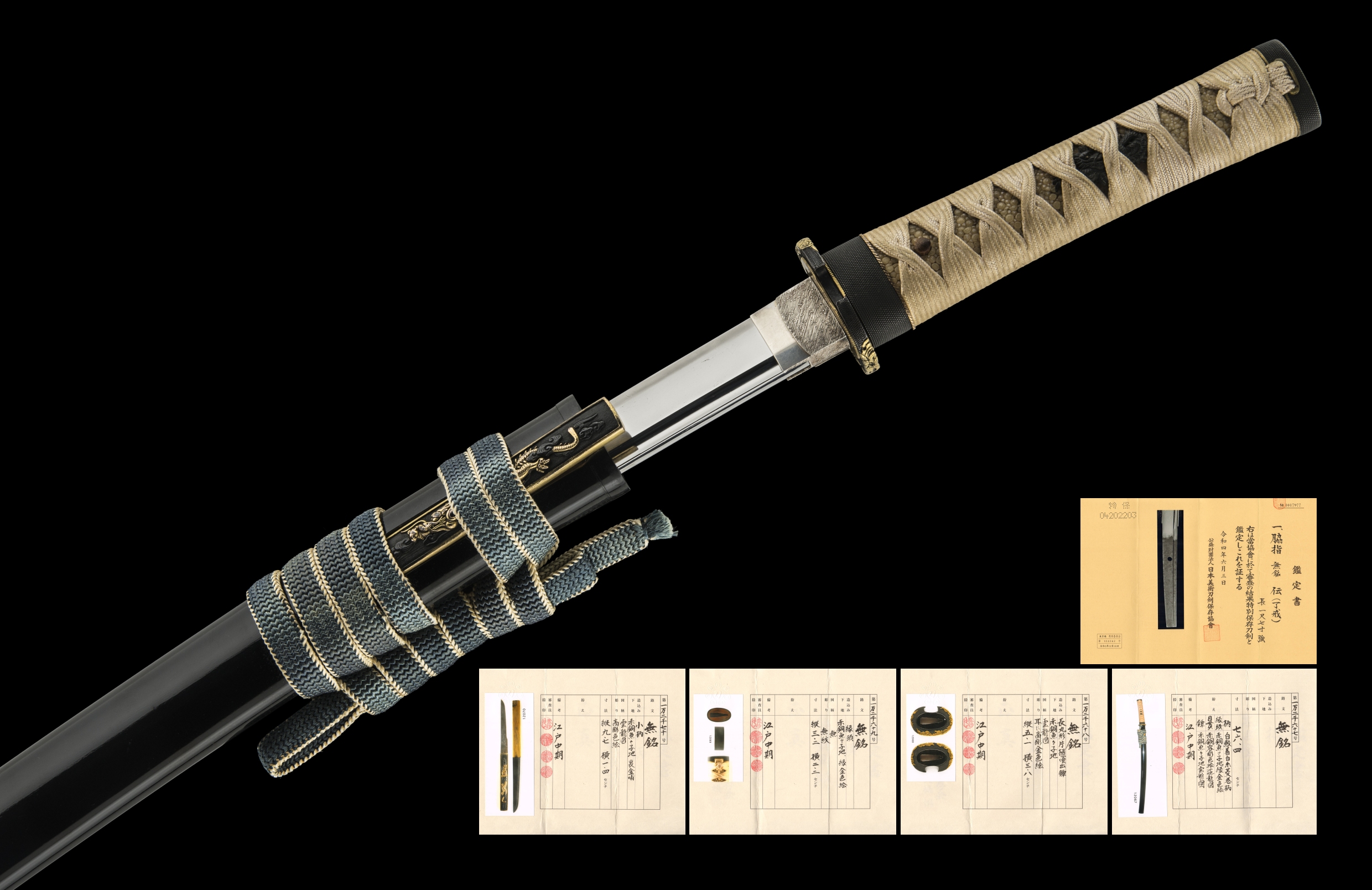
Ryôkai is said to be the son of grandmaster Rai Kunitoshi, having left the celebrated Rai family at the age of 16 to take the priest name Ryôkai. Dated signatures by the smith range between the 5th year of Shôô era (1292) and the 2nd year of Enkyô era (1309) – dates that align closely with Kunitoshi’s active period around Kôan era (1278-1288). Ryôkai is ranked jô-saku by Fujishiro, a strong achievement given the class of smiths working at the end of the Kamakura period, and surviving blades attributed to him are relatively scarce. This wakizashi was once a much longer tachi. In approximately the late Muromachi to early Edo period, it was greatly shortened to its present o-suriage nakago and lost its signature in the process.
The blade has an old soul. It carries a graceful curvature and long bôhi grooves that extend right through the butt end of the tang in kaki-tôshi fashion – a hallmark of quality workmanship. The jigane is a dense ko-itame mixed with masame-hada, fine ji-nie, and a light shirake utsuri that drifts through the body. The hamon is a bright suguha-based temper with ko-gunome, plentiful ko-ashi, flowing sunagashi, and scattered yô – those delightful floating clusters of nie crystals that speak directly to the Ko-Rai tradition. History speaks through the steel.
The sword is complemented by a superb set of middle-Edo period koshirae (circa 1700-1780) executed throughout in a unified cloud-and-dragon theme. The kuro-roiro-nuri saya is lacquered in deep glossy black. The hamidashi-tsuba is shakudô with nanako ground and a crawling cloud dragon circling the rim, certified by the NTHK-NPO to the Mino school. The fuchi-kashira carries the same dragon motif in shakudô with gold accents, and the shakudô menuki beneath the antique silk wrap are finely detailed crawling dragons. A kozuka bearing a cloud dragon in relief is fitted within the saya, its small blade playfully signed Ryôkai – almost certainly gimei, but a fitting tribute. The entire mounting is certified by the NTHK-NPO as authentic.
| Item Number | UJWA255 |
| Sword Type | Wakizashi |
| Attribution | Attributed to Ryôkai (o-suriage mumei) |
| School | Rai |
| Province | Yamashiro |
| Period | Kôtô – Late Kamakura period (Shôô~Enkyô eras: 1292~1309) |
| Nagasa | 51.5cm |
| Sori | 1.0cm |
| Moto-haba | 2.46cm |
| Weight | 395g |
| Nakago | O-suriage, kaki-tôshi bôhi on both sides |
| Jihada | Ko-itame mixed with masame-hada, ji-nie, yô, shirake utsuri |
| Hamon | Suguha with ko-gunome, ko-ashi, sunagashi, yô |
| Certificates | NBTHK Tokubetsu Hozon; NTHK-NPO Kanteisho (koshirae, tsuba, fitting, kozuka) |
| Fujishiro Rank | Jô-saku |
| Koshirae | Kuro-roiro-nuri chiisagatana-koshirae, middle-Edo period (1700~1780), cloud-and-dragon theme throughout |
| Tsuba | Hamidashi-tsuba, shakudô with nanako ground, cloud-dragon motif, Mino school, mid-Edo period – NTHK-NPO certified |
| Fuchi-kashira | Shakudô with nanako ground, cloud-dragon motif, gold accents, mid-Edo period – NTHK-NPO certified |
| Menuki | Shakudô crawling dragons, wrapped under antique silk |
| Tsuka | Antique silk braid (teal and cream), same-gawa (ray skin) |
| Habaki | Silver habaki with diagonal file marks |
| Catalogue | Catalogue 39 |
| Status | Sold |
| Includes | Shirasaya, Edo dragon koshirae, fabric bags, stand, kit, booklet, description |