
ITEM# UJWA261 – Catalogue 42 – Sold
A Tadamitsu Tameshigiri Wakizashi (備州長船忠光作)
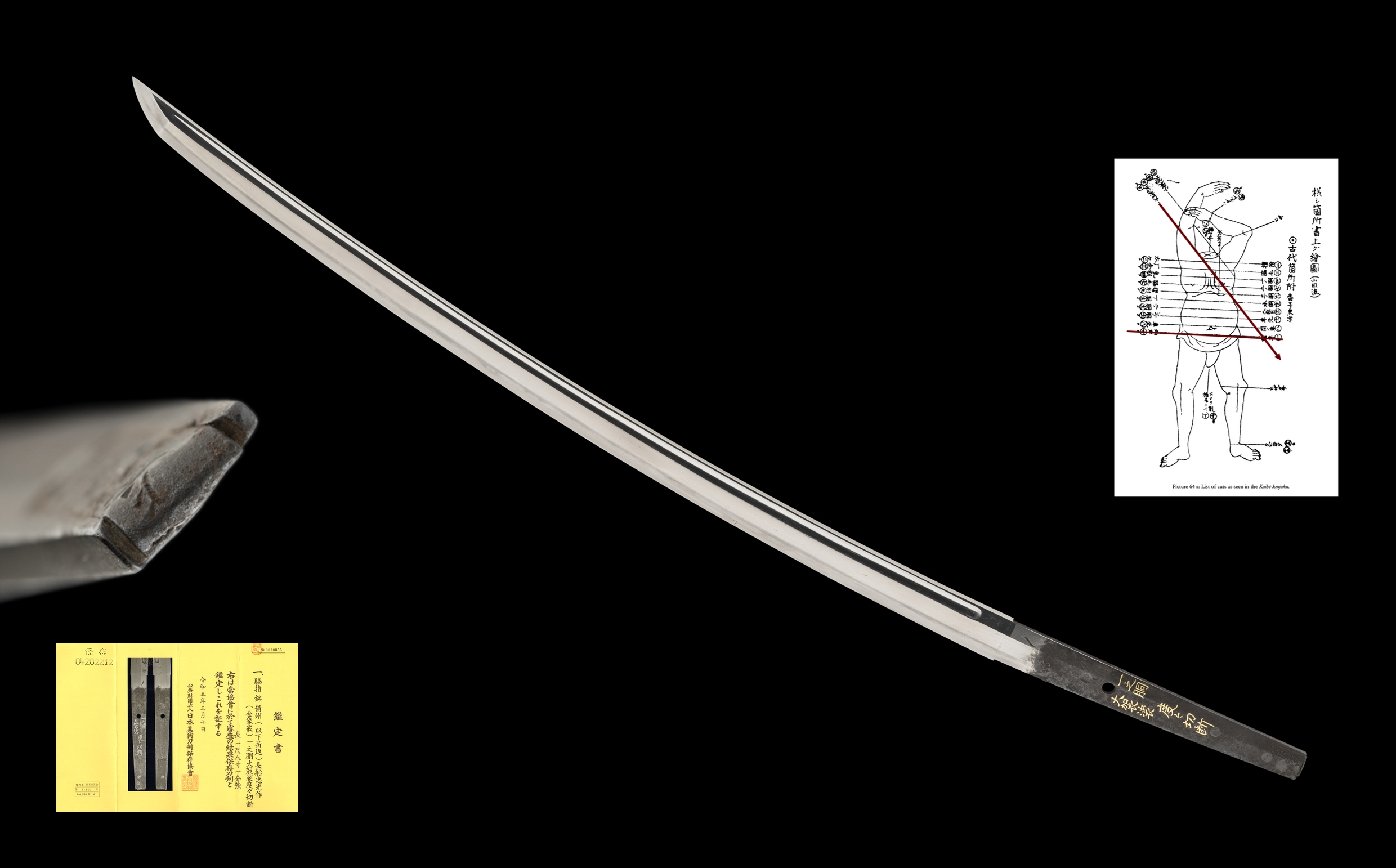
This is a battle-hardened blade from the peak of the Sengoku-jidai (warring states period), forged in the mid-1500s by jô-saku smith Jûrôzaemon Tadamitsu, who worked in Osafune village, Bishû province, during the Tenbun era (1532~1555). Originally crafted as a curvy katate-uchi – a compact one-handed fighting sword – at what was likely around 63cm, it was shortened to its present ô-wakizashi length of 54.9cm sometime in the late 1500s to early 1600s. Rather than discarding the signature as was common practice, a skilled hand preserved it by folding the nakago strip over and inserting it back into a slot on the opposite side – the rare technique known as orikaeshi-mei. A full-length bo-higroove was added on both omote and ura after the shortening to lighten the blade and improve its cutting performance.
The steel is thoroughly convincing for the Osafune tradition of the era: a jihada of fine ko-mokume and flowing nagare-hada with ji-nie and beautiful midare-utsuri, the smokey Bizen reflection that follows the hamon in a billowing wavy pattern. The hamon itself is bright suguha mixed with ko-gunome midare, active ko-ashi, and a particularly strong line of kinsuji that runs through the temper line – a visual treat when examined under good light. The nakago retains remnants of an original horimono engraving from the pre-shortened blade, likely a kurikara dragon design in the Sue-Bizen style.
The standout feature of this sword is its tameshigiri (cutting test) inscription, rendered in bright, well-preserved gold inlay (kinzôgan) on the nakago. It records that the sword was tested twice on a human body – severing cleanly through the centre of the chest (ichi no dô) and diagonally through the body from the base of the neck to the opposite armpit, a vicious cut known as ô-kesa. The inscription reads ichinodô ô-kesa tabitabi setsudan. A separate saya inscription in ink, dated Reiwa 6 (April 2024) during the Year of the Dragon, records the smith attribution, the cutting test, and the blade length. This ô-wakizashi comes in shirasaya with a finely executed gold-wrapped habaki; if the new owner wishes to add a custom koshirae, the team at Unique Japan is well placed to make that journey possible.
| Item Number | UJWA261 |
| Sword Type | Ô-wakizashi (suriage) |
| Swordsmith | Bishû Osafune Tadamitsu (Jûrôzaemon) |
| Swordsmith (JP) | 備州長船忠光 |
| Signature | Bishû (ika orikaeshi) Osafune Tadamitsu saku |
| School | Sue-Bizen, Osafune |
| Province | Bishû (Bizen) |
| Period | Sue-Kotô, Tenbun era (1532~1555) |
| Nagasa | 54.9cm |
| Sori | 1.6cm |
| Moto-haba | 2.46cm |
| Weight | 470g |
| Nakago | Suriage, orikaeshi-mei, kiri-yasurime, 1 mekugi-ana |
| Jihada | Ko-mokume and nagare-hada with ji-nie and midare-utsuri |
| Hamon | Bright suguha with ko-gunome midare, ko-ashi and kinsuji |
| Certificates | NBTHK Hozon (sword and koshirae) |
| Fujishiro Rank | Jô-saku |
| Tameshigiri (JP) | 一之胴大袈裟度々切断 |
| Habaki | Gold-wrapped, horizontal file marks |
| Catalogue | Catalogue 42 |
| Status | Sold |
| Includes | Shirasaya, fabric bags, stand, kit, printed description |