
ITEM# UJKA449 – Catalogue 42 – Sold
A Norikatsu Katana (於東武小石川館水府住勝村徳勝作之)
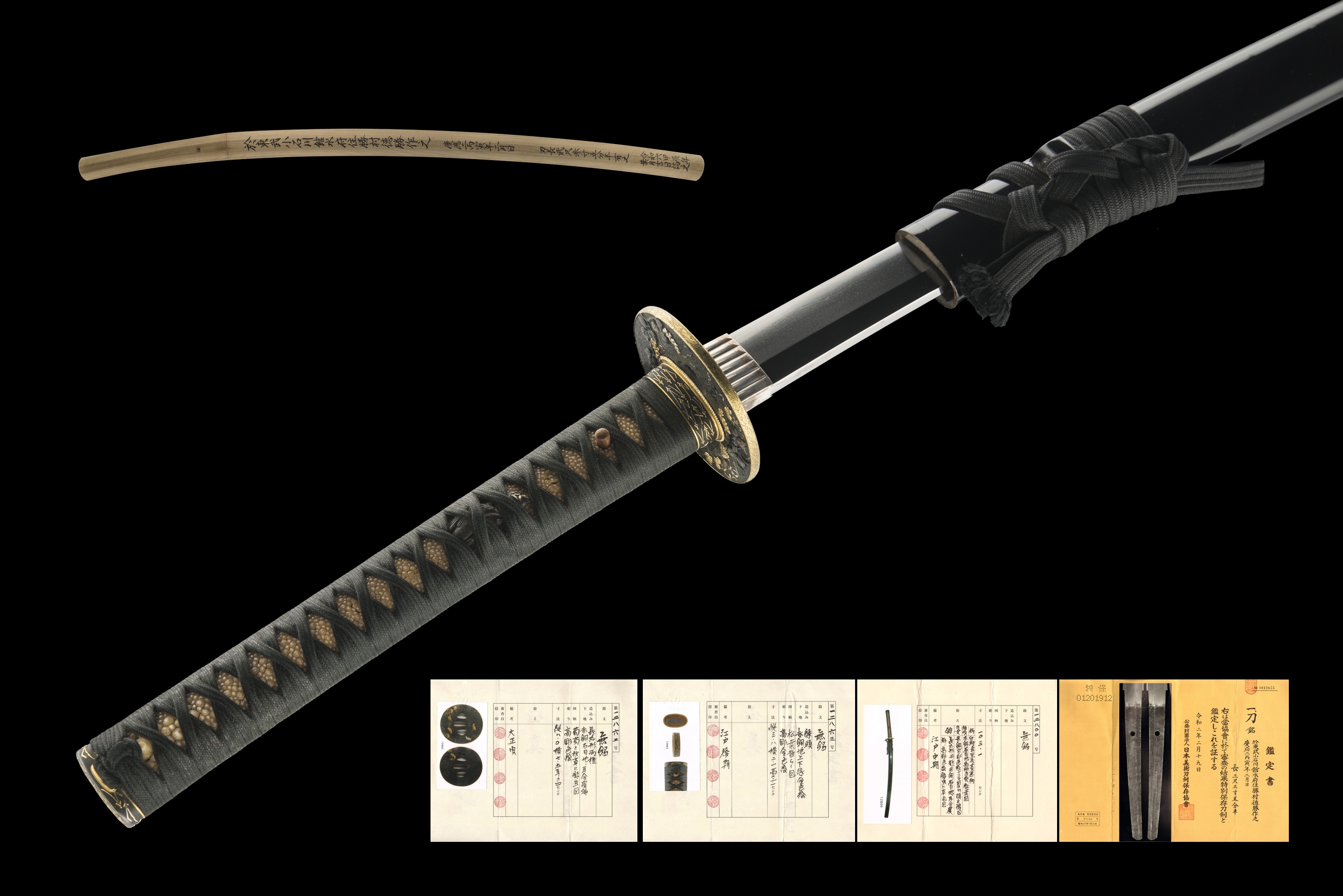
This formidable katana was forged in February 1866 by Katsumura Norikatsu, one of the most accomplished smiths of the shinshintô period. Born in Mito in 1809 as Katsumura Hikoroku, Norikatsu apprenticed under local smith Kannai Norimune before securing a coveted position working in the Mito domain’s arsenals. Over his career he shifted decisively toward the Yamato tradition, producing a first-class masame-hada combined with a sunagashi-laden suguha that places him in the highest company. By the time he crafted this blade at the Koishikawa residence of the Mito domain – the very park where Tokyo Dome now stands – he was working as the personal sword instructor to Tokugawa Yoshiatsu, the tenth leader of the Mito domain and brother of the final shogun.
The workmanship is sublime. The masame-hada is extraordinary – a grain of remarkable technical difficulty that only the most confident smith would attempt, as an imperfectly forged blade can separate along its hundreds of parallel layers. Here it is realised to perfection, enriched with ji-nie and chikei. The beaming suguha hamon carries a treasury of fine activities: sunagashi, ko-ashi, kinsuji, uchinoke, and a brilliant sweeping hakikake-bôshi in the kissaki. This is Yamato-den quality at the very highest level, consciously reaching back to the masterworks of the Hôshô school from the Kamakura period.
The sword is accompanied by an exceptional set of Late Edo period koshirae – likely original to the sword – that captures the beauty of a crisp autumn day. The tsuba, attributed to Kôgo Yoshitoshi, and the fuchi-kashira, attributed to Kusakari Kiyosada of Mutsu province, both depict sun-drenched fallen pine needles and foraging bell crickets from Koishikawa park. The menuki tell a more dramatic story: a predatory hawk hunting a bear cub sheltering in a cave. A silver-wrapped habakiwith vertical file marks mirrors the straight grain of the blade itself. This is a sword crafted for a ruling daimyô family in the final years of the last samurai. History in your hands.
| Item Number | UJKA449 |
| Sword Type | Katana |
| Swordsmith | Katsumura Norikatsu (shodai) |
| Swordsmith (JP) | 勝村徳勝 (初代) |
| Signature | Tôbu Koishikawa-kan ni oite Suifu-jû Katsumura Norikatsu kore o tsukuru |
| Date | Keiô 2, Hinoe-Toradoshi, Nigatsu-hi (February 1866) |
| Province | Mito (Hitachi) |
| Period | Shinshintô – Late Edo period (Keiô era: 1865-1868) |
| Nagasa | 71.3cm (ubu) |
| Sori | 1.67cm |
| Moto-haba | 3.04cm |
| Weight | 915g |
| Nakago | Ubu (original, unaltered tang), sujikai-yasurime (diagonal file marks), 1 mekugi-ana |
| Jihada | Outstanding masame-hada with ji-nie and chikei |
| Hamon | Bright suguha with sunagashi, ko-ashi, kinsuji and uchinoke |
| Boshi | Hakikake-bôshi in the kissaki, gently turning back (kaeri) |
| Certificates | NBTHK Tokubetsu Hozon (No. 1012655, issued Reiwa 2 / 2020); NTHK-NPO Kanteishô (koshirae, fuchi-kashira and tsuba certified as Authentic) |
| Fujishiro Rank | Jô-saku (superior swordsmith) |
| Sayagaki | Nozomi-san (shodô artist) — inscribed on a lucky day in the eighth month, Reiwa 6 (August 2024) |
| Koshirae | Kuro-roiro-nuri saya uchigatana-koshirae (glossy black lacquered), crafted during the Late Edo period (1866-1868) |
| Tsuba | Autumn garden with bell crickets (suzumushi) and foliage; attributed to Kôgo Yoshitoshi, circa Taishô period (1912-1926). NTHK-NPO Kanteishô certified. |
| Fuchi-kashira | Fallen sun-drenched pine needles; attributed to Kusakari Kiyosada of Mutsu province. NTHK-NPO Kanteishô certified. |
| Menuki | Predatory hawk hunting a bear cub sheltering in a cave |
| Tsuka | Well-aged samekawa (ray skin) wrapped in classic hishimaki black braid |
| Habaki | Silver-wrapped with vertical file marks echoing the masame grain |
| Catalogue | Catalogue 42 |
| Status | Sold |
| Includes | Shirasaya, Edo-koshirae, fabric bags, stand, kit, printed description |