
ITEM# UJKA367 – Catalogue 42 – Sold
A Yukihiro Katana (一肥前国出羽守藤原行広)
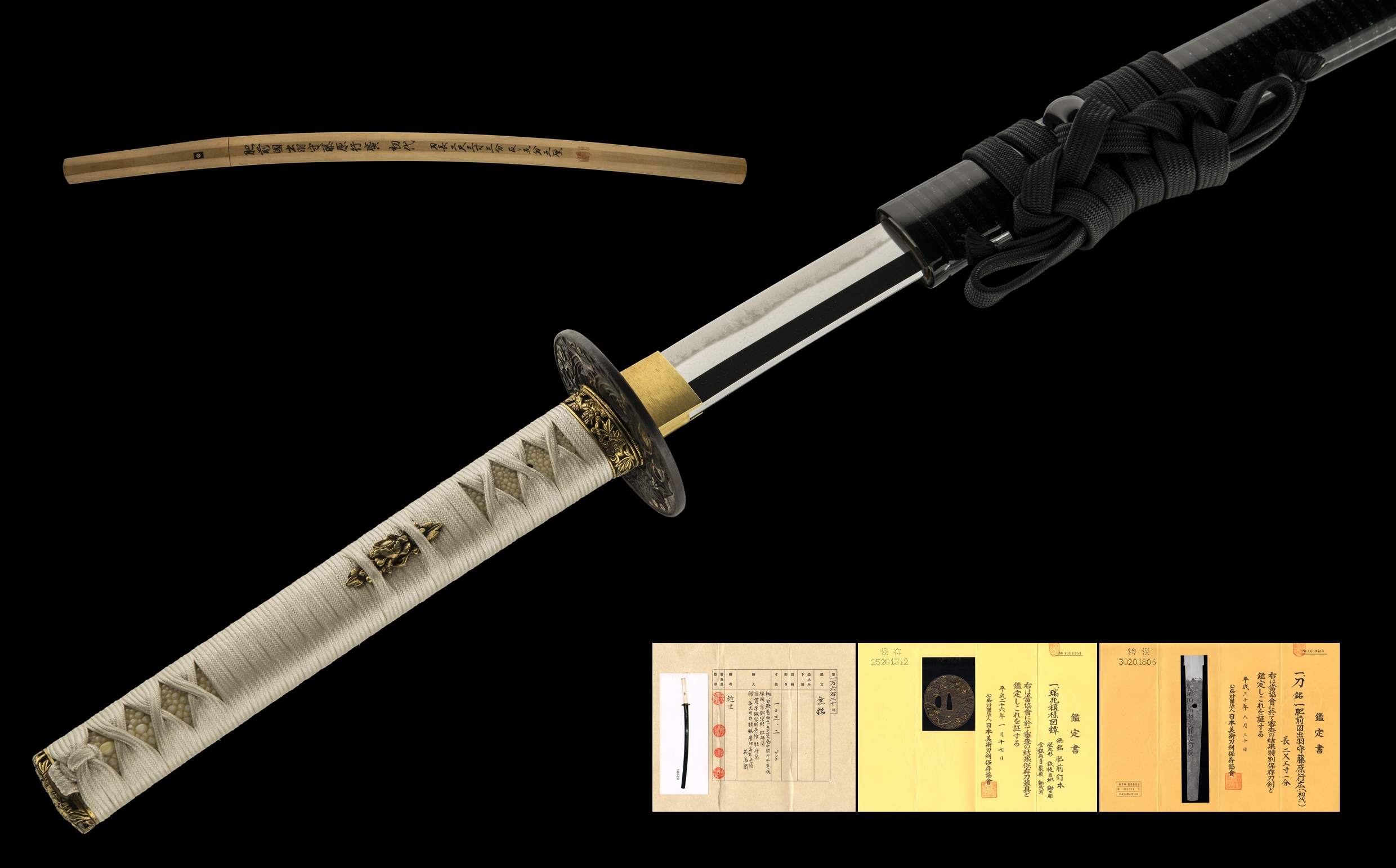
Talented Hizen swordsmith Yukihiro, son of Yoshinobu and younger brother to shodai Masahiro, was born in 1617 and received his Dewa no Daijo title in 1648. His Dewa no Kami title followed in 1663, and this katana – signed with that senior title – belongs to the final, most accomplished phase of his career. In 1650 Yukihiro moved to Nagasaki to study Dutch forging techniques with Hisatsugu and Tanenaga, and is assumed to have also studied the Bizen Ichimonji tradition in Edo with Noriyoshi. The result is a blade that carries all the hallmarks that make the Hizen tradition so sought after. Yukihiro died on May 27, 1683, and no fewer than six generations followed in his footsteps. Fujishiro ranks him jô-saku – a superior swordsmith – and he stands as one of the most celebrated names in the Hizen arsenal.
The blade itself has terrific energy. The chôji-midare hamon is brilliant and lively, showcasing Yukihiro’s trademark abu nomefu – the iconic horsefly eyes that appear as circular dots of nie within the ashi. A magnificent long line of kinsuji channels through the yokote and deep into the bôshi. On the tachi side the monouchi area shows a serrated, almost crystalline quality with long icicle-like ashi, while the ura side tends toward an undulating notare with sporadic icicles and a more classic choji-midare in the mid-section. The finely forged ko-mokume-hada transitions beautifully into the characteristic Hizen konuka-hada, and the body of the blade is alive with swirling pools of chikei visible to the naked eye.
The koshirae is a striking ensemble. The saya is lacquered in fuemaki style – kuro-roiro aogai-mijin fuemaki nuri – a demanding technique in which mother-of-pearl is inlaid in stripes resembling the holes of a traditional Japanese flute, the fue. The effect under light is extraordinary: the inlay sparkles like scattered stars against the glossy black ground. The tsuba, carrying its own NBTHK Hozon certificate, is a beautiful polished iron example from Hizen’s neighbouring province Higo, attributed to the Kugimoto school, with flowers, birds, bamboo, and clouds rendered in silver and gold inlay – a motif said to bring good fortune. The menuki and fuchi-kashira celebrate the peony, the king of flowers and a samurai symbol of bravery and honour.
| Item Number | UJKA367 |
| Sword Type | Katana |
| Swordsmith | Dewa no Kami Yukihiro (1st gen.) |
| Swordsmith (JP) | 出羽守藤原行広 (初代) |
| Signature | Ichi Hizen no Kuni Dewa no Kami Fujiwara Yukihiro |
| School | Hizen |
| Province | Hizen (resident of Saga) |
| Period | Shintô – Late Kanbun-Enpô era (1667-1675) |
| Nagasa | 69.7cm |
| Sori | 1.60cm |
| Moto-haba | 2.98cm |
| Weight | 705g |
| Nakago | Ubu-nakago (original, unaltered tang); sujikai-yasurime (diagonal file marks); 1 mekugi-ana |
| Jihada | Ko-mokume leading to Hizen konuka-hada, thick nie-deki, ji-nie and abundant chikei |
| Hamon | Gunome chôji-midare with kinsuji, sunagashi, and abu nomefu |
| Boshi | Kinsuji channelling through the yokote and into the bôshi |
| Certificates | NBTHK Tokubetsu Hozon (issued Reiwa 6 / 2024, February 23rd) |
| Fujishiro Rank | Jô-saku (a superior swordsmith) |
| Sayagaki | Shirasaya inscribed: Hizen no Kuni Dewa no Kami Fujiwara Yukihiro, Shodai — blade length 2-shaku 3-sun 3-bu, curvature 5-bu 5-rin |
| Koshirae | Uchigatana-koshirae; kuro-roiro aogai-mijin fuemaki nuri saya (mother-of-pearl striped lacquer); crafted Modern period; with NTHK-NPO Kanteisho Certificate of Authenticity |
| Tsuba | Kugimoto school, Hizen province; polished iron, elongated round form; flowers, birds, bamboo and clouds motif in gold and silver inlay (zuichô-moyô / lucky motifs); NBTHK Hozon (issued Heisei 26 / 2014, January 17th) |
| Fuchi-kashira | Shakudo, peony and shisa lion motif in gold inlay |
| Menuki | Peony motif in gold |
| Tsuka | Katate-maki (single-wrap) braided hilt in white; same (ray skin) visible at diamonds |
| Habaki | Gold habaki with horizontal file marks |
| Catalogue | Catalogue 42 |
| Status | Sold |
| Includes | Shirasaya, fuemaki koshirae, stand, cleaning kit, booklet, printed description, koshirae bag |