
⇩ Download Catalogue 41 (141MB)
Free to download. All swords in this catalogue are sold.
Index of Swords
Opening Remarks
Hi everyone, all good? Thank you for downloading Catalogue 41. I hope all dads out there had a memorable Father’s Day. I spent a good portion of the day working out at the gym with my son Lennon — he is now 15 and about 6’1”, getting stronger by the minute. The thing about YouTube is that he can research his favourite gurus and build this full-on routine with surgeon-like knowledge of all the muscle groups. When I was younger, we just picked up weights and hacked away. Well, I’m still sore, but we had a great time!
I wish to thank my assistants Ayumu Ogusu and Yuki Ando, my keen proofreader Yvan, and our killer photographer Eric Bossick for their hard work and dedication in the production of this catalogue.
We kick off with a katana by nidai Kunisuke, known as Naka-Kawachi. The NBTHK Tokubetsu Hozon certificate dates this katana to the Shôhô era (1644–1648), making it one of Kunisuke’s very earliest works to collect. Lovely jihada, great hataraki, and a charming koshirae featuring a gorgeous Ôwari tsuba and the thieving demon Shôshitsuki and the speedy deity Idaten! Next we have a katana by Hôjôji Masateru dated to August 1682 during the Tenna era. Masateru first studied under shodai Hôjôji Masahiro and then under second generation Kinmichi in Kyôto, who granted him permission to sign with a chrysanthemum on the nakago. The hamon has thick comet-like nioguchi that is impressive under the light. It also comes with a brilliant theme of rain and cloud dragons on the koshirae, perfectly timed as 2024 is the Year of the Dragon.
An incredibly long ubu-nakago katana by Shizumoto of the Taira-Takada school follows. I love this piece. It has a cutting edge of 81cm and dates back nearly 500 years to August 1533. We know the blade was originally created for patron Gotô Tôgorô of the powerful Ôtomo clan. This is a masterwork among the known works of Shizumoto — a rare and collectible katana from the late Muromachi period with a terrific set of Edo period koshirae.
We then move on to the most prestigious sword of the catalogue: a naginata-naoshi katana attributed to Bizen Osafune Yoshikage, master of the naginata. Crafted in the early 1300s and later reworked into a katana through the process known as naginata-naoshi, this piece is certified NBTHK Tokubetsu Jûyô Tôken — the highest rank at the NBTHK. What makes this sword remarkable is that it serves as a transition-point in Yoshikage’s career. The ura side reflects his earlier style — smaller elements, a more exacting midare-ba, and hardening in ko-nie deki. The omote side, however, displays an itame forging structure with midare-utsuri and a flamboyant chôji-based midareba in the Chôgi and Sôden-Bizen tradition, rich with kinsuji and sunagashi. A sword worthy of display in any museum.
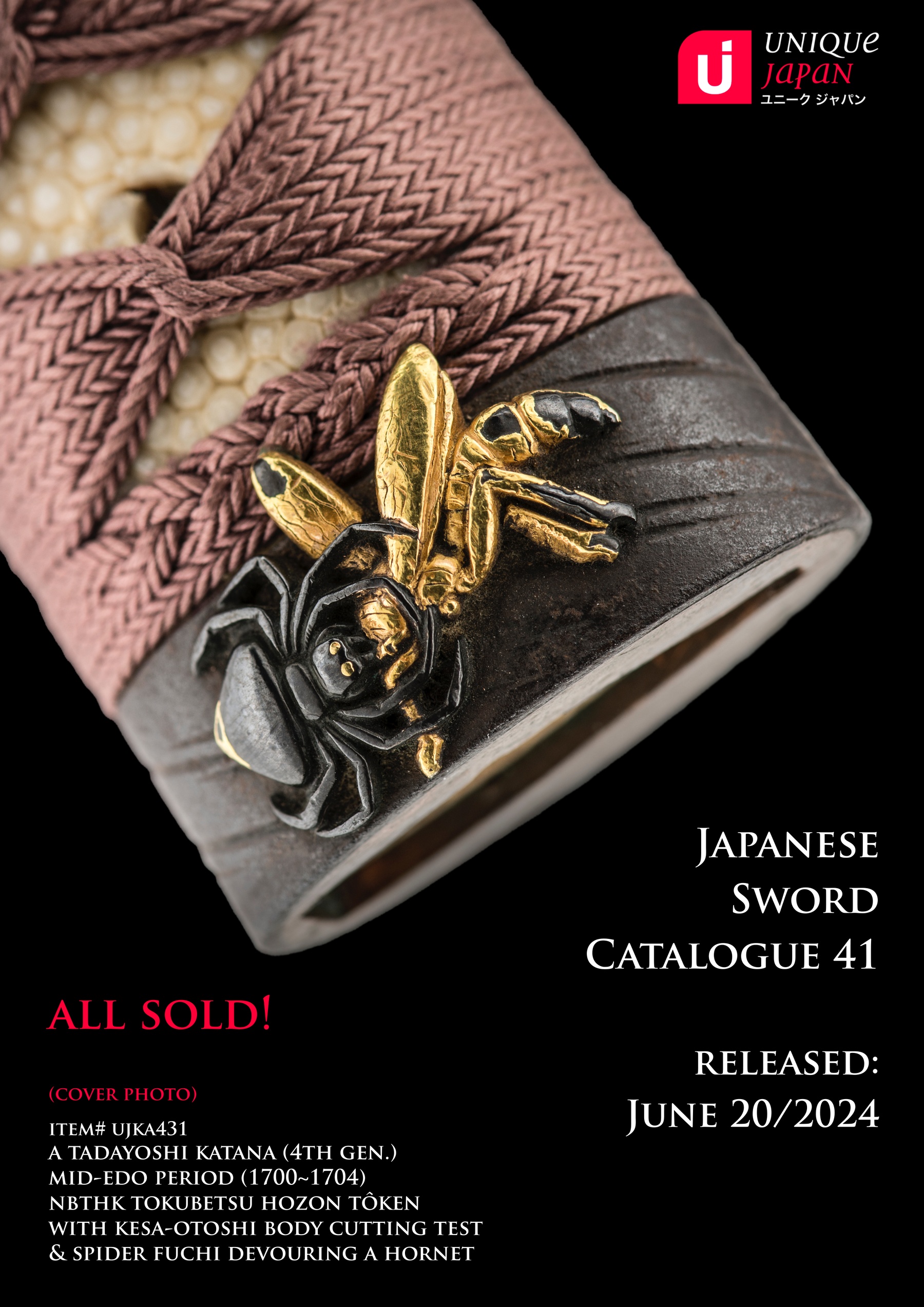
For those seeking a tameshigiri sword, look to yondai Tadayoshi, a superior swordsmith from the prestigious Tadayoshi school in Hizen province. This extremely sharp and powerful katana was tested on December 19, 1800 by Nagasaka Miki Katsuhide, who severed diagonally through a human body from the base of the shoulder through to the opposite armpit — a vicious test known as kesa-otoshi. A brilliant mid-Edo period kizami (sectioned) koshirae accompanies the sword, with a wickedly attractive fuchi-kashira and menuki set from the Tetsugendô school featuring a predatory spider devouring its hornet nemesis.
Our sixth sword is by Hizen Masashige, who after studying under grandmaster Inoue Shinkai returned to Hizen under the name Shinryô. This rare and handsome katana is forged with a mixture of masame and ko-itame-hada and bursts open under the light with a beautifully bright gunome-midare hamon with eye-catching sunagashi. A long and powerful katana attributed to Kanabô Masatsugu follows, showing exactly why Kanabô swords were prized among samurai warriors as dependable battle-tested blades. Its hefty 74.7cm nagasa is dominated by an ô-kissaki just shy of 10cm in length. Wonderful straight-grain masame-hada with wood-grain pools of mokume-hada and loads of sunagashi fill this dynamic blade.
The next piece is a brilliant katana attributed to Kashû Sanekage from Kaga province, inspired by grandmaster Norishige. It is a wide, stout, and very sharp sword with a definite Sôshû energy abounding with a vibrant gunome-midare hamon incorporating ji-nie, glorious chikei, and spectacular amounts of sunagashi.
Our final two swords are sold reference pieces: an extremely rare Tokubetsu Jûyô naginata-naoshi katana attributed to the illustrious Kamakura period Fukuoka-Ichimonji school with an origami from 1714 by Hon’ami Kôchû, and a cutting-test katana by Koyama Munetsugu with a special custom koshirae built for the client. For those seeking shorter swords, we have tantôs and wakizashi coming up — please enquire to learn more.
Thank you for all your passion, trust, and confidence. We look forward to serving you. Have a great summer!
Warm regards,
Pablo Kuntz
June 2024