
ITEM# UJKA430 – Catalogue 41 – Sold
A Yoshikage Naginata-Naoshi Katana (義景)
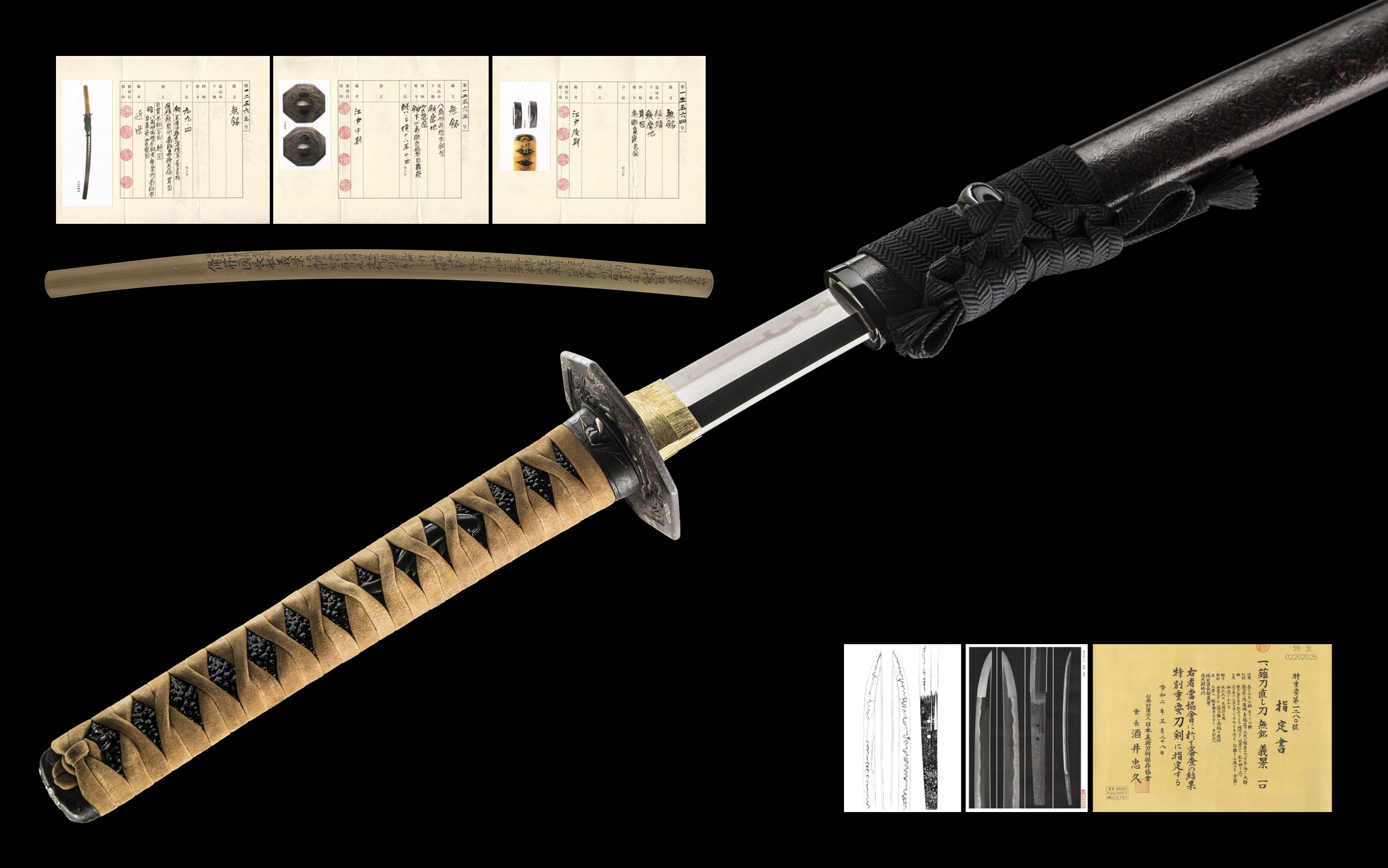
Few swords capture a swordsmith’s full career on a single blade – this extraordinary naginata-naoshi by Osafune Yoshikage does exactly that. Attributed to one of the most accomplished smiths of the early Nanbokuchô period, the blade was originally forged as a naginata and later preserved into a katana, a process known as naginata-naoshi. It has been designated Tokubetsu Jûyô Tôken at the 26th NBTHK shinsa – the highest certification the NBTHK issues – and stands as the only naginata-naoshi by Yoshikage to hold this rank. The NBTHK concluded their assessment with the note that this is an outstanding masterwork among all blades known by this smith.
What sets this piece apart is that each side of the blade tells a different chapter of Yoshikage’s development. The ura (reverse) side reflects his early manner under Chikakage: tightly arranged, exacting midare-ba hardened in ko-nie-deki. The omote (front) is a different story entirely – a flamboyant chôji-based midareba driven by powerful kinsuji and sunagashi, accompanied by a vivid midare-utsuri in the full Sôden-Bizen manner of Chôgi. Yoshikage was one of the earliest smiths to embrace this cross-tradition synthesis, and this blade is the evidence. Dated works range from Kenmu 2 (1335) to Enbun 3 (1358); this blade falls squarely at the transition point.
The accompanying uchigatana-koshirae is a handsome ensemble in its own right. The saya is lacquered in red and black with a raised peony pattern (shu-kuro botan-mon nuri). The octagonal iron tsuba, attributed to the Nanban school from Nagasaki and certified by the NTHK-NPO, is decorated with a cloud dragon design and carries an auspicious eight-sided form. The fuchi-kashira, attributed to a late generation of Shimizu Jingo of Higo province, features a motif of mushrooms on polished iron – also NTHK-NPO certified. The menuki are a pair of large catfish (namazu) swimming over black-lacquered ray skin, a nod to Japanese mythology in which the great underground catfish Ônamazu is said to cause earthquakes. Together, the fittings are a collector’s package as thoughtfully assembled as the blade itself.
| Item Number | UJKA430 |
| Sword Type | Katana (naginata-naoshi) |
| Attribution | Attributed to Osafune Yoshikage (mumei) |
| School | Osafune (Sôden-Bizen) |
| Province | Bizen |
| Period | Kôtô – Nanbokuchô period (Kenmu era: 1334-1338) |
| Nagasa | 69.5cm (ô-suriage) |
| Sori | 1.5cm |
| Moto-haba | 2.95cm |
| Weight | 835g |
| Nakago | Ô-suriage, mumei, katte-sagari yasurime, two mekugi-ana, 20.1cm |
| Jihada | Standing-out itame mixed with mokume, ji-nie, chikei and midare-utsuri |
| Hamon | Gunome in nioi-deki with ko-nie mixed with ko-gunome, chôji, kinsuji and sunagashi |
| Boshi | Prominently midare-komi with some hakikake, running out in yakitsume fashion |
| Certificates | NBTHK Tokubetsu Juyo Token (26th shinsa, May 28, 2020); NTHK-NPO Kanteishô (koshirae, fuchi-kashira and tsuba certified as Authentic) |
| Fujishiro Rank | Jô-saku |
| Sharpness Rating | Ô-wazamono |
| Sayagaki | Tanobe Michihiro (Tanzan-sensei) — Bizen no Kuni Osafune Yoshikage, dated Reiwa gannen (August 2019) |
| Koshirae | Shu-kuro botan-mon nuri saya uchigatana-koshirae (朱黒牡丹紋塗鞘打刀拵) — uchigatana-koshirae lacquered in red and black with raised peony pattern; crafted in modern times |
| Tsuba | Nanban school (Nagasaki), octagonal polished iron, cloud dragon design, circa mid-Edo period (1700s); NTHK-NPO Kanteishô certified |
| Fuchi-kashira | Attributed to late generation of Shimizu Jingo, Higo province, Late Edo period; mushroom motif on polished iron; NTHK-NPO Kanteishô certified |
| Menuki | Two large catfish (namazu) on black-lacquered samekawa (ray skin) |
| Habaki | Gold ni-ju habaki |
| Catalogue | Catalogue 41 |
| Status | Sold |
| Includes | Shirasaya, koshirae, fabric bags, stand, kit, printed description |